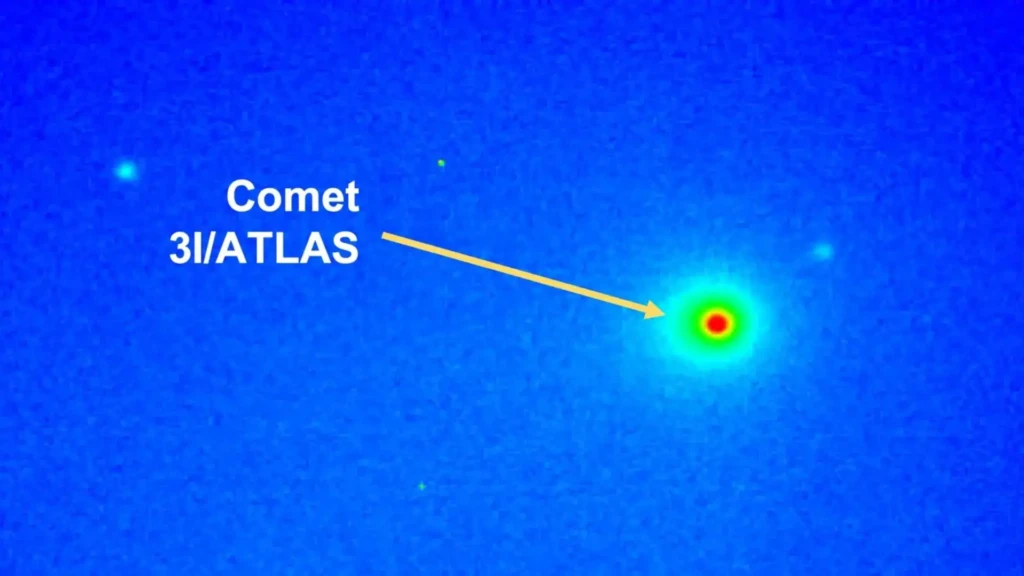
ISRO has shared a fresh picture of the interstellar comet 3I/ATLAS, offering new insights into its mysterious nature. Scientists at the Physical Research Laboratory (PRL), Ahmedabad recently studied this icy visitor with the 1.2-meter telescope situated at Mount Abu, Rajasthan, as it continues cruising out of our solar system. This ground-based observatory, located at an altitude of 1,680 meters near Gurushikhar, is used for exoplanet hunting, high-energy phenomena, and solar system studies.
The false colour picture, ISRO says, was captured between November 12-15. It presents the comet as a bright red dot with a haze around it (the coma) formed due to sublimation [conversion of solids directly into gas] of frozen ice on the surface.
Scientists say 3I/ATLAS reached perihelion (closest point to the Sun) on October 30 and is moving on its hyperbolic trajectory out of the solar system, never to return again. Discovered by the NASA-funded ATLAS (Asteroid Terrestrial-impact Last Alert System) survey telescope in Chile, 3I/ATLAS is the third confirmed interstellar comet and has sparked a fierce debate about its nature due to several ‘anomalies.’
In a statement, ISRO shared that PRL’s telescope was used to photograph the comet and to analyse its light spectrum for identifying the materials present in its coma. The agency explained, “The coma of a comet is the large, glowing atmosphere of gas and dust that forms around its nucleus as it gets closer to the Sun. It is created when the Sun’s heat causes the frozen ices on the nucleus to vaporize, or “sublimate,” releasing gas and dust that form a large, diffuse cloud.”

While the lack of 3I/ATLAS’s tail has been a subject of debate, PRL astronomers note that the tail may not be visible simply because of the viewing angle from Earth. We may be looking almost straight at the comet, so any dust tail would appear behind it.
ALSO READ: Comet 3I/ATLAS Vs Comet Lemmon: Why The Former Has No Tail Post Perihelion
According to ISRO, the spectroscopic measurements show that 3I/ATLAS behaves like a typical comet, as its gas output from sublimation is consistent with what is seen in ordinary comets. The telescope detected strong signatures of CN (cyanogen), C2 (diatomic carbon) and C3 (triatomic carbon) – these are molecules commonly found in the comas of typical solar-system comets.
“The production rate ratios seem to place this comet in the class of ‘typical comets’ of the solar system. Further observations will be continued as the comet gradually comes into the darker part of the night,” it added. The production rate above refers to the rate of release of gas from the comet’s nucleus into the coma, and this reveals the activity level.
3I/ATLAS will reportedly make its closest approach to Earth on December 19 and the ground-based observatories are likely to reveal more about its post-perihelion status. Harvard physicist Avi Loeb recently posited that the comet may have broken into over a dozen pieces, something which will be confirmed after forthcoming observations.
ALSO READ: Comet 3I/ATLAS May Have Broken Into 16 Or More Pieces, Says Scientist