Blue Terra Journal

  • Home
  • Spaceflight
    SpaceflightShow More
    SpaceX Starship
    SpaceX Starship’s 12th Test Flight Targeted On May 20; No Booster Catch This Time
    May 13, 2026
    SpaceX's Starship during launch rehearsal.
    SpaceX Completes Starship’s Launch Rehearsal For Flight 12 This Week; What To Expect?
    May 13, 2026
    China US rivalry reach new heights.
    ‘Rival’ China Is Unintentionally The Biggest Motivator For NASA’s Moon Ambitions
    April 28, 2026
    NASA Voyager 1 illustration
    NASA Shuts Down Another Voyager 1 Instrument; How Long Can This Spacecraft Last?
    April 22, 2026
    NASA's SR-1 Freedom spacecraft.
    What Is NASA’s SR-1 Freedom Mission? The First Nuclear Reactor In Space Explained
    March 27, 2026
  • Astronomy
    AstronomyShow More
    Artist's impression of NASA's Psyche spacecraft.
    NASA’s Psyche Spacecraft Will Zoom Past Mars Today On Its Way To Metal-Rich Asteroid
    May 15, 2026
    Comet MAPS image
    Video: Comet MAPS destroyed after plunging into the Sun; event caught by NASA missions
    April 18, 2026
    Apophis asteroid flyby
    ‘God Of Chaos’: Apophis Asteroid Will Fly Dangerously Close To Earth Exactly 5 Years From Now
    April 14, 2026
    Meteor spotted over Houston.
    Video Captures 1-Ton Meteor Exploding Over Houston Skies, NASA Releases Statement
    March 22, 2026
    NASA black hole simulation
    Fall Into A Black Hole With This Incredibly Scary Simulation Made By NASA
    March 18, 2026
  • India
    IndiaShow More
    Shubhanshu Shukla aboard the ISS.
    ISRO Astronaut Shubhanshu Shukla Awarded Ashoka Chakra For Heroic Ax-4 Mission
    February 9, 2026
    ISRO's PSLV lifts off to space.
    ISRO’s PSLV Rocket Suffers Third Stage Failure After Successful Liftoff; Payloads Lost
    January 23, 2026
    Dhruva Space team at ISRO facility.
    India’s Dhruva Space To Launch 10 Missions, Including 1st Northeastern Satellite, On ISRO’s PSLV
    January 12, 2026
    ISRO's PSLV rocket
    ISRO To Seek Redemption With PSLV-C62 Mission Launch On January 12
    January 12, 2026
    ISRO SSLV
    ISRO’s SSLV Rocket Just Got Better After Latest Third Stage Test Fire
    December 31, 2025
  • Artemis
    ArtemisShow More
    NASA Artemis II mission
    Welcome Home! NASA’s Artemis II Astronauts Are Back After Historic Moon Voyage
    April 22, 2026
    NASA Artemis II iPhone image
    iPhones Reigned Supreme On NASA’s Artemis II Moon Mission
    April 10, 2026
    Artemis II NASA
    All Eyes On Scary Artemis II Reentry As NASA Moon Mission Nears Completion
    April 9, 2026
    NASA Artemis II
    NASA Artemis II Crew Names Moon Crater ‘Carroll’ After Commander Reid Wiseman’s Late Wife
    April 7, 2026
    NASA Artemis II
    Watch: NASA Artemis II Astronauts Begin Flyby Of Moon’s Far Side For The First Time Ever
    April 9, 2026
  • More
    • About
    • Privacy Policy
    • Terms
    • Contact

Blue Terra Journal

  • Home
  • Spaceflight
  • Astronomy
  • India
  • Artemis
Search
  • Pages
    • About
    • Contact
    • Privacy Policy
    • Terms

Home - Astronomy - Earth Gets Another Geomagnetic Storm Warning After Strong Solar Eruption | Video

Astronomy

Earth Gets Another Geomagnetic Storm Warning After Strong Solar Eruption | Video

A G3 geomagnetic storm incoming.

Harsh Vardhan
Last updated: December 8, 2025 12:45 PM
Harsh Vardhan
Share
5 Min Read
Earth geomagnetic storm
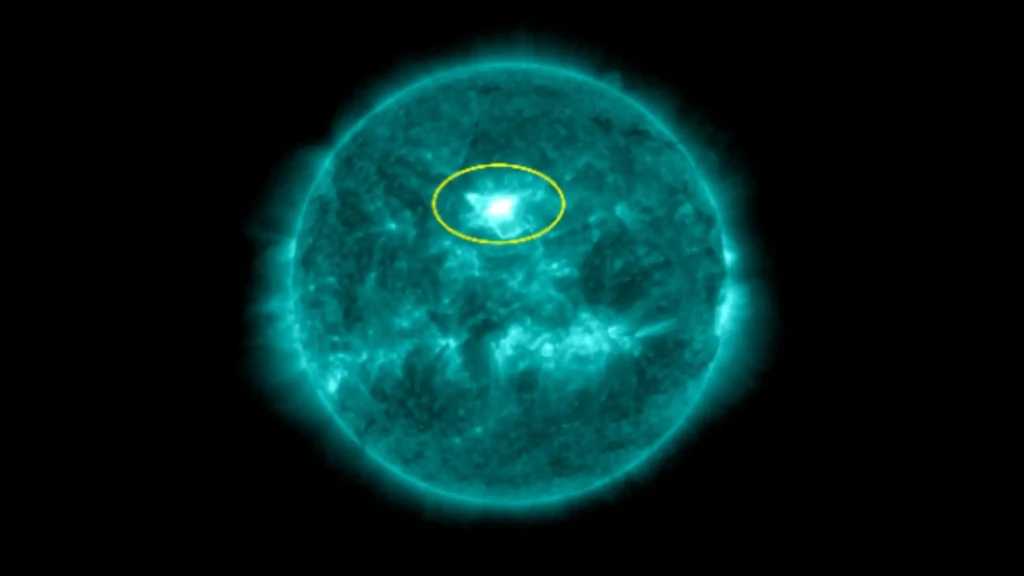
Eruption on the Sun's Region 4299. Image: NOAA
SHARE

Contents
  • What are coronal mass ejections?
  • Earth witnesses CME and solar flare

We have another geomagnetic storm coming our way. The National Oceanic and Atmospheric Administration’s Space Weather Prediction Center (SWPC) has issued a warning about a G3 [strong] geomagnetic storm for December 9 due to a recent coronal mass ejection (CME) event. The event occurred on December 7 from the Sun’s Region 4299 which is currently facing Earth.

A full-halo coronal mass ejection (CME), associated with an M8.1 flare from Region 4299 at 20:39 UTC on 06 December, is expected to impact Earth early to midday on 09 December, potentially causing periods of G3 (Strong) geomagnetic storming. pic.twitter.com/L2qCfEWmRW

— NOAA Space Weather Prediction Center (@NWSSWPC) December 7, 2025

What are coronal mass ejections?

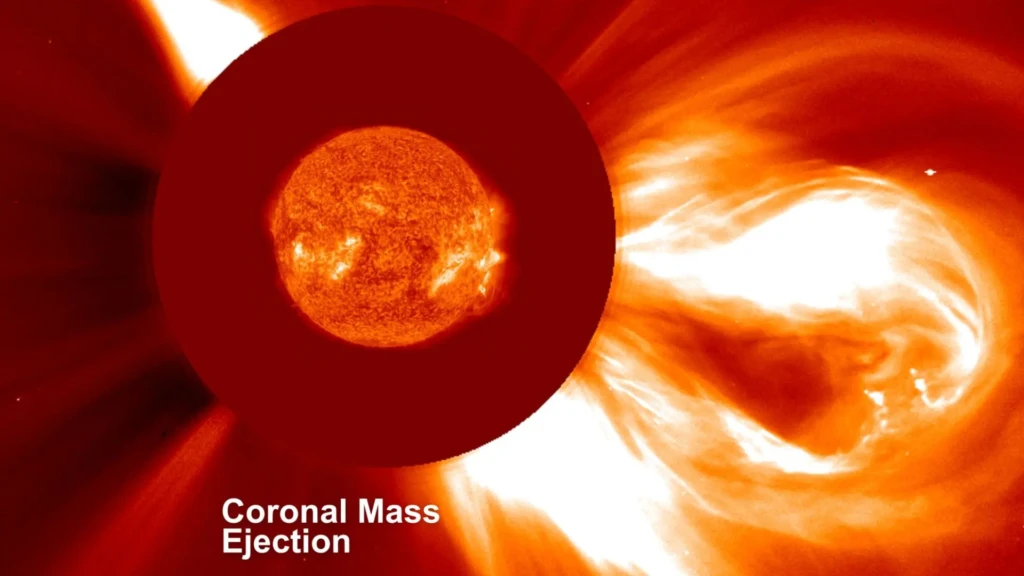
Coronal mass ejections are the release of huge clouds of electrically charged particles called plasma from the Sun’s corona – the outer atmospheric layer. These clouds weigh billions of tons and the particles can travel millions of kilometres into outer space.
Earth solar eruption
A coronal mass ejection. Image: NASA

When directed toward Earth, the plasma travelling fast after a violent eruption can reach us within a few hours; the slower ones take a couple of days or more. When the charged particles interact with Earth’s magnetosphere and atmosphere, they cause a disturbance which results in a geomagnetic storm.

Earth witnesses CME and solar flare

Apart from the CME, the weather prediction center also flagged a solar flare event from Region 4298 today. Solar flares are intense bursts of light and they are the most powerful explosions in the solar system. According to NASA, the biggest flares can have energy equivalent to a billion hydrogen bombs. The flares and CMEs are closely related but they don’t always occur simultaneously.

Sunspot Region 4299 ☀️ Two solar flares 1) M1.1 triggered 2) M8.1 – both produced a coronal mass ejection 1) slower, to NE 2) faster, earth-directed – possible arrival 8/9 December

Base difference imagery SDO AIA 171/193/211 is showing dimming regions pic.twitter.com/6hVgIhxq5Q

— Marko Rummelsburg (@doktornihil) December 7, 2025

The strength of flares are divided into five classes – A, B, C, M and X – with A being the weakest and X being the strongest. December 8’s flare was classified as X1.1/2b.

Meanwhile, the CME event is predicted to impact Earth tomorrow. According to the SWPC, the subsequent geomagnetic storm may have minor effects on technological infrastructure and auroras may be visible over the polar regions and the US.

A solar storm is launching now in the Earth-strike zone! Region 4299 is once again waking up, albeit with only minor M-class flaring, but along with its nearby unstable filaments, this is enough to cause a large eruption. Waiting for the eruption to finish and for coronagraph… pic.twitter.com/OoUUj1hHfF

— Dr. Tamitha Skov (@TamithaSkov) December 6, 2025

Space weather physicist Dr. Tamitha Skov shared a footage of the recent solar eruption from Region 4299. “A solar storm is launching now in the Earth-strike zone! Region 4299 is once again waking up, albeit with only minor M-class flaring, but along with its nearby unstable filaments, this is enough to cause a large eruption,” she posted on December 7.

In another post today, Skov revealed that the solar flare from Region 4298 caused radio blackout on Earth’s dayside. “Expect HF/VHF radio band degradation, especially near Asian Pacific, Eastern Russia, China, India, & East Africa. A third solar storm launching too!” she wrote.

ALSO READ: Strongest Solar Eruption Of 2025 Lights Up Skies With Auroras, Triggers Blackouts

ALSO READ: How Do Auroras Form? Science Behind This Colourful Cosmic Phenomenon

TAGGED:Aurorascoronal mass ejectionEarthgeomagnetic stormSolar Eruption
Share This Article
Facebook Pinterest Whatsapp Whatsapp LinkedIn Copy Link Print

Latest News

Artist's impression of NASA's Psyche spacecraft.
NASA’s Psyche Spacecraft Will Zoom Past Mars Today On Its Way To Metal-Rich Asteroid
Astronomy
SpaceX Starship
SpaceX Starship’s 12th Test Flight Targeted On May 20; No Booster Catch This Time
Spaceflight
SpaceX's Starship during launch rehearsal.
SpaceX Completes Starship’s Launch Rehearsal For Flight 12 This Week; What To Expect?
Spaceflight
China US rivalry reach new heights.
‘Rival’ China Is Unintentionally The Biggest Motivator For NASA’s Moon Ambitions
Spaceflight

You Might Also Like

NASA Mars
Astronomy

NASA Rover Has Recorded Electric Sparks In Dust Devils On Mars; Here’s The Audio

December 9, 2025
Comet 3I/ATLAS NASA Avi Loeb
Astronomy

Comet 3I/ATLAS Entered The Oort Cloud 8000 Years Ago. What Was Earth Like Then?

December 15, 2025
NASA Moon orbiter
Astronomy

Blood Moon 2026: When And Where To See The Total Lunar Eclipse On March 3?

March 2, 2026
image
Astronomy

Japan’s Akatsuki Orbiter Goes Silent Forever Ending Our Venus Presence

November 6, 2025
© 2026, Blue Terra Journal
  • About
  • Privacy Policy
  • Terms
  • Contact
Welcome Back!

Sign in to your account

Username or Email Address
Password

Lost your password?