Blue Terra Journal

  • Home
  • Spaceflight
    SpaceflightShow More
    SpaceX Starship
    SpaceX Starship’s 12th Test Flight Targeted On May 20; No Booster Catch This Time
    May 13, 2026
    SpaceX's Starship during launch rehearsal.
    SpaceX Completes Starship’s Launch Rehearsal For Flight 12 This Week; What To Expect?
    May 13, 2026
    China US rivalry reach new heights.
    ‘Rival’ China Is Unintentionally The Biggest Motivator For NASA’s Moon Ambitions
    April 28, 2026
    NASA Voyager 1 illustration
    NASA Shuts Down Another Voyager 1 Instrument; How Long Can This Spacecraft Last?
    April 22, 2026
    NASA's SR-1 Freedom spacecraft.
    What Is NASA’s SR-1 Freedom Mission? The First Nuclear Reactor In Space Explained
    March 27, 2026
  • Astronomy
    AstronomyShow More
    Artist's impression of NASA's Psyche spacecraft.
    NASA’s Psyche Spacecraft Will Zoom Past Mars Today On Its Way To Metal-Rich Asteroid
    May 15, 2026
    Comet MAPS image
    Video: Comet MAPS destroyed after plunging into the Sun; event caught by NASA missions
    April 18, 2026
    Apophis asteroid flyby
    ‘God Of Chaos’: Apophis Asteroid Will Fly Dangerously Close To Earth Exactly 5 Years From Now
    April 14, 2026
    Meteor spotted over Houston.
    Video Captures 1-Ton Meteor Exploding Over Houston Skies, NASA Releases Statement
    March 22, 2026
    NASA black hole simulation
    Fall Into A Black Hole With This Incredibly Scary Simulation Made By NASA
    March 18, 2026
  • India
    IndiaShow More
    Shubhanshu Shukla aboard the ISS.
    ISRO Astronaut Shubhanshu Shukla Awarded Ashoka Chakra For Heroic Ax-4 Mission
    February 9, 2026
    ISRO's PSLV lifts off to space.
    ISRO’s PSLV Rocket Suffers Third Stage Failure After Successful Liftoff; Payloads Lost
    January 23, 2026
    Dhruva Space team at ISRO facility.
    India’s Dhruva Space To Launch 10 Missions, Including 1st Northeastern Satellite, On ISRO’s PSLV
    January 12, 2026
    ISRO's PSLV rocket
    ISRO To Seek Redemption With PSLV-C62 Mission Launch On January 12
    January 12, 2026
    ISRO SSLV
    ISRO’s SSLV Rocket Just Got Better After Latest Third Stage Test Fire
    December 31, 2025
  • Artemis
    ArtemisShow More
    NASA Artemis II mission
    Welcome Home! NASA’s Artemis II Astronauts Are Back After Historic Moon Voyage
    April 22, 2026
    NASA Artemis II iPhone image
    iPhones Reigned Supreme On NASA’s Artemis II Moon Mission
    April 10, 2026
    Artemis II NASA
    All Eyes On Scary Artemis II Reentry As NASA Moon Mission Nears Completion
    April 9, 2026
    NASA Artemis II
    NASA Artemis II Crew Names Moon Crater ‘Carroll’ After Commander Reid Wiseman’s Late Wife
    April 7, 2026
    NASA Artemis II
    Watch: NASA Artemis II Astronauts Begin Flyby Of Moon’s Far Side For The First Time Ever
    April 9, 2026
  • More
    • About
    • Privacy Policy
    • Terms
    • Contact

Blue Terra Journal

  • Home
  • Spaceflight
  • Astronomy
  • India
  • Artemis
Search
  • Pages
    • About
    • Contact
    • Privacy Policy
    • Terms

Home - Astronomy - Massive Coronal Mass Ejection Spotted On Another Star For The First Time

Astronomy

Massive Coronal Mass Ejection Spotted On Another Star For The First Time

Harsh Vardhan
Last updated: November 13, 2025 2:23 PM
Harsh Vardhan
Share
4 Min Read
European Space Agency
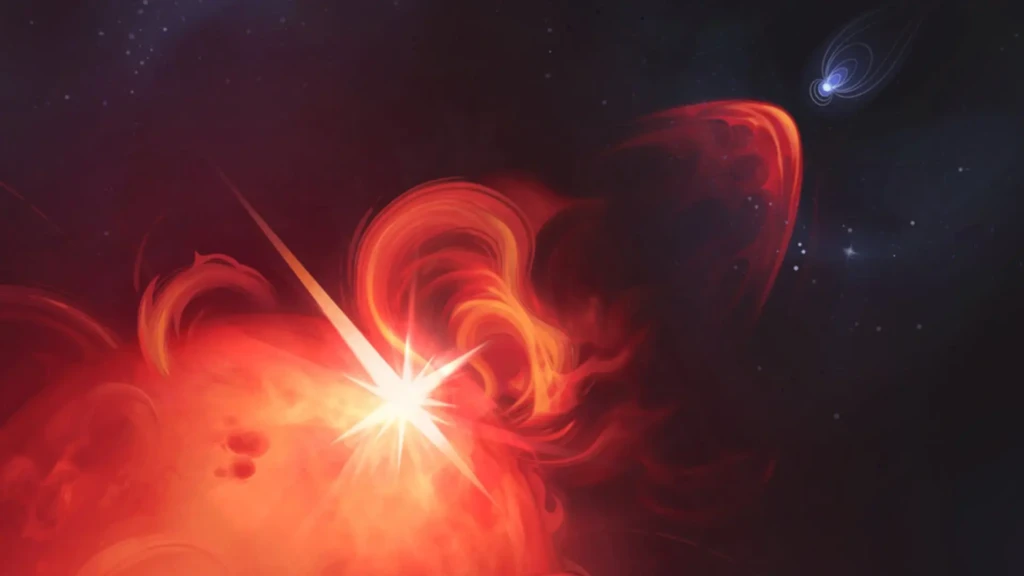
The coronal mass ejection may be stripping planets of their atmosphere. Image: ESA
SHARE

Astronomers have confirmed witnessing an explosion on a star other than the Sun for the first time. According to the European Space Agency (ESA), a powerful burst was caught by its XMM-Newton Space Observatory and the Low Frequency Array (LOFAR) telescope on a star located around 130 light-years away.

📣 For the first time ever, scientists have confirmed seeing a giant explosion on a star other than our own!

Our @ESA_XMM observatory and the LOFAR telescope contributed to making this long sought-after discovery 👉 https://t.co/NQkRTFJPWZ

1/ pic.twitter.com/1669zfZgNs

— ESA Science (@esascience) November 12, 2025

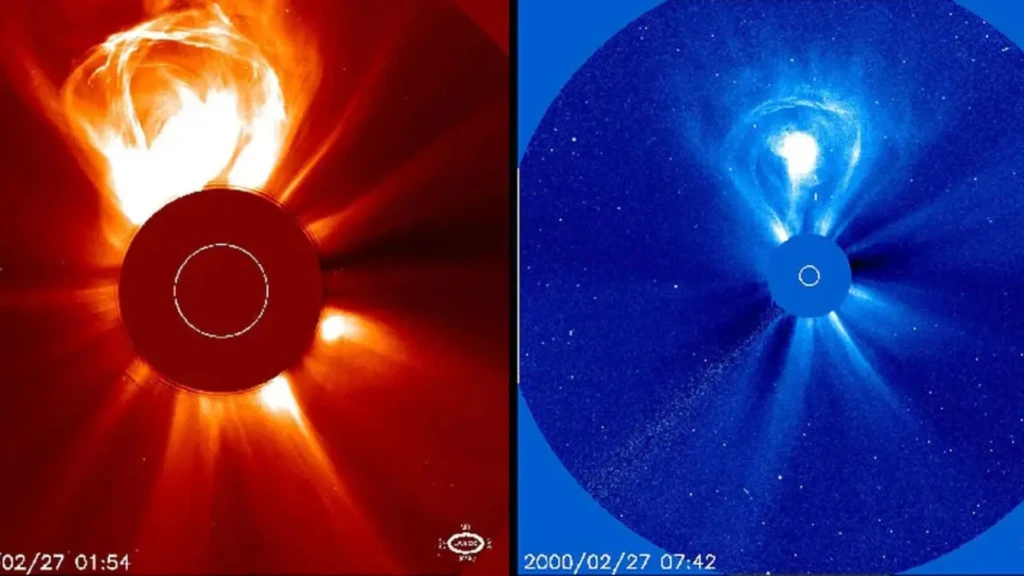
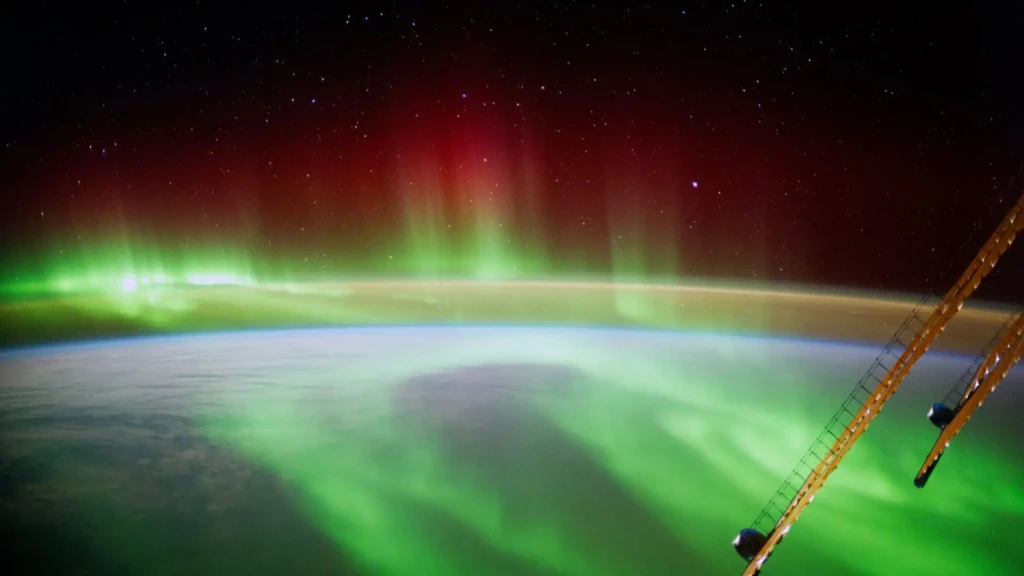
The event is said to be a coronal mass ejection or CME, the eruption from the Sun’s corona (outermost atmospheric region) which releases an enormous cloud of supercharged gas. NASA says that a large CME can contain a billion tons of matter that can accelerate to millions of kilometres per hour. CMEs are the reason why we see auroras on Earth and they’re drivers of space weather.
Coronal mass ejection.
A Coronal mass ejection event. Image: SOHO/ESA/NASA

“Astronomers have wanted to spot a CME on another star for decades,” stated Joe Callingham of the Netherlands Institute for Radio Astronomy (ASTRON) and lead author of the study published in Nature. “Previous findings have inferred that they exist, or hinted at their presence, but haven’t actually confirmed that material has definitively escaped out into space. We’ve now managed to do this for the first time,” he added.
Aurora
Aurora caused by coronal mass ejection. Image: ESA

Callingham and team were able to notice the event through a burst of radio waves associated with the shock wave that is produced during a CME. The scientists deducted that the radio signal they received must have resulted from a CME.

ALSO READ: Strongest Solar Eruption Of 2025 Lights Up Skies With Auroras, Triggers Blackouts

Why this discovery is concerning

While the discovery is historic and exciting, it raises some concerns about habitability of a planet around such stars. This CME-flinging star is a red dwarf which are generally fainter, cooler and smaller than the Sun. However, if a planet is close enough, over-exposure to intense CME events can strip the planet of its atmosphere, leaving behind an uninhabitable world.

According to ESA, scientists found that this red dwarf is roughly half as massive as the Sun, rotates 20 times faster and its magnetic field is 300 times more powerful. While most known planets in the Milky Way orbit such stars, constant bombardment by charged particles may cause them to lose atmosphere despite being in the habitable zone.

The study says that the CME from this star moved at 2,400 km per second and was fast and dense enough to completely strip away atmospheres of any planets around it.

“It seems that intense space weather may be even more extreme around smaller stars – the primary hosts of potentially habitable exoplanets,” said Henrik Eklund, an ESA research fellow based at the European Space Research and Technology Centre (ESTEC), Netherlands. “This has important implications for how these planets keep hold of their atmospheres and possibly remain habitable over time.”

ALSO READ: Comet 3I/ATLAS May Have Broken Into 16 Or More Pieces, Says Scientist
TAGGED:Aurorascoronal mass ejectionEuropean Space AgencyNASASpace
Share This Article
Facebook Pinterest Whatsapp Whatsapp LinkedIn Copy Link Print

Latest News

Artist's impression of NASA's Psyche spacecraft.
NASA’s Psyche Spacecraft Will Zoom Past Mars Today On Its Way To Metal-Rich Asteroid
Astronomy
SpaceX Starship
SpaceX Starship’s 12th Test Flight Targeted On May 20; No Booster Catch This Time
Spaceflight
SpaceX's Starship during launch rehearsal.
SpaceX Completes Starship’s Launch Rehearsal For Flight 12 This Week; What To Expect?
Spaceflight
China US rivalry reach new heights.
‘Rival’ China Is Unintentionally The Biggest Motivator For NASA’s Moon Ambitions
Spaceflight

You Might Also Like

Blue Origin and SpaceX launches to be affected amid US shutdown.
Spaceflight

Trouble For Blue Origin, SpaceX As US Government Shutdown Restricts Rocket Launches

November 11, 2025
NASA's SLS rocket at the launch pad.
Artemis

NASA’s SLS rocket arrives at launch pad for Artemis II Moon mission; What’s next?

April 1, 2026
NASA Moon orbiter
Astronomy

NASA Prepares To Save Its Orbiter During Total Solar Eclipse On The Moon

March 3, 2026
NASA black hole simulation
Astronomy

Fall Into A Black Hole With This Incredibly Scary Simulation Made By NASA

March 18, 2026
© 2026, Blue Terra Journal
  • About
  • Privacy Policy
  • Terms
  • Contact
Welcome Back!

Sign in to your account

Username or Email Address
Password

Lost your password?