Blue Terra Journal

  • Home
  • Spaceflight
    SpaceflightShow More
    SpaceX Starship
    SpaceX Starship’s 12th Test Flight Targeted On May 20; No Booster Catch This Time
    May 13, 2026
    SpaceX's Starship during launch rehearsal.
    SpaceX Completes Starship’s Launch Rehearsal For Flight 12 This Week; What To Expect?
    May 13, 2026
    China US rivalry reach new heights.
    ‘Rival’ China Is Unintentionally The Biggest Motivator For NASA’s Moon Ambitions
    April 28, 2026
    NASA Voyager 1 illustration
    NASA Shuts Down Another Voyager 1 Instrument; How Long Can This Spacecraft Last?
    April 22, 2026
    NASA's SR-1 Freedom spacecraft.
    What Is NASA’s SR-1 Freedom Mission? The First Nuclear Reactor In Space Explained
    March 27, 2026
  • Astronomy
    AstronomyShow More
    Artist's impression of NASA's Psyche spacecraft.
    NASA’s Psyche Spacecraft Will Zoom Past Mars Today On Its Way To Metal-Rich Asteroid
    May 15, 2026
    Comet MAPS image
    Video: Comet MAPS destroyed after plunging into the Sun; event caught by NASA missions
    April 18, 2026
    Apophis asteroid flyby
    ‘God Of Chaos’: Apophis Asteroid Will Fly Dangerously Close To Earth Exactly 5 Years From Now
    April 14, 2026
    Meteor spotted over Houston.
    Video Captures 1-Ton Meteor Exploding Over Houston Skies, NASA Releases Statement
    March 22, 2026
    NASA black hole simulation
    Fall Into A Black Hole With This Incredibly Scary Simulation Made By NASA
    March 18, 2026
  • India
    IndiaShow More
    Shubhanshu Shukla aboard the ISS.
    ISRO Astronaut Shubhanshu Shukla Awarded Ashoka Chakra For Heroic Ax-4 Mission
    February 9, 2026
    ISRO's PSLV lifts off to space.
    ISRO’s PSLV Rocket Suffers Third Stage Failure After Successful Liftoff; Payloads Lost
    January 23, 2026
    Dhruva Space team at ISRO facility.
    India’s Dhruva Space To Launch 10 Missions, Including 1st Northeastern Satellite, On ISRO’s PSLV
    January 12, 2026
    ISRO's PSLV rocket
    ISRO To Seek Redemption With PSLV-C62 Mission Launch On January 12
    January 12, 2026
    ISRO SSLV
    ISRO’s SSLV Rocket Just Got Better After Latest Third Stage Test Fire
    December 31, 2025
  • Artemis
    ArtemisShow More
    NASA Artemis II mission
    Welcome Home! NASA’s Artemis II Astronauts Are Back After Historic Moon Voyage
    April 22, 2026
    NASA Artemis II iPhone image
    iPhones Reigned Supreme On NASA’s Artemis II Moon Mission
    April 10, 2026
    Artemis II NASA
    All Eyes On Scary Artemis II Reentry As NASA Moon Mission Nears Completion
    April 9, 2026
    NASA Artemis II
    NASA Artemis II Crew Names Moon Crater ‘Carroll’ After Commander Reid Wiseman’s Late Wife
    April 7, 2026
    NASA Artemis II
    Watch: NASA Artemis II Astronauts Begin Flyby Of Moon’s Far Side For The First Time Ever
    April 9, 2026
  • More
    • About
    • Privacy Policy
    • Terms
    • Contact

Blue Terra Journal

  • Home
  • Spaceflight
  • Astronomy
  • India
  • Artemis
Search
  • Pages
    • About
    • Contact
    • Privacy Policy
    • Terms

Home - Astronomy - Comet 3I/ATLAS May Have Broken Into 16 Or More Pieces, Says Scientist

Astronomy

Comet 3I/ATLAS May Have Broken Into 16 Or More Pieces, Says Scientist

The comet could disintegrate further in the coming days.

Harsh Vardhan
Last updated: November 17, 2025 12:44 PM
Harsh Vardhan
Share
4 Min Read
Comet 3I/ATLAS
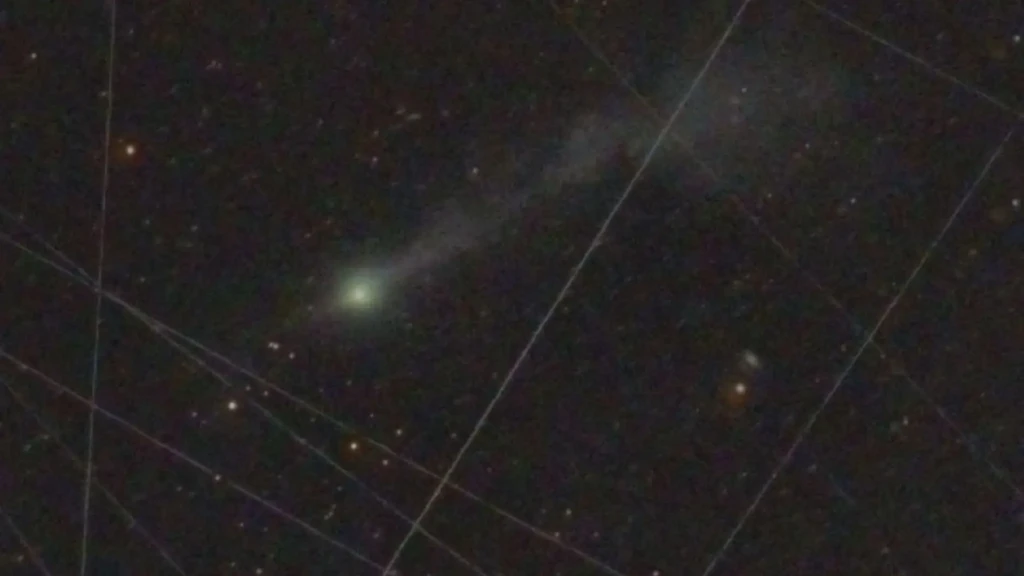
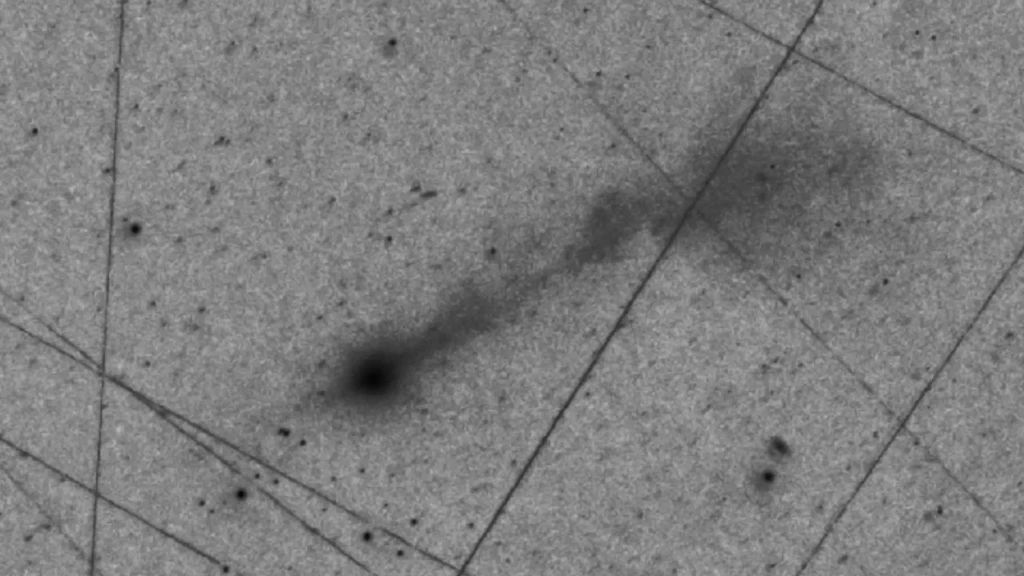
Comet 3I/ATLAS photographed on November 9. Image: Frank Niebling and Michael Buechner/ British Astronomical Association
SHARE

The interstellar comet 3I/ATLAS may have broken apart after passing close to the Sun on October 30. The theory has been put forth by Harvard Physicist Avi Loeb after he analysed the comet’s new pictures captured late last week. The images revealed that 3I/ATLAS has multiple outflowing jets millions of kilometres long and the loss of its material is inconsistent with its surface area.

3I/ATLAS was discovered by the NASA-funded Asteroid Terrestrial-impact Last Alert System (ATLAS) survey telescope in July, and it has been a subject of debate due to its unusual characteristics like a lack of cometary tail, sudden unexplained brightness and increased acceleration.
Comet 3I/ATLAS
Comet 3I/ATLAS photographed on November 9. Image: Frank Niebling and Michael Buechner/ British Astronomical Association

What’s happening with 3I/ATLAS?

The latest images show that the comet has a jet about million km long pointing toward the Sun and nearly three million km in the opposite direction. Based on his calculations, Loeb wrote in a blog that these jets have caused 3I/ATLAS to lose 16% of its total mass (33 billion tons), and concluded that it’s most likely because the comet got disintegrated.

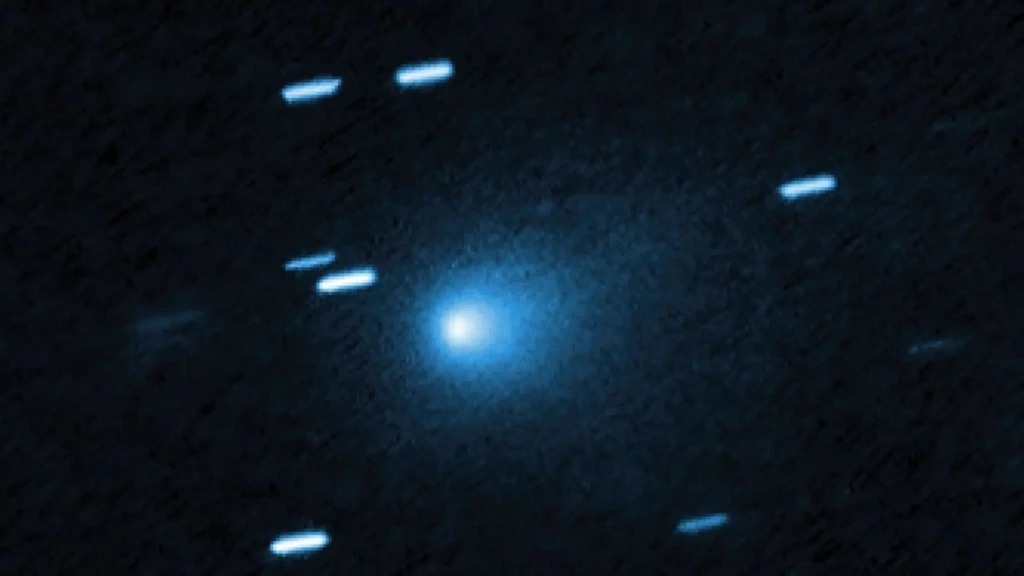
Citing the Hubble telescope observations, Loeb says the comet has a surface area 5.6 km wide. But an object shedding this much material (roughly five billion tons per month) should have a surface area between 23-50 km across. This means, he says, the comet could have broken into 16 or more pieces.
Comet 3I/ATLAS
Comet 3I/ATLAS captured by Hubble space telescope on July 21. Image: NASA

“Breakup into fragments would have increased the surface area of its material,” Loeb wrote adding that 3I/ATLAS exploded at perihelion (closest point to the Sun) and “we are witnessing the resulting fireworks.”

“The tidal force of the Sun is expected to separate the fragments in the coming weeks, creating an appearance similar to that of the comet Shoemaker-Levi 9 in 1994 near Jupiter,” Loeb further wrote.

Just captured interstellar comet 3I/ATLAS from Sabadell Observatory barely an hour ago — a bit blurry due to its low altitude, but still amazing to see! ☄️✨ #3IATLAS #Astronomy pic.twitter.com/SLsBdvRxPz

— Joan Miquel González Navarra (@astrojoanmiquel) November 9, 2025

But there’s another interesting aspect of this theory – a contrasting scenario. If upcoming observations during 3I/ATLAS’s close approach with Earth on December 19 show the comet intact, “we will have to consider that it is something other than a natural comet,” says Loeb. He also says those observations will confirm whether the jets behave like natural gas or are being produced from alien-tech thrusters.

Another ‘anomaly’ pointed out by the scientist is 3I/ATLAS’s presence in our solar system. This comet is a million times more massive than 1I/Oumuamua and Loeb says it is statistically impossible for such a large object to enter our solar system. He calculated that the odds of a natural comet’s retrograde trajectory and alignment near the ecliptic plane same as Earth are about one in a hundred million.

READ MORE: Comet 3I/ATLAS: Should We Take Avi Loeb’s Alien Theory Seriously? 

READ MORE: China’s Mars Orbiter Snapped Comet 3I/ATLAS. What Did It See?

TAGGED:Avi LoebcometComet 3I/ATLASNASASpace
Share This Article
Facebook Pinterest Whatsapp Whatsapp LinkedIn Copy Link Print

Latest News

Artist's impression of NASA's Psyche spacecraft.
NASA’s Psyche Spacecraft Will Zoom Past Mars Today On Its Way To Metal-Rich Asteroid
Astronomy
SpaceX Starship
SpaceX Starship’s 12th Test Flight Targeted On May 20; No Booster Catch This Time
Spaceflight
SpaceX's Starship during launch rehearsal.
SpaceX Completes Starship’s Launch Rehearsal For Flight 12 This Week; What To Expect?
Spaceflight
China US rivalry reach new heights.
‘Rival’ China Is Unintentionally The Biggest Motivator For NASA’s Moon Ambitions
Spaceflight

You Might Also Like

NASA DART
Astronomy

When NASA’s DART Mission Proved We Could Stop Armageddon

December 28, 2025
NASA's Crew-11 astronauts.
Spaceflight

NASA Crew-11 Evacuation LIVE: Watch Four Astronauts Depart From The ISS On Jan. 15

January 17, 2026
NASA Japan
Spaceflight

NASA Lends Support To Japan After H3 Rocket Failure; Here’s What Went Wrong

December 23, 2025
NASA MS-27
Spaceflight

NASA Astronaut Returns With Russian Cosmonauts After Spending 245 Days In Space | Photos

December 13, 2025
© 2026, Blue Terra Journal
  • About
  • Privacy Policy
  • Terms
  • Contact
Welcome Back!

Sign in to your account

Username or Email Address
Password

Lost your password?