Blue Terra Journal

  • Home
  • Spaceflight
    SpaceflightShow More
    NASA's SR-1 Freedom spacecraft.
    What Is NASA’s SR-1 Freedom Mission? The First Nuclear Reactor In Space Explained
    March 27, 2026
    Artist's impression of a NASA Moon base.
    NASA Moon Base: How The US Will Spend $20 Billion On This Ambitious Project
    March 25, 2026
    Russia's Soyuz rocket ascending to space.
    Russia’s Progress Spacecraft Suffers Mystery Glitch On Its Way To ISS; What Happened?
    March 23, 2026
    Robert Goddard
    Celebrating Robert Goddard – The Man Who Changed Rocketry 100 Years Ago
    March 17, 2026
    International Space Station gets extension to beat China
    Watch Out China! US Proposes Extending International Space Station Lifespan To 2032
    March 10, 2026
  • Astronomy
    AstronomyShow More
    Meteor spotted over Houston.
    Video Captures 1-Ton Meteor Exploding Over Houston Skies, NASA Releases Statement
    March 22, 2026
    NASA black hole simulation
    Fall Into A Black Hole With This Incredibly Scary Simulation Made By NASA
    March 18, 2026
    Comet C/2026 A1 MAPS
    Comet C/2026 A1 MAPS: What Are ‘Sun-Grazer’ Comets And Why Are They Special?
    March 12, 2026
    Moon is safe from asteroid 2024 YR4.
    The Moon Is Safe! James Webb Space Telescope Rules Out Asteroid 2024 YR4’s Collision
    March 6, 2026
    NASA Moon orbiter
    NASA Prepares To Save Its Orbiter During Total Solar Eclipse On The Moon
    March 3, 2026
  • India
    IndiaShow More
    Shubhanshu Shukla aboard the ISS.
    ISRO Astronaut Shubhanshu Shukla Awarded Ashoka Chakra For Heroic Ax-4 Mission
    February 9, 2026
    ISRO's PSLV lifts off to space.
    ISRO’s PSLV Rocket Suffers Third Stage Failure After Successful Liftoff; Payloads Lost
    January 23, 2026
    Dhruva Space team at ISRO facility.
    India’s Dhruva Space To Launch 10 Missions, Including 1st Northeastern Satellite, On ISRO’s PSLV
    January 12, 2026
    ISRO's PSLV rocket
    ISRO To Seek Redemption With PSLV-C62 Mission Launch On January 12
    January 12, 2026
    ISRO SSLV
    ISRO’s SSLV Rocket Just Got Better After Latest Third Stage Test Fire
    December 31, 2025
  • Artemis
    ArtemisShow More
    NASA Artemis II crew
    NASA’s Christina Koch Turns ‘Space Plumber’ To Fix $30 Million Toilet On Artemis II Mission
    April 3, 2026
    NASA Orion spacecraft
    NASA’s Artemis II Astronauts Are Moon-Bound After Successful Trans-Lunar Injection Burn
    April 3, 2026
    NASA Artemis II lifts off.
    Artemis II Lifts Off! NASA Launches 4 Astronauts To The Moon After Over 50 Years
    April 2, 2026
    NASA's Artemis II astronauts
    NASA Artemis II Launch Live: Watch Humanity Return To The Moon On April 2
    April 2, 2026
    NASA Apollo 8 image
    NASA Artemis II: Why This Moon Mission Is Our Generation’s Apollo 8
    March 30, 2026
  • More
    • About
    • Privacy Policy
    • Terms
    • Contact

Blue Terra Journal

  • Home
  • Spaceflight
  • Astronomy
  • India
  • Artemis
Search
  • Pages
    • About
    • Contact
    • Privacy Policy
    • Terms

Home - Spaceflight - NASA’s ESCAPADE Mission Is Off To Mars. What Happens Next?

Spaceflight

NASA’s ESCAPADE Mission Is Off To Mars. What Happens Next?

It's going to be a long journey.

Harsh Vardhan
Last updated: December 4, 2025 8:42 PM
Harsh Vardhan
Share
6 Min Read
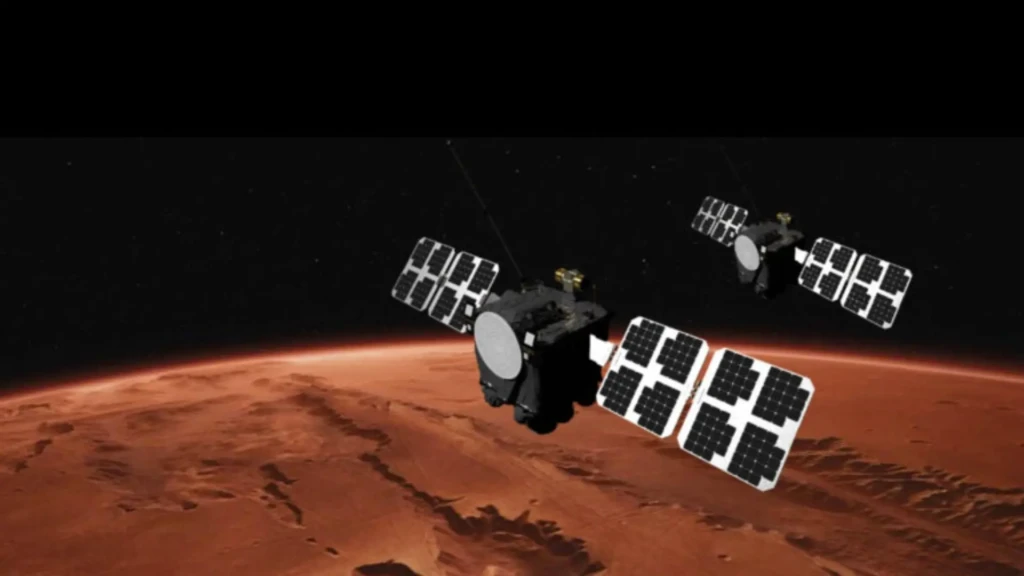
NASA ESCAPADE Mars spacecraft.
Artist's impression of the ESCAPADE satellites around Mars. Image: NASA
SHARE

Contents
  • What is ESCAPADE?
  • What’s next for ESCAPADE? 

NASA’s ESCAPADE mission is finally off to Mars after suffering multiple delays due to bad weather and solar storm. It lifted off atop Blue Origin‘s New Glenn rocket at 1:15 am IST on November 14 (3:45 pm EST, Nov 13) from the Cape Canaveral Space Force Station in Florida, and injected the spacecraft into the desired orbit with impressive accuracy. Blue Origin achieved another milestone in this mission – landing the first stage New Glenn booster on a drone ship stationed in the Atlantic Ocean on its second attempt.

pic.twitter.com/mRFHLuLi7Q

— Jeff Bezos (@JeffBezos) November 13, 2025

Blue Origin’s CEO Dave Limp declared the mission a complete success adding, “never before in history has a booster this large nailed the landing on the second try. This is just the beginning as we rapidly scale our flight cadence and continue delivering for our customers.“

pic.twitter.com/uD4FJ3xC8M

— Jeff Bezos (@JeffBezos) November 13, 2025

SpaceX was the first company to achieve booster landing both on land and sea with Falcon 9, but Falcon boosters are much smaller (41.2 metres) as compared to New Glenn’s (57 metres).

What is ESCAPADE?

ESCAPADE is the world’s first twin-spacecraft mission that is Mars-bound to study the red planet’s magnetosphere and its interaction with solar winds. The satellites named Blue and Gold, built by Rocket Lab, are designed to fly in separate elliptical orbits around Mars to study how the planet lost its atmosphere and eventually its oceans.
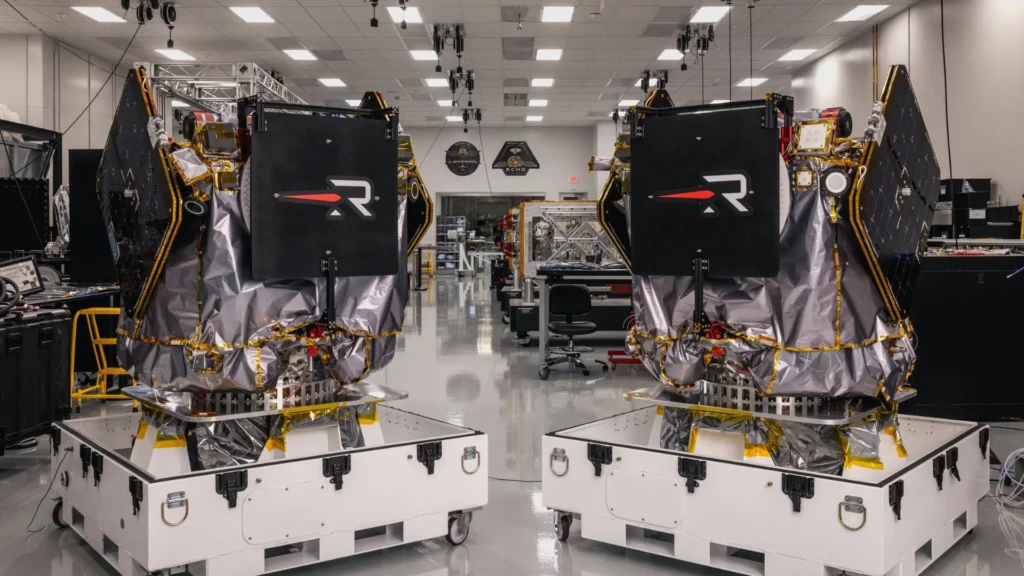
NASA's ESCAPADE satellites.
NASA’s ESCAPADE satellites. Image: Rocket Lab

According to University of California, Berkeley, which will lead the science operations, Blue and Gold will fly in formation to map the magnetic fields, upper atmosphere and ionosphere of Mars in 3D.

“The geological evidence shows that Mars once had water on it, and in order to keep the water, you need a thick atmosphere,” space physicist Shaoxui Xu, deputy principal investigator for the mission, said in a statement. “So we know that there was a thick enough atmosphere on Mars once upon a time, but now it is very tenuous. There are only two ways for atmosphere to leave — either go into the ground or escape to space, and there are a lot of studies showing that escape has been a very significant contributor to the evolution of the atmosphere.“

If Earth’s magnetosphere weakens significantly, the solar wind could strip away the atmosphere and eventually our planet might also lose all its water.

READ MORE: ESCAPADE: Why It May Be NASA’s Most Important Mars Mission In Years

What’s next for ESCAPADE? 

After its successful orbital insertion, the two satellites established communications with mission control before crusing towards the second Lagrange Point (L2). 

“The twins are talking! We have successfully established contact with both ESCAPADE spacecraft, Blue and Gold. We’re on our way to Mars to enable @NASA and @ucbssl to study the Martian magnetosphere!” Rocket Lab said in an update on X.
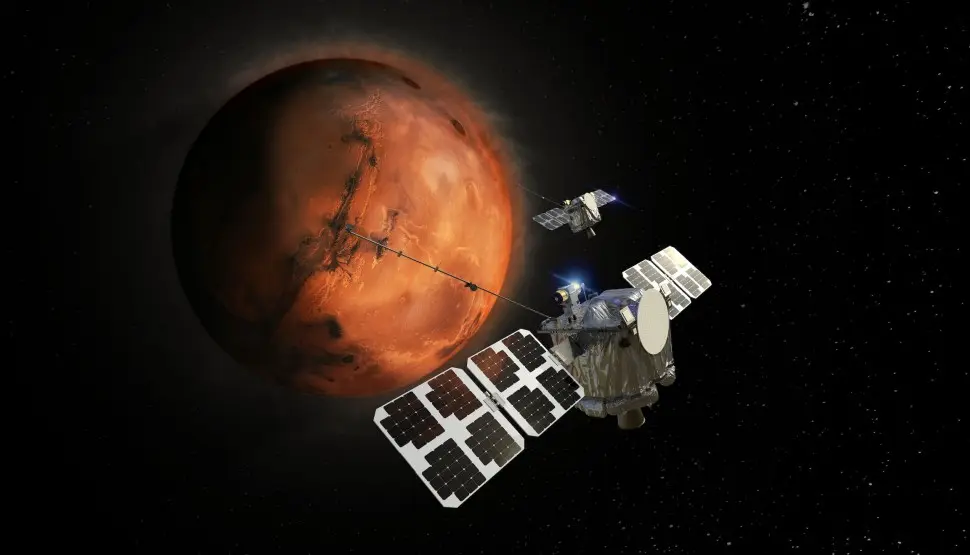
NASA ESCAPADE Mars spacecraft.
Artist’s impression of the ESCAPADE satellites. Image: Rocket Lab

In the next few hours and days, the satellites will deploy their antennas and solar arrays while correcting their course for journey to L2. ESCAPADE’s path to Mars is like no other, because the mission team has decided to park it in a ‘libration loiter orbit’ at L2 until late 2026. It will take the orbiters about a month to reach the spot where they will spend a year. L2 is where NASA has stationed the James Webb Space Telescope because it offers a great view of the universe, free from atmospheric disturbance, and a gravitationally stable location which significantly saves fuel.

According to NASA, Mars and Earth are currently on the opposite sides of the Sun and a journey to the red planet will increase travel time and fuel consumption. So ESCAPADE will wait until Earth and Mars properly align late next year. When the time is right, the satellites will loop back to Earth and use its gravity to slingshot towards Mars. This will kickstart their 11-month journey to the red planet.

After arriving on Mars, the orbiters will occupy separate orbits and use their four identical instruments to observe the planet from different vantage points. “To understand how the solar wind drives different kinds of atmospheric escape is a key piece of the puzzle of the climate evolution of Mars. ESCAPADE gives us what you might call a stereo perspective — two different vantage points simultaneously,” said Robert Lillis, ESCAPADE principal investigator of UC Berkeley’s Space Sciences Laboratory (SSL). Interestingly, ESCAPADE will work in tandem with NASA’s MAVEN orbiter along with the European Space Agency’s (ESA) ExoMars Trace Gas Orbiter and Mars Express spacecraft. 

READ MORE: Memorial On Mars? Celestis Will Send Cremated Remains, DNA Samples In 2030

TAGGED:Blue OriginESCAPADEMarsNASANew GlennRocket Lab
Share This Article
Facebook Pinterest Whatsapp Whatsapp LinkedIn Copy Link Print

Latest News

NASA Artemis II crew
NASA’s Christina Koch Turns ‘Space Plumber’ To Fix $30 Million Toilet On Artemis II Mission
Artemis
NASA Orion spacecraft
NASA’s Artemis II Astronauts Are Moon-Bound After Successful Trans-Lunar Injection Burn
Artemis
NASA Artemis II lifts off.
Artemis II Lifts Off! NASA Launches 4 Astronauts To The Moon After Over 50 Years
Artemis
NASA's Artemis II astronauts
NASA Artemis II Launch Live: Watch Humanity Return To The Moon On April 2
Artemis

You Might Also Like

NASA's Artemis II crew
Artemis

Inside Artemis II: How NASA Will Study Astronaut Health And Deep Space Radiation

January 30, 2026
Blue Origin NS-37 mission
Spaceflight

Blue Origin’s New Shepard Director Replaces NS-38 Mission Crew Member After He Falls Sick

January 21, 2026
NASA Artemis 2 Orion spacecraft.
Artemis

Artemis 2: Unraveling NASA Orion Capsule – Humanity’s Ride To The Moon

November 26, 2025
Blue Origin's New Glenn rocket.
Spaceflight

Blue Origin Postpones NASA’s ESCAPADE Mission Launch Due To Solar Storm

November 13, 2025
© 2026, Blue Terra Journal
  • About
  • Privacy Policy
  • Terms
  • Contact
Welcome Back!

Sign in to your account

Username or Email Address
Password

Lost your password?