Blue Terra Journal

  • Home
  • Spaceflight
    SpaceflightShow More
    SpaceX Starship
    SpaceX Starship’s 12th Test Flight Targeted On May 20; No Booster Catch This Time
    May 13, 2026
    SpaceX's Starship during launch rehearsal.
    SpaceX Completes Starship’s Launch Rehearsal For Flight 12 This Week; What To Expect?
    May 13, 2026
    China US rivalry reach new heights.
    ‘Rival’ China Is Unintentionally The Biggest Motivator For NASA’s Moon Ambitions
    April 28, 2026
    NASA Voyager 1 illustration
    NASA Shuts Down Another Voyager 1 Instrument; How Long Can This Spacecraft Last?
    April 22, 2026
    NASA's SR-1 Freedom spacecraft.
    What Is NASA’s SR-1 Freedom Mission? The First Nuclear Reactor In Space Explained
    March 27, 2026
  • Astronomy
    AstronomyShow More
    Artist's impression of NASA's Psyche spacecraft.
    NASA’s Psyche Spacecraft Will Zoom Past Mars Today On Its Way To Metal-Rich Asteroid
    May 15, 2026
    Comet MAPS image
    Video: Comet MAPS destroyed after plunging into the Sun; event caught by NASA missions
    April 18, 2026
    Apophis asteroid flyby
    ‘God Of Chaos’: Apophis Asteroid Will Fly Dangerously Close To Earth Exactly 5 Years From Now
    April 14, 2026
    Meteor spotted over Houston.
    Video Captures 1-Ton Meteor Exploding Over Houston Skies, NASA Releases Statement
    March 22, 2026
    NASA black hole simulation
    Fall Into A Black Hole With This Incredibly Scary Simulation Made By NASA
    March 18, 2026
  • India
    IndiaShow More
    Shubhanshu Shukla aboard the ISS.
    ISRO Astronaut Shubhanshu Shukla Awarded Ashoka Chakra For Heroic Ax-4 Mission
    February 9, 2026
    ISRO's PSLV lifts off to space.
    ISRO’s PSLV Rocket Suffers Third Stage Failure After Successful Liftoff; Payloads Lost
    January 23, 2026
    Dhruva Space team at ISRO facility.
    India’s Dhruva Space To Launch 10 Missions, Including 1st Northeastern Satellite, On ISRO’s PSLV
    January 12, 2026
    ISRO's PSLV rocket
    ISRO To Seek Redemption With PSLV-C62 Mission Launch On January 12
    January 12, 2026
    ISRO SSLV
    ISRO’s SSLV Rocket Just Got Better After Latest Third Stage Test Fire
    December 31, 2025
  • Artemis
    ArtemisShow More
    NASA Artemis II mission
    Welcome Home! NASA’s Artemis II Astronauts Are Back After Historic Moon Voyage
    April 22, 2026
    NASA Artemis II iPhone image
    iPhones Reigned Supreme On NASA’s Artemis II Moon Mission
    April 10, 2026
    Artemis II NASA
    All Eyes On Scary Artemis II Reentry As NASA Moon Mission Nears Completion
    April 9, 2026
    NASA Artemis II
    NASA Artemis II Crew Names Moon Crater ‘Carroll’ After Commander Reid Wiseman’s Late Wife
    April 7, 2026
    NASA Artemis II
    Watch: NASA Artemis II Astronauts Begin Flyby Of Moon’s Far Side For The First Time Ever
    April 9, 2026
  • More
    • About
    • Privacy Policy
    • Terms
    • Contact

Blue Terra Journal

  • Home
  • Spaceflight
  • Astronomy
  • India
  • Artemis
Search
  • Pages
    • About
    • Contact
    • Privacy Policy
    • Terms

Home - Spaceflight - What Is NASA’s SR-1 Freedom Mission? The First Nuclear Reactor In Space Explained

Spaceflight

What Is NASA’s SR-1 Freedom Mission? The First Nuclear Reactor In Space Explained

The mission will take off in December 2028.

Blue Terra Journal
Last updated: March 27, 2026 5:01 PM
Blue Terra Journal
Share
4 Min Read
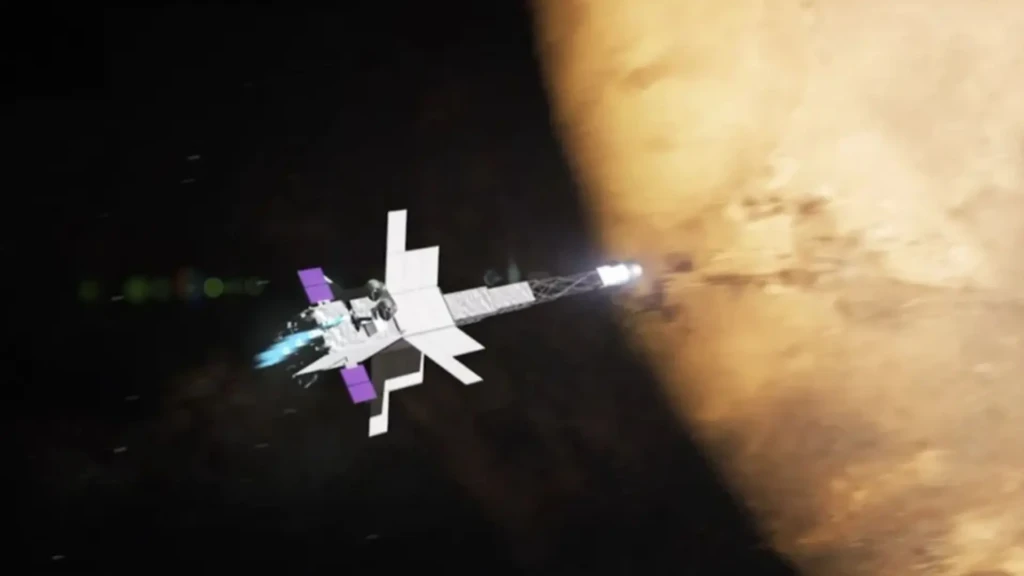
NASA's SR-1 Freedom spacecraft.
Artist's concept of NASA's SR-1 Freedom spacecraft. Image: NASA
SHARE


Contents
  • Why NASA wants nuclear propulsion?
  • The SR-1 Freedom mission

Nuclear propulsion might soon be a reality. NASA has announced the SR-1 Freedom spacecraft mission which will take off in 2028 with the world’s first nuclear reactor as a power source. Enroute to Mars, this spacecraft will deliver three tiny helicopters onto the surface of the red planet and lay the foundation of future human landings.

The SR-1 mission brings together NASA and the US Department of Energy which are also building a nuclear reactor to power bases on the Moon.

NASA is advancing nuclear power and propulsion in space to accomplish President Trump’s national space objectives.

With SR-1 Freedom, launching in 2028, we will demonstrate nuclear electric propulsion and deliver SkyFall helicopters to Mars.

In collaboration with @Energy, these… pic.twitter.com/gkGLs7xiVu

— NASA (@NASA) March 24, 2026

The concept of using nuclear propulsion in spaceflight is decades old but hasn’t been achieved yet due to several reasons including high costs, political barriers and technical challenges.

NASA says that the December 2028 launch window to Mars will force decisions for the SR-1 mission, which decades of study never did.

Why NASA wants nuclear propulsion?

Space agencies have traditionally relied on solar energy in spaceflight but it is not a reliable source. There are regions on the Moon which are under darkness for days and without continuous electricity supply, the spacecraft could go dead.

On Mars, dust storms block sunlight for weeks and could jeopardise the mission.

Long term missions need power that works everywhere, independent of the Sun – that’s where nuclear fission comes in. NASA plans to use uranium whose decay would deliver more than 20 kilowatts of electrical power and ensure continuous energy supply to the spacecraft.

The SR-1 Freedom mission

According to NASA, the SR-1 spacecraft, will start a nuclear fission reactor within 48 hours of leaving Earth’s gravity. This reactor will power the electric thrusters to help the spacecraft steer itself towards Mars. SR-1 Freedom will deliver the Skyfall payload – three Ingenuity class helicopters – equipped with cameras, ground-penetrating radar, and radios to survey potential human landing sites, search for subsurface water, and relay navigation data for future landers.

NASA believes that the SR-1 mission will enable the Lunar Reactor-1 (LR-1), a fission surface-power system designed to keep the Moon Base operating through periods of darkness.

Speaking about SR-1, NASA Administrator Jared Isaacman said – “This mission will bring America’s nuclear power capabilities to space and deliver the Skyfall payload of Ingenuity class helicopters to explore the Red Planet. Nuclear power and propulsion will be the key to undertaking crewed missions to Mars and exploring the outer solar system.”

ALSO READ: NASA Moon Base: How The US Will Spend $20 Billion On This Ambitious Project

ALSO READ: Video Captures 1-Ton Meteor Exploding Over Houston Skies, NASA Releases Statement

TAGGED:MarsmoonNASANuclear propulsionSR-1 freedom
Share This Article
Facebook Pinterest Whatsapp Whatsapp LinkedIn Copy Link Print

Latest News

Artist's impression of NASA's Psyche spacecraft.
NASA’s Psyche Spacecraft Will Zoom Past Mars Today On Its Way To Metal-Rich Asteroid
Astronomy
SpaceX Starship
SpaceX Starship’s 12th Test Flight Targeted On May 20; No Booster Catch This Time
Spaceflight
SpaceX's Starship during launch rehearsal.
SpaceX Completes Starship’s Launch Rehearsal For Flight 12 This Week; What To Expect?
Spaceflight
China US rivalry reach new heights.
‘Rival’ China Is Unintentionally The Biggest Motivator For NASA’s Moon Ambitions
Spaceflight

You Might Also Like

NASA OSIRIX-APEX
Spaceflight

NASA’s Deep Space Probes Send Stunning Images Of Earth, Moon And Uranus

November 29, 2025
NASA Artemis II
Artemis

Send Your Name To The Moon For Free On NASA’s Artemis II Mission — Here’s How

December 29, 2025
Jared Isaacman
Spaceflight

Jared Isaacman Is Back As Trump Renominates Him For NASA Head Post

November 9, 2025
Comet 3I/ATLAS pre-perihelion.
Astronomy

Comet 3I/ATLAS Is NOT Changing Colours, But Sudden Brightness Remains A Mystery

November 19, 2025
© 2026, Blue Terra Journal
  • About
  • Privacy Policy
  • Terms
  • Contact
Welcome Back!

Sign in to your account

Username or Email Address
Password

Lost your password?