Blue Terra Journal

  • Home
  • Spaceflight
    SpaceflightShow More
    NASA's SR-1 Freedom spacecraft.
    What Is NASA’s SR-1 Freedom Mission? The First Nuclear Reactor In Space Explained
    March 27, 2026
    Artist's impression of a NASA Moon base.
    NASA Moon Base: How The US Will Spend $20 Billion On This Ambitious Project
    March 25, 2026
    Russia's Soyuz rocket ascending to space.
    Russia’s Progress Spacecraft Suffers Mystery Glitch On Its Way To ISS; What Happened?
    March 23, 2026
    Robert Goddard
    Celebrating Robert Goddard – The Man Who Changed Rocketry 100 Years Ago
    March 17, 2026
    International Space Station gets extension to beat China
    Watch Out China! US Proposes Extending International Space Station Lifespan To 2032
    March 10, 2026
  • Astronomy
    AstronomyShow More
    Meteor spotted over Houston.
    Video Captures 1-Ton Meteor Exploding Over Houston Skies, NASA Releases Statement
    March 22, 2026
    NASA black hole simulation
    Fall Into A Black Hole With This Incredibly Scary Simulation Made By NASA
    March 18, 2026
    Comet C/2026 A1 MAPS
    Comet C/2026 A1 MAPS: What Are ‘Sun-Grazer’ Comets And Why Are They Special?
    March 12, 2026
    Moon is safe from asteroid 2024 YR4.
    The Moon Is Safe! James Webb Space Telescope Rules Out Asteroid 2024 YR4’s Collision
    March 6, 2026
    NASA Moon orbiter
    NASA Prepares To Save Its Orbiter During Total Solar Eclipse On The Moon
    March 3, 2026
  • India
    IndiaShow More
    Shubhanshu Shukla aboard the ISS.
    ISRO Astronaut Shubhanshu Shukla Awarded Ashoka Chakra For Heroic Ax-4 Mission
    February 9, 2026
    ISRO's PSLV lifts off to space.
    ISRO’s PSLV Rocket Suffers Third Stage Failure After Successful Liftoff; Payloads Lost
    January 23, 2026
    Dhruva Space team at ISRO facility.
    India’s Dhruva Space To Launch 10 Missions, Including 1st Northeastern Satellite, On ISRO’s PSLV
    January 12, 2026
    ISRO's PSLV rocket
    ISRO To Seek Redemption With PSLV-C62 Mission Launch On January 12
    January 12, 2026
    ISRO SSLV
    ISRO’s SSLV Rocket Just Got Better After Latest Third Stage Test Fire
    December 31, 2025
  • Artemis
    ArtemisShow More
    NASA Artemis II crew
    NASA’s Christina Koch Turns ‘Space Plumber’ To Fix $30 Million Toilet On Artemis II Mission
    April 3, 2026
    NASA Orion spacecraft
    NASA’s Artemis II Astronauts Are Moon-Bound After Successful Trans-Lunar Injection Burn
    April 3, 2026
    NASA Artemis II lifts off.
    Artemis II Lifts Off! NASA Launches 4 Astronauts To The Moon After Over 50 Years
    April 2, 2026
    NASA's Artemis II astronauts
    NASA Artemis II Launch Live: Watch Humanity Return To The Moon On April 2
    April 2, 2026
    NASA Apollo 8 image
    NASA Artemis II: Why This Moon Mission Is Our Generation’s Apollo 8
    March 30, 2026
  • More
    • About
    • Privacy Policy
    • Terms
    • Contact

Blue Terra Journal

  • Home
  • Spaceflight
  • Astronomy
  • India
  • Artemis
Search
  • Pages
    • About
    • Contact
    • Privacy Policy
    • Terms

Home - Astronomy - NASA’s Voyager 1 Will Be One Light-Day Away From Earth In 2026 – What This Means

Astronomy

NASA’s Voyager 1 Will Be One Light-Day Away From Earth In 2026 – What This Means

This probe keeps going.

Harsh Vardhan
Last updated: January 26, 2026 10:25 PM
Harsh Vardhan
Share
5 Min Read
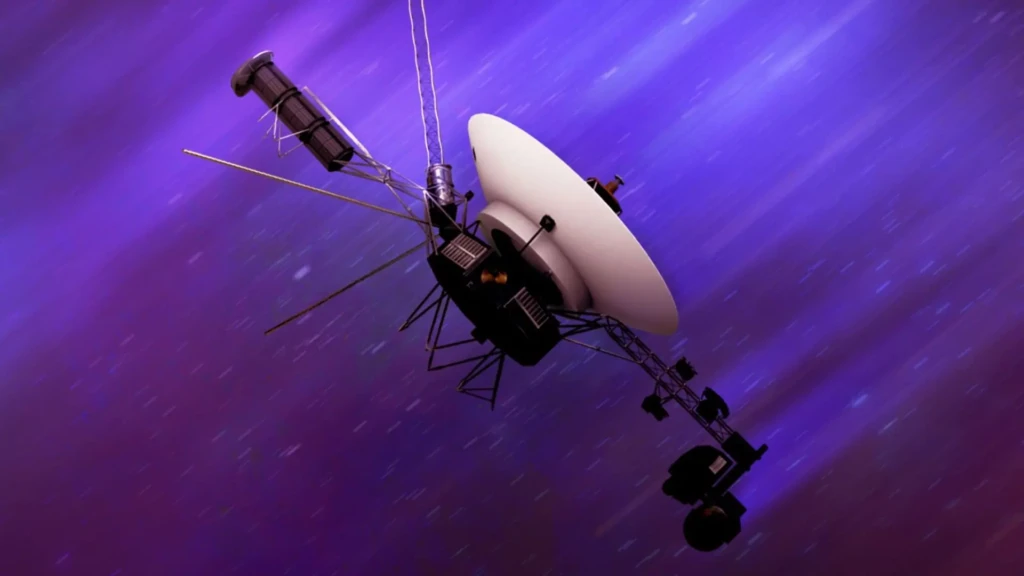
Voyager 1 illustration
Artist's concept of Voyager 1. Image: NASA
SHARE

The Voyager 1 spacecraft is set to achieve a milestone this year that will be the first for humankind. In November 2026, the 48-year-old NASA probe will be one light-day away from Earth, 14 years after leaving the solar system. This means radio signals from the spacecraft will take one full day to reach Earth and back. Mars, for instance, is 12 light-minutes away from our planet. As of today, the probe is over 25 billion kilometres away.

Launched on September 5, 1977, Voyager 1 was designed to explore the outer solar system planets primarily Jupiter and Saturn along with their moons and other characteristics. In August 2012, it became the first human-made spacecraft to leave the solar system and enter interstellar space. This was determined by the changes in the atoms, particles, and magnetic fields detected by the onboard instruments outside the heliosphere – a protective bubble of particles created by the Sun.

Its twin – Voyager 2 – which was launched before Voyager 1 on August 20, 1977 – entered interstellar space in November 2018 and both probes together have significantly improved scientists’ understanding of the outer solar system.

Voyager 1 and its cosmic journey

Despite launching after Voyager 2, Voyager 1 was the first to exit the solar system due to its shorter and high-speed path. Its direct trajectory placed it perfectly for flybys of Jupiter and Saturn where stunning discoveries were unfolding. Using a suite of 10 instruments and two cameras, Voyager 1 discovered a thin ring around Jupiter and two new moons – Thebe and Metis – orbiting the gas giant. It discovered five more moons around Saturn and a new ring called the G-ring.
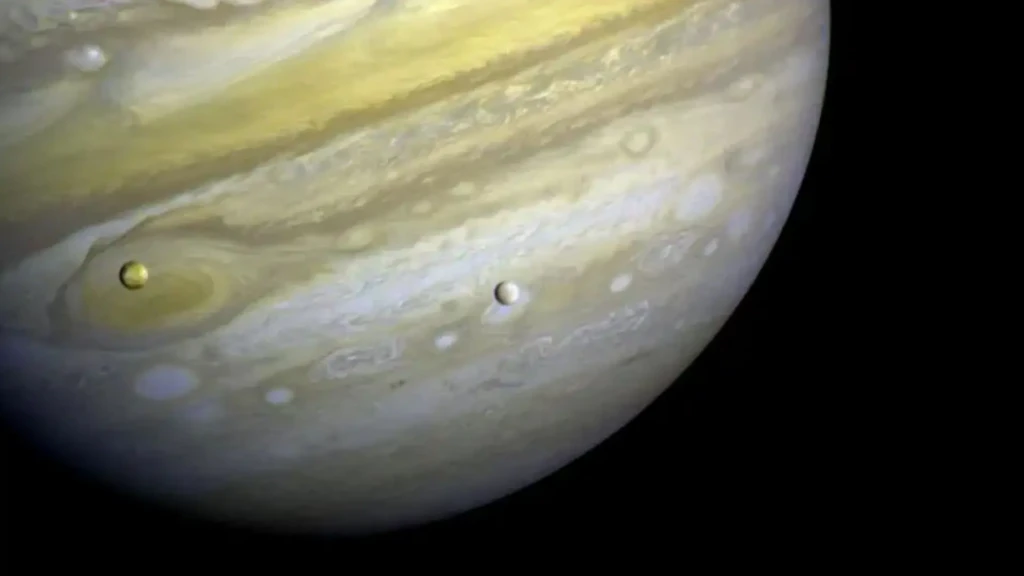
Voyager 1 image of Jupiter
Voyager 1 image of Jupiter and its moons Io (left) and Europa. Image: NASA

During the April 1978 observations, Voyager 1 revealed that Jupiter’s atmosphere is more turbulent than thought during the Pioneer 10 and 11 missions, and took invaluable closeup photos of the Jovian moons Amalthea, Io, Europa, Ganymede, and Callisto.
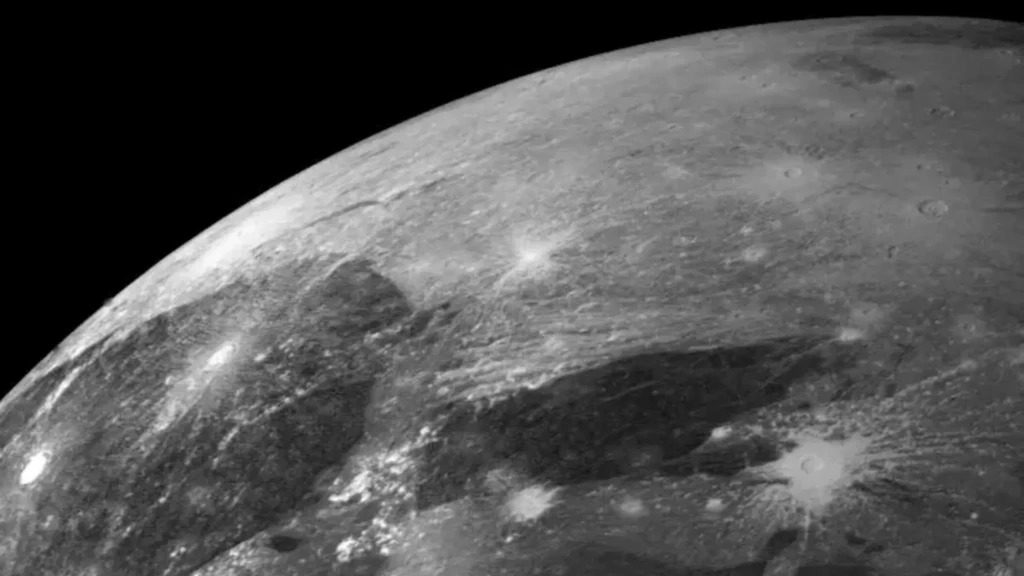
Voyager 1 image of Ganymede
Surface of Jupiter’s moon Ganymede captured by Voyager 1. Image: NASA

At its closest, the spacecraft was 2,80,000 km from Jupiter and 1,26,000 km from Saturn – where it photographed the moons Titan, Mimas, Enceladus, Tethys, Dione, and Rhea. Thanks to Voyager 1’s flyby, scientists were able to determine that Titan’s surface is hidden by a thick atmosphere composed of 90 percent nitrogen. The presence of methane and complex hydrocarbons also indicated that Titan might be a stage for prebiotic chemical reactions.
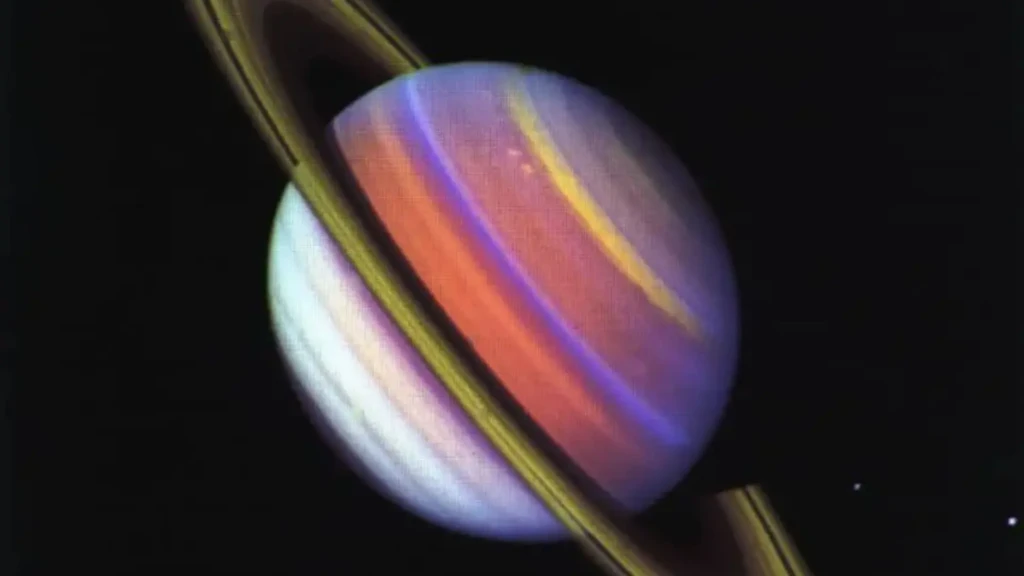
Voyager 1's view of Saturn
Voyager 1’s view of Saturn in ultraviolet, violet and green filters. Image: NASA

As of January 2026, Voyager 1 reportedly has three functional instruments as the rest were shut down to conserve energy. According to NASA, the Voyager twins use three radioisotope thermoelectric generators (RTGs) that generate electricity from the heat of decaying plutonium. Instruments that were drawing too much power and were of relatively less importance were turned off right after the planetary flybys decades ago. Voyager 1’s cameras – which delivered the iconic ‘pale blue dot’ image of Earth in 1990 – were among these devices that were shut down forever.

Since March 2025, only three instruments are active on both Voyager probes – those that NASA considers important to study interstellar space.

The passage of time seems to be having its effect on the probes as they repeatedly experience communication blackouts; the most recent was reported in December 2024. NASA expects that both probes would be active through early 2031 with at least one operational instrument, before the engineers have to bid farewell to the pioneers for good.

ALSO READ: NASA Losing Hope Of Recovering Its Mars Orbiter MAVEN; ‘Looking Very Unlikely’

ALSO READ: The Fermi Paradox: Why We’ve Never Seen Aliens

 

TAGGED:NASASpaceVoyager 1Voyager 2
Share This Article
Facebook Pinterest Whatsapp Whatsapp LinkedIn Copy Link Print

Latest News

NASA Artemis II crew
NASA’s Christina Koch Turns ‘Space Plumber’ To Fix $30 Million Toilet On Artemis II Mission
Artemis
NASA Orion spacecraft
NASA’s Artemis II Astronauts Are Moon-Bound After Successful Trans-Lunar Injection Burn
Artemis
NASA Artemis II lifts off.
Artemis II Lifts Off! NASA Launches 4 Astronauts To The Moon After Over 50 Years
Artemis
NASA's Artemis II astronauts
NASA Artemis II Launch Live: Watch Humanity Return To The Moon On April 2
Artemis

You Might Also Like

Blue Origin NS-37 mission
Spaceflight

Blue Origin To Attempt Launch Of NS-37 Mission With Six Humans Again On Dec 20

December 20, 2025
Blue Origin NS-37 mission
Spaceflight

Blue Origin Scrubs NS-37 Crew Mission A Minute Before Launch Due To Anomaly

December 19, 2025
3I/ATLAS
Astronomy

So What Happened To Comet 3I/ATLAS After Its Closest Approach To Earth?

January 7, 2026
NASA Moon orbiter
Astronomy

Blood Moon 2026: When And Where To See The Total Lunar Eclipse On March 3?

March 2, 2026
© 2026, Blue Terra Journal
  • About
  • Privacy Policy
  • Terms
  • Contact
Welcome Back!

Sign in to your account

Username or Email Address
Password

Lost your password?