Blue Terra Journal

  • Home
  • Spaceflight
    SpaceflightShow More
    SpaceX Dragon spacecraft for NASA's Crew-12 mission.
    SpaceX Rolls Out Dragon Spacecraft For NASA’s Crew-12 Mission While Falcon 9 Remains Grounded
    February 4, 2026
    NASA partners with Axiom Space
    NASA And Axiom Space Announce 5th Private Crew Mission To International Space Station In 2027
    February 1, 2026
    Blue Origin Mark 1 lander.
    Blue Origin Halts New Shepard Missions For At Least 2 Years To Land Humans On The Moon
    February 1, 2026
    SpaceX Starship on flight 11.
    SpaceX CEO Elon Musk Reveals When Starship Will Launch On Next Test Flight
    January 29, 2026
    NOAA's SOLAR-1 observatory.
    NOAA’s Sun Spying SOLAR-1 Observatory Reaches Its Destination 1.5 Million Km From Earth
    January 31, 2026
  • Astronomy
    AstronomyShow More
    Voyager 1 illustration
    NASA’s Voyager 1 Will Be One Light-Day Away From Earth In 2026 – What This Means
    January 26, 2026
    Auroras triggered by CMEs.
    Auroras Flood The Night Skies After Largest Solar Radiation Storm In Over 20 Years | Photos
    January 20, 2026
    Hubble discovers Cloud-9.
    Hubble Telescope Uncovers New Object ‘Cloud-9’ – A ‘Failed Galaxy’ With No Stars
    January 13, 2026
    SpaceX launches NASA telescope.
    SpaceX Launches NASA’s Exoplanet Exploring Telescope Pandora On Twilight Mission
    January 19, 2026
    Comet 3I/ATLAS by Hubble telescope
    Comet 3I/ATLAS Is Not An Alien Spacecraft – This Research Likely Confirms It
    January 10, 2026
  • India
    IndiaShow More
    Shubhanshu Shukla aboard the ISS.
    ISRO Astronaut Shubhanshu Shukla Awarded Ashoka Chakra For Heroic Ax-4 Mission
    January 25, 2026
    ISRO's PSLV lifts off to space.
    ISRO’s PSLV Rocket Suffers Third Stage Failure After Successful Liftoff; Payloads Lost
    January 23, 2026
    Dhruva Space team at ISRO facility.
    India’s Dhruva Space To Launch 10 Missions, Including 1st Northeastern Satellite, On ISRO’s PSLV
    January 12, 2026
    ISRO's PSLV rocket
    ISRO To Seek Redemption With PSLV-C62 Mission Launch On January 12
    January 12, 2026
    ISRO SSLV
    ISRO’s SSLV Rocket Just Got Better After Latest Third Stage Test Fire
    December 31, 2025
  • Artemis
    ArtemisShow More
    NASA's Artemis II SLS Rocket
    NASA Delays Artemis II Moon Mission Launch To March – Here’s Why
    February 3, 2026
    NASA's SLS rocket.
    Astronauts In Quarantine, Rocket Powered On – How NASA Is Preparing For Artemis II
    February 3, 2026
    NASA's Artemis II crew
    Inside Artemis II: How NASA Will Study Astronaut Health And Deep Space Radiation
    January 30, 2026
    NASA's SLS rocket at launch pad.
    NASA’s Artemis II To Carry Relic Of Humanity’s First Flight And More To The Moon
    January 27, 2026
    NASA's SLS rocket
    NASA’s SLS Rocket Rolls Out To The Launch Pad For Artemis II – Here’s What’s Next
    January 27, 2026
  • More
    • About
    • Privacy Policy
    • Terms
    • Contact

Blue Terra Journal

  • Home
  • Spaceflight
  • Astronomy
  • India
  • Artemis
Search
  • Pages
    • About
    • Contact
    • Privacy Policy
    • Terms

Home - Spaceflight - ESCAPADE: Why It May Be NASA’s Most Important Mars Mission In Years

Spaceflight

ESCAPADE: Why It May Be NASA’s Most Important Mars Mission In Years

ESCAPADE is launching no earlier than November 9.

Harsh Vardhan
Last updated: November 19, 2025 9:22 PM
Harsh Vardhan
Share
5 Min Read
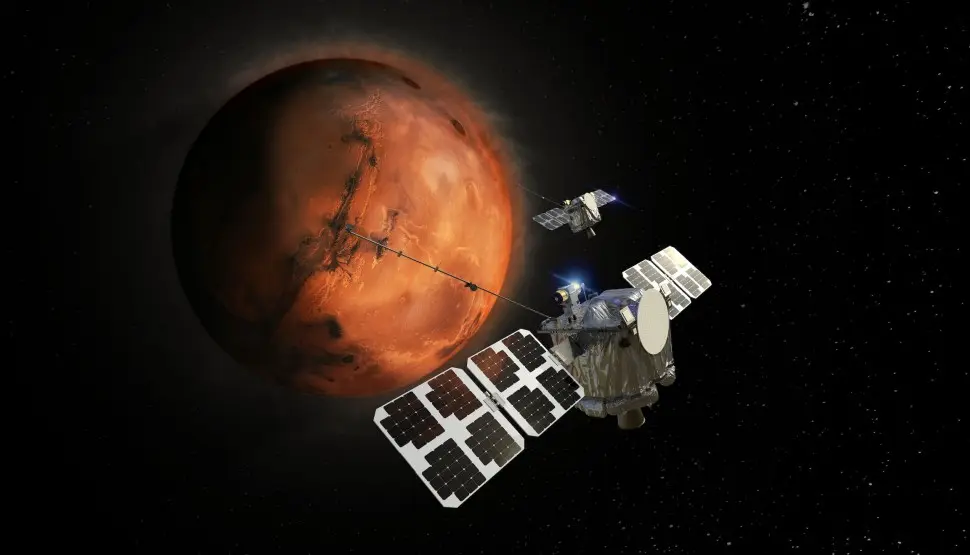
NASA ESCAPADE Mars spacecraft.
Artist's impression of the ESCAPADE satellites. Image: Rocket Lab
SHARE

Contents
  • ESCAPADE’s purpose
  • ESCAPADE’s journey to Mars 
  • What will ESCAPADE do? 

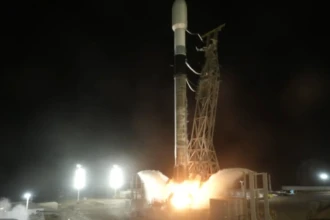
Blue Origin announced Thursday that it is targeting the launch of NASA‘s ESCAPADE mission no earlier than November 9. The first-ever twin-spacecraft mission to Mars will launch atop Blue Origin’s biggest rocket New Glenn from Florida, US, in its second-ever flight and first for NASA.

Short for Escape and Plasma Acceleration and Dynamics Explorers, ESCAPADE is the first new Mars mission that NASA has built in more than five years. It follows the launch of the Perseverance rover, which took off on July 20, 2020, and it’s currently hunting for signs of past or present life on the red planet’s Jezero crater.

🚀 Launch Alert | We’re targeting New Glenn’s second launch no earlier than Sunday, November 9, from LC-36. NG-2 will send @NASA‘s ESCAPADE twin spacecraft on their journey to Mars and carry a @Viasat technology demonstration for @NASASpaceOps‘ Communications Services Project. pic.twitter.com/6rK6wg9yxJ

— Blue Origin (@blueorigin) November 5, 2025

Built at a cost of just $80 million, the mission has been funded by NASA’s Small Innovative Missions for Planetary Exploration (SIMPLEx) program and is managed by the Space Sciences Laboratory at the University of California, Berkeley. Other partners include Rocket Lab which built the satellites, NASA’s Goddard Space Flight Center, Embry-Riddle Aeronautical University, Advanced Space LLC and Blue Origin, the launch provider.
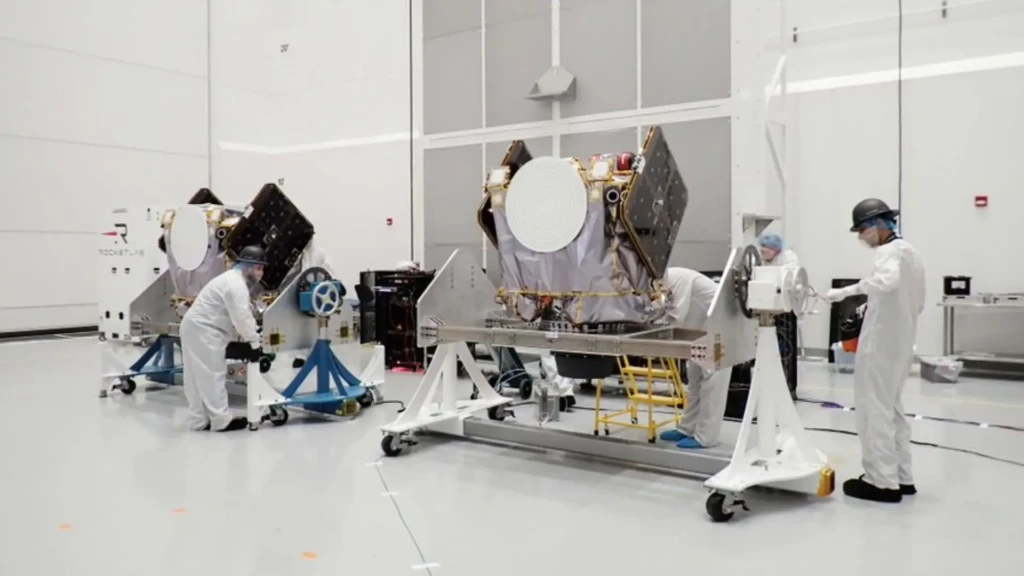
image 5 1
The twin ESCAPADE satellites. Image: Rocket Lab

ESCAPADE’s purpose

ESCAPADE’s purpose is to study the interaction between the solar wind and the red planet’s hybrid magnetosphere to understand how Mars lost its atmosphere. The popular theory is that somehow the planet’s global magnetosphere weakened between 3.5  and 4 billion years ago, which allowed the Sun and other cosmic objects to bombard it with high-energy particles. This bombardment, combined with strong solar winds, stripped gases from the atmosphere, turning Mars into a barren land with an extremely weak, localised magnetic field. 

Magnetospheres are considered essential for a planet’s habitability. According to NASA, Earth’s magnetosphere, which is generated by its molten core and is the strongest of all rocky planets in our solar system, is what makes this planet habitable because it shields us from solar wind and cosmic radiation, preventing erosion of the atmosphere.

This lack of global magnetosphere is what caused Mars to lose its atmosphere and ultimately liquid water. Using ESCAPDE’s data, scientists will study how planets lose habitability and possibly gain insight into what Earth might look like without its magnetosphere.

ALSO READ: How Gaganyaan Delays Are Setting India Back In The Space Race

ESCAPADE’s journey to Mars 

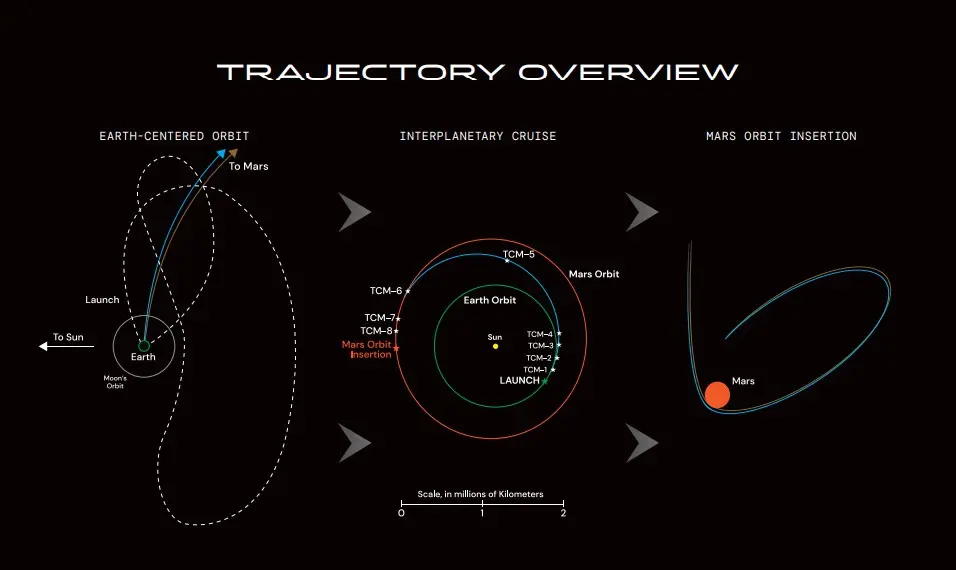
ESCAPADE will take an interesting course to get to Mars. Instead of waiting for the Earth-Mars alignment window in late 2026, the satellites fixated on Rocket Lab’s Photon platform, will first travel 1.5 million km from Earth to enter a ‘libration loitering orbit’ at the second Lagrange Point or L2 where they will stay for a year.
tj
ESCAPADE’s trajectory. Image: Rocket Lab

The L2 is a region in space where a spacecraft can remain in a fixed position with minimal fuel usage for extended periods of time. It is the same location where the James Webb Space Telescope is stationed. After leaving the L2 orbit, ESCAPADE will begin its 10-month journey and reach Mars in September 2027.

What will ESCAPADE do? 

The two satellites, named Blue and Gold, are fitted with several instruments to observe Mars from their unique dual viewpoint. Initially, both will operate in highly elliptical orbits while in close proximity, and get as close as 160 kilometres from the planet’s surface. The satellites will then take on different orbital planes to study the interaction between the solar wind and the Martian atmosphere.

According to Rocket Lab, they will collect data on the structure, composition, variability, and dynamics of Mars’ unique hybrid magnetosphere using electrostatic analysers, magnetometers, sensors and cameras with visible and infrared capabilities. The entire mission is expected to last 43 months, including 11 months of data collection by Blue and Gold.

ALSO READ: Japan’s Akatsuki Orbiter Goes Silent Forever Ending Our Venus Presence

TAGGED:Blue OriginESCAPADEMarsNASANew GlennRocket Lab
Share This Article
Facebook Pinterest Whatsapp Whatsapp LinkedIn Copy Link Print

Latest News

SpaceX Dragon spacecraft for NASA's Crew-12 mission.
SpaceX Rolls Out Dragon Spacecraft For NASA’s Crew-12 Mission While Falcon 9 Remains Grounded
Spaceflight
NASA's Artemis II SLS Rocket
NASA Delays Artemis II Moon Mission Launch To March – Here’s Why
Artemis
NASA's SLS rocket.
Astronauts In Quarantine, Rocket Powered On – How NASA Is Preparing For Artemis II
Artemis
NASA partners with Axiom Space
NASA And Axiom Space Announce 5th Private Crew Mission To International Space Station In 2027
Spaceflight

You Might Also Like

NASA Artemis 2
Artemis

NASA Stacks Artemis 2 Spacecraft On Moon Rocket; Here’s What’s Next

December 4, 2025
NASA Artemis II
Spaceflight

From NASA’s Artemis II To ISRO’s Gaganyaan, Biggest Space Events Awaiting Us In 2026

January 1, 2026
Concept of GRU Space's Moon hotel.
Spaceflight

US-Based Startup Is Offering Hotel Room Reservations On The Moon For $1 Million – Here’s The Plan

February 1, 2026
SpaceX Starlink
Spaceflight

SpaceX’s Starlink Satellite Is Breaking Apart In Orbit, Will Crash Within Weeks

December 22, 2025
© 2026, Blue Terra Journal
  • About
  • Privacy Policy
  • Terms
  • Contact
Welcome Back!

Sign in to your account

Username or Email Address
Password

Lost your password?