Blue Terra Journal

  • Home
  • Spaceflight
    SpaceflightShow More
    NASA's MAVEN orbiter
    NASA’s MAVEN Orbiter Confirmed Dead On Mars; What Did It Achieve In 11 Years?
    June 5, 2026
    Blue Origin's New Glenn rocket.
    What Blue Origin’s New Glenn Explosion Means For NASA And Its Moon Ambitions
    June 10, 2026
    Elon Musk SpaceX Starship
    Elon Musk’s SpaceX launches new Starship V3 on 12th mission, but it wasn’t flawless
    June 5, 2026
    SpaceX Starship
    SpaceX Starship’s 12th Test Flight Targeted On May 20; No Booster Catch This Time
    May 31, 2026
    SpaceX's Starship during launch rehearsal.
    SpaceX Completes Starship’s Launch Rehearsal For Flight 12 This Week; What To Expect?
    May 13, 2026
  • Astronomy
    AstronomyShow More
    The galactic bulge by Euclid telescope. Credit: European Space Agency
    This Euclid Telescope Image Of Milky Way’s Centre With 60 Million Stars May Break Your Brain
    June 27, 2026
    UFO videos shared by US government
    UFO Alert! US Government Releases New Videos Of Glowing Orbs Floating In The Sky
    June 13, 2026
    Meteor over Mayon volcano
    Watch: Flashy Green Meteor Streaks Over Erupting Volcano In The Philippines
    May 27, 2026
    Artist's impression of NASA's Psyche spacecraft.
    NASA’s Psyche Spacecraft Will Zoom Past Mars Today On Its Way To Metal-Rich Asteroid
    May 15, 2026
    Comet MAPS image
    Video: Comet MAPS destroyed after plunging into the Sun; event caught by NASA missions
    April 18, 2026
  • India
    IndiaShow More
    Shubhanshu Shukla aboard the ISS.
    ISRO Astronaut Shubhanshu Shukla Awarded Ashoka Chakra For Heroic Ax-4 Mission
    February 9, 2026
    ISRO's PSLV lifts off to space.
    ISRO’s PSLV Rocket Suffers Third Stage Failure After Successful Liftoff; Payloads Lost
    January 23, 2026
    Dhruva Space team at ISRO facility.
    India’s Dhruva Space To Launch 10 Missions, Including 1st Northeastern Satellite, On ISRO’s PSLV
    January 12, 2026
    ISRO's PSLV rocket
    ISRO To Seek Redemption With PSLV-C62 Mission Launch On January 12
    January 12, 2026
    ISRO SSLV
    ISRO’s SSLV Rocket Just Got Better After Latest Third Stage Test Fire
    December 31, 2025
  • Artemis
    ArtemisShow More
    NASA Artemis III crew
    NASA Artemis III: Meet The Astronauts Who Will Set The Stage For 2028 Moon Landing
    June 10, 2026
    Blue Origin's New Glenn rocket.
    What Blue Origin’s New Glenn Explosion Means For NASA And Its Moon Ambitions
    June 10, 2026
    NASA Artemis II mission
    Welcome Home! NASA’s Artemis II Astronauts Are Back After Historic Moon Voyage
    April 22, 2026
    NASA Artemis II iPhone image
    iPhones Reigned Supreme On NASA’s Artemis II Moon Mission
    April 10, 2026
    Artemis II NASA
    All Eyes On Scary Artemis II Reentry As NASA Moon Mission Nears Completion
    April 9, 2026
  • More
    • About
    • Privacy Policy
    • Terms
    • Contact

Blue Terra Journal

  • Home
  • Spaceflight
  • Astronomy
  • India
  • Artemis
Search
  • Pages
    • About
    • Contact
    • Privacy Policy
    • Terms

Home - Spaceflight - Celebrating Robert Goddard – The Man Who Changed Rocketry 100 Years Ago

Spaceflight

Celebrating Robert Goddard – The Man Who Changed Rocketry 100 Years Ago

All hail Robert Goddard.

Blue Terra Journal
Last updated: March 17, 2026 12:14 AM
Blue Terra Journal
Share
4 Min Read
Robert Goddard
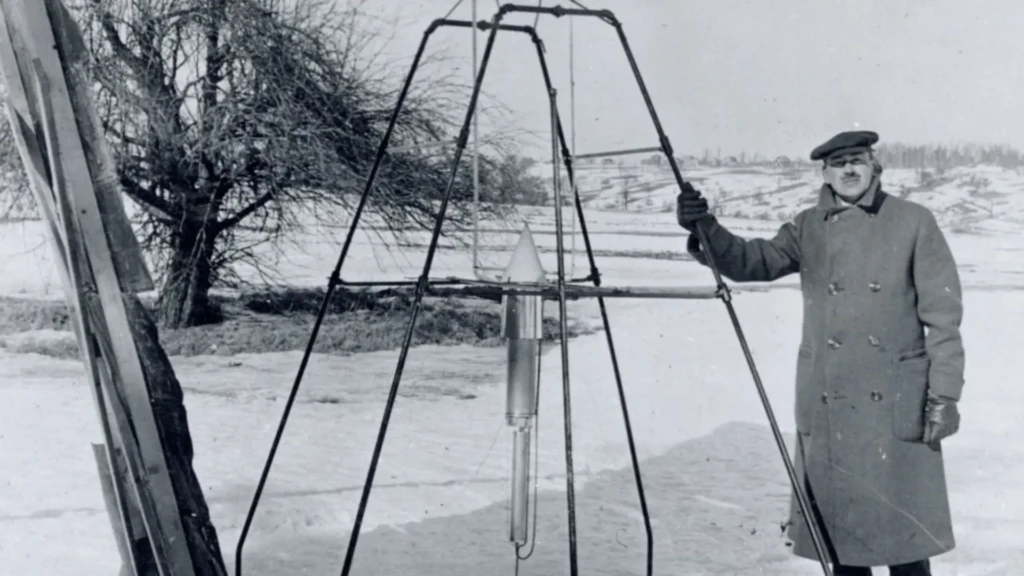
Robert Goddard posing with his liquid fuelled rocket. Image: NASA
SHARE

March 16 is momentous for rocket science as it was on this day a century ago that the first liquid-fuelled rocket took flight. Back in 1926, Robert Goddard was a relenting scientist who was laying the groundwork for the many accomplishments humans made in space.

On a cold morning of March 16, 1926, Goddard, his wife Esther and two of his colleagues visited a farm a few miles south in Auburn, Massachusetts with probably his greatest creation – Nell. It was a rocket fitted with liquid propulsion system and stood no taller than 11 feet and just 4.5 kg.

A 2.5-second rocket flight that heralded decades of discovery in space!

Today marks 100 years since the first successful test of a liquid-fueled rocket. Robert H. Goddard’s achievement would have appeared unimpressive by most measures: His rocket flew just 41 feet in the air,… pic.twitter.com/B30j2wmv7T

— NASA History Office (@NASAhistory) March 16, 2026

Working up a blend of gasoline and liquid oxygen, Goddard had prepared the rocket for takeoff after years of careful construction, testing and hard work. And take off it did.

Nell climbed 41 feet high in the air and landed in a cabbage patch 60 yards away. While the entire flight only lasted about three seconds, it opened the door for application for decades to come.

Robbert Goddard's liquid fuelled rocket
Robert Goddard’s assistant Henry Sachs (left), former student and fellow Clark University Physics professor Percy Roope (middle), and wife Esther Goddard. Image: NASA

Goddard, who was a professor at Clark University in Massachussetts, remembered the flight in his journal – “It looked almost magical as it rose, without any appreciably greater noise or flame, as if it said, ‘I’ve been here long enough; I think I’ll be going somewhere else, if you don’t mind.” Over the years, he kept refining his rockets and made liquid-propulsion the backbone of spaceflight.

Liquid engines are better than solid ones as they allow throttle control, can be restarted in space after being shutdown and deliver higher performance for high-stakes missions.

According to NASA, which has named a facility after the scientist, Goddard was subjected to ridicule by the press for suggesting this technology could one day take humanity to the Moon. “Of course [Goddard] only seems to lack the knowledge ladled out daily in high schools,” the New York Times had reportedly written at the time.

ALSO READ: A New Comet Is Set To Dive Into The Sun And May Be Visible During The Day

The newspaper couldn’t have been more wrong as Goddard’s innovation eventually allowed humanity to leave the solar system via the Voyager probes which were sent into deep space by liquid-fuelled rockets. This technology is why NASA today has rovers on Mars, why 12 men walked on the Moon and why spacecraft have been able to spy the outer solar system planets.

And it doesn’t just stop here. NASA’s Artemis II crewed Moon mission which is due to launch on April 1 will fly atop the SLS rocket and so will follow-up missions – all powered by liquid fuelled engines.

In 1959, NASA honoured this innovator by naming its first new complex the Goddard Space Flight Center and a decade later, astronaut Buzz Aldrin carried a miniature Goddard biography to the Moon on the Apollo 11 mission.

ALSO READ: Japan’s Private Rocket Kairos Meets Third Failure In A Row; Video Captures Explosion

TAGGED:Artemis IINASARobert Goddardrocket
Share This Article
Facebook Pinterest Whatsapp Whatsapp LinkedIn Copy Link Print

Latest News

The galactic bulge by Euclid telescope. Credit: European Space Agency
This Euclid Telescope Image Of Milky Way’s Centre With 60 Million Stars May Break Your Brain
Astronomy
UFO videos shared by US government
UFO Alert! US Government Releases New Videos Of Glowing Orbs Floating In The Sky
Astronomy
NASA Artemis III crew
NASA Artemis III: Meet The Astronauts Who Will Set The Stage For 2028 Moon Landing
Artemis
NASA's MAVEN orbiter
NASA’s MAVEN Orbiter Confirmed Dead On Mars; What Did It Achieve In 11 Years?
Spaceflight

You Might Also Like

Comet MAPS image
Astronomy

Video: Comet MAPS destroyed after plunging into the Sun; event caught by NASA missions

April 18, 2026
image 8
Astronomy

China’s Mars Orbiter Snapped Comet 3I/ATLAS. What Did It See?

November 30, 2025
eclipse supermoon
Astronomy

Biggest Skywatching Events Of 2026: Solar Eclipses, Meteor Showers, Supermoons And More

January 17, 2026
NASA's SLS rocket
Artemis

NASA Shifts Moon Landing To Artemis IV, Alters Artemis III To Test Mission

February 28, 2026
© 2026, Blue Terra Journal
  • About
  • Privacy Policy
  • Terms
  • Contact
Welcome Back!

Sign in to your account

Username or Email Address
Password

Lost your password?