Blue Terra Journal

  • Home
  • Spaceflight
    SpaceflightShow More
    SpaceX Dragon spacecraft for NASA's Crew-12 mission.
    SpaceX Rolls Out Dragon Spacecraft For NASA’s Crew-12 Mission While Falcon 9 Remains Grounded
    February 4, 2026
    NASA partners with Axiom Space
    NASA And Axiom Space Announce 5th Private Crew Mission To International Space Station In 2027
    February 1, 2026
    Blue Origin Mark 1 lander.
    Blue Origin Halts New Shepard Missions For At Least 2 Years To Land Humans On The Moon
    February 1, 2026
    SpaceX Starship on flight 11.
    SpaceX CEO Elon Musk Reveals When Starship Will Launch On Next Test Flight
    January 29, 2026
    NOAA's SOLAR-1 observatory.
    NOAA’s Sun Spying SOLAR-1 Observatory Reaches Its Destination 1.5 Million Km From Earth
    January 31, 2026
  • Astronomy
    AstronomyShow More
    Voyager 1 illustration
    NASA’s Voyager 1 Will Be One Light-Day Away From Earth In 2026 – What This Means
    January 26, 2026
    Auroras triggered by CMEs.
    Auroras Flood The Night Skies After Largest Solar Radiation Storm In Over 20 Years | Photos
    January 20, 2026
    Hubble discovers Cloud-9.
    Hubble Telescope Uncovers New Object ‘Cloud-9’ – A ‘Failed Galaxy’ With No Stars
    January 13, 2026
    SpaceX launches NASA telescope.
    SpaceX Launches NASA’s Exoplanet Exploring Telescope Pandora On Twilight Mission
    January 19, 2026
    Comet 3I/ATLAS by Hubble telescope
    Comet 3I/ATLAS Is Not An Alien Spacecraft – This Research Likely Confirms It
    January 10, 2026
  • India
    IndiaShow More
    Shubhanshu Shukla aboard the ISS.
    ISRO Astronaut Shubhanshu Shukla Awarded Ashoka Chakra For Heroic Ax-4 Mission
    January 25, 2026
    ISRO's PSLV lifts off to space.
    ISRO’s PSLV Rocket Suffers Third Stage Failure After Successful Liftoff; Payloads Lost
    January 23, 2026
    Dhruva Space team at ISRO facility.
    India’s Dhruva Space To Launch 10 Missions, Including 1st Northeastern Satellite, On ISRO’s PSLV
    January 12, 2026
    ISRO's PSLV rocket
    ISRO To Seek Redemption With PSLV-C62 Mission Launch On January 12
    January 12, 2026
    ISRO SSLV
    ISRO’s SSLV Rocket Just Got Better After Latest Third Stage Test Fire
    December 31, 2025
  • Artemis
    ArtemisShow More
    NASA's Artemis II SLS Rocket
    NASA Delays Artemis II Moon Mission Launch To March – Here’s Why
    February 3, 2026
    NASA's SLS rocket.
    Astronauts In Quarantine, Rocket Powered On – How NASA Is Preparing For Artemis II
    February 3, 2026
    NASA's Artemis II crew
    Inside Artemis II: How NASA Will Study Astronaut Health And Deep Space Radiation
    January 30, 2026
    NASA's SLS rocket at launch pad.
    NASA’s Artemis II To Carry Relic Of Humanity’s First Flight And More To The Moon
    January 27, 2026
    NASA's SLS rocket
    NASA’s SLS Rocket Rolls Out To The Launch Pad For Artemis II – Here’s What’s Next
    January 27, 2026
  • More
    • About
    • Privacy Policy
    • Terms
    • Contact

Blue Terra Journal

  • Home
  • Spaceflight
  • Astronomy
  • India
  • Artemis
Search
  • Pages
    • About
    • Contact
    • Privacy Policy
    • Terms

Home - Astronomy - Comet 3I/ATLAS Entered The Oort Cloud 8000 Years Ago. What Was Earth Like Then?

Astronomy

Comet 3I/ATLAS Entered The Oort Cloud 8000 Years Ago. What Was Earth Like Then?

Earth was very different when comet 3I/ATLAS began its inward journey.

Harsh Vardhan
Last updated: December 15, 2025 9:02 PM
Harsh Vardhan
Share
7 Min Read
Comet 3I/ATLAS NASA Avi Loeb
Comet 3I/ATLAS captured by Hubble telescope. Image: NASA
SHARE

Contents
  • Comet 3I/ATLAS’s journey through Oort Cloud
  • What was Earth like 8,000 years ago?

The comet 3I/ATLAS will make its closest approach to Earth on December 19, thousands of years after it started entering the solar system’s outer boundary called the Oort Cloud. Fast forward to 2025, Earth has changed dramatically due to changing climate, evolving humans and the rise of society. Now that 3I/ATLAS is flying past our planet, humans have invented agriculture, walked on the Moon, split the atom, discovered antibiotics, built the pyramids, sent spacecraft out of the solar system and achieved countless other milestones.

With this interstellar visitor approaching, here’s what Earth looked like 8,000 years ago.

Comet 3I/ATLAS’s journey through Oort Cloud

Before we dive into the condition of the Earth, you should know how comet 3I/ATLAS made it to the inner solar system. According to Harvard Physicist Avi Loeb, it began travelling through the Oort Cloud 8,000 years ago.

Comet 3I/ATLAS
Comet 3I/ATLAS captured post perihelion. Image: GeminiObs/NOIRLab/NSF/AURA/B. Bolin

The Oort Cloud, named after Dutch astronomer Jan Oort, is the most distant region in our solar system comprising of hundreds of billions of icy objects. NASA says it’s called a ‘cloud’ and not a ‘belt’ because the objects do not necessarily travel in the same direction in a shared orbital plane around the Sun. The Oort Cloud is the origin point of many long-period comets when something disturbs the orbit of one of the icy bodies.

What was Earth like 8,000 years ago?

When 3I/ATLAS began entering the Oort Cloud, homo sapiens were the only human species left on Earth which was in the Holocene epoch. According to University of California’s Museum of Paleontology, the Holocene is the era comprising the last 11,700 years of Earth’s history and it marked the end of the last major ice age (Pleistocene).

Since it was a relatively warmer period, ice sheets were melting and oceans were rising, reshaping the coastal regions. While Sahara was transitioning from lush green to an arid region, forests were expanding in other parts of the world and humans were settling in permanent villages.

Comet 3I/ATLAS
Comet 3I/ATLAS captured in X-ray by ESA’s XMM-Newton telescope. Image: ESA

According to National Geographic, agriculture took root around 12,000 years ago enabling humans to pivot from a hunter-gatherer lifestyle. Author Yuval Nova Harari writes in his book Sapiens that farming began in south-eastern Turkey, western Iran and the Levant (region comprising Israel, Jordan, Syria, Lebanon, Palestine). By this time, humans were already making use of animals like dogs, goats, sheep, pigs and cattle that were domesticated hundreds of years before farming was widespread.

Despite all this progress, large civilisations like Egyptian, Mesopotamian, Indus Valley and Chinese had not emerged yet. In the Indian subcontinent, sparse settlement had sprouted after 7000 BC, with Mehrgarh in Balochistan, Pakistan, being the most prominent example. These settlements later evolved into the Indus Valley civilisation which existed between 3300-1300 BC, per Archaeological Survey of India. 
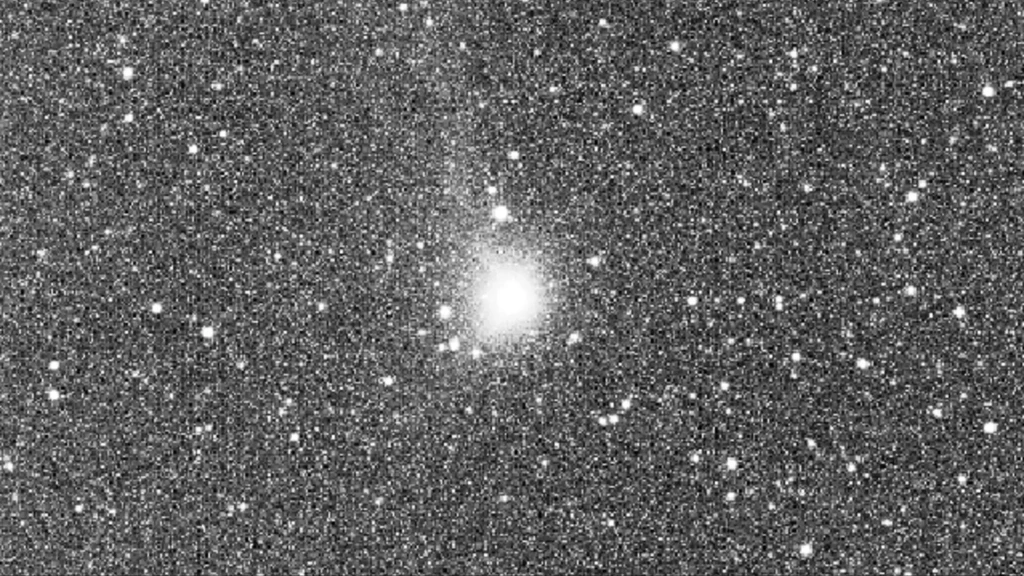
comet 3I/ATLAS Oort Cloud
Comet 3I/ATLAS photographed by ESA’s JUICE spacecraft. Image: ESA

Many agrarian societies also started emerging around 8000 years ago in China. Although, the Chinese land was inhabited as early as 780,000 years ago by Homo Erectus Pekinesis (Peking Man) along the Yellow River, followed by tribes like Hua and Xia – ancestors of ethnic majority Han Chinese – thousands of years later, writes Linda Jaivin in her book The Shortest History Of China.

ALSO READ: Interstellar Comet 3I/ATLAS Captured In Ghostly X-ray Image By ESA Telescope

After a certain point, humans reigned supreme, outclassing eight other species – Homo habilis, Homo rudolfensis, Homo erectus, Homo antecessor, Homo heidelbergensis, Homo floresiensis (‘the hobbit’), Homo neanderthalensis (Neanderthals) and Homo naledi. There were also the Denisovans, our mysterious cousins who are said to have lived with Homo sapiens and interbred. 

Archaeologists and geneticists have also found clear evidence of interbreeding between Homo sapiens and other species which improved the former’s chances of survival. According to a 2020 study published in Cell, people with African ancestry have close to 0.5 percent Neanderthal DNA in their genome whereas European and Asian genomes have 1.7 percent and 1.8 percent, respectively. Most of the mainland Wolly mammoths were already wiped out but a few survived on Wrangel Island in the Arctic until 4,000 years ago, per National History Museum. Giant sloths are also reported to have existed in the Caribbean and South America until 6,000 years ago along with the flightless bird Moa in New Zealand, which went extinct as recently as in the 13th century.

As 3I/ATLAS finally arrives near Earth this month, we have long moved on from stone tools to exploring space. It is now travelling on its hyperbolic outbound trajectory at a higher speed thanks to a slingshot from the Sun. The comet will leave the inner solar system within a few years but it will still take thousands of years to cross the Oort Cloud and reach interstellar space. By the time that happens, Earth may be unrecognisable and humans may colonise other planets, or perhaps not survive at all.

ALSO READ: What Are Interstellar Comets And What Makes Them Special?
TAGGED:Comet 3I/ATLASNASAOort CloudSolar System
Share This Article
Facebook Pinterest Whatsapp Whatsapp LinkedIn Copy Link Print

Latest News

SpaceX Dragon spacecraft for NASA's Crew-12 mission.
SpaceX Rolls Out Dragon Spacecraft For NASA’s Crew-12 Mission While Falcon 9 Remains Grounded
Spaceflight
NASA's Artemis II SLS Rocket
NASA Delays Artemis II Moon Mission Launch To March – Here’s Why
Artemis
NASA's SLS rocket.
Astronauts In Quarantine, Rocket Powered On – How NASA Is Preparing For Artemis II
Artemis
NASA partners with Axiom Space
NASA And Axiom Space Announce 5th Private Crew Mission To International Space Station In 2027
Spaceflight

You Might Also Like

NASA CHAPEA Mars
Spaceflight

Mars On Earth: Why NASA Is Training Humans To Live Like Martians

November 19, 2025
Perseverance rover NASA
Astronomy

How Long Could The Perseverance Rover Last On Mars? NASA Answers

December 30, 2025
NASA MS-27
Spaceflight

NASA Astronaut Returns With Russian Cosmonauts After Spending 245 Days In Space | Photos

December 13, 2025
Solar Storm
Astronomy

Strongest Solar Eruption Of 2025 Lights Up Skies With Auroras, Triggers Blackouts

November 12, 2025
© 2026, Blue Terra Journal
  • About
  • Privacy Policy
  • Terms
  • Contact
Welcome Back!

Sign in to your account

Username or Email Address
Password

Lost your password?