Black holes are arguably the most feared objects in astronomy, probably because of their unfathomable size and the fact that nobody knows what hides beyond the event horizon – the outer boundary and a point of no return. What scientists do know is that these objects are millions even billions of times more massive the Sun thus have enormous gravity and any person falling toward it would experience a phenomenon called ‘sphagettification‘ – get stretched like a sphagetti due to the intense gravitational pull. Extremely painful as you can imagine.
Sphagettification was predicted by Albert Einstein’s general relativity and popularised by Stephen Hawking. It happens because the tidal forces on an object nearer the black hole is much stronger than that on the other end.
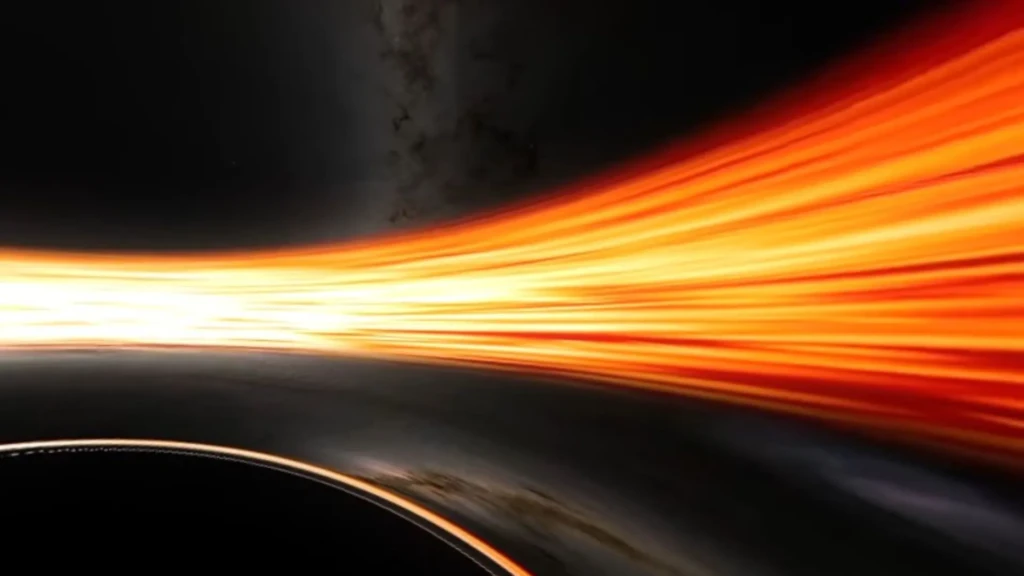
But what would that unfortunate person experience while moving toward the event horizon. Let’s forget the painful sphagettification as well, what would it look like plunging into a black hole?
A simulation (above) created by a NASA supercomputer has the answer.
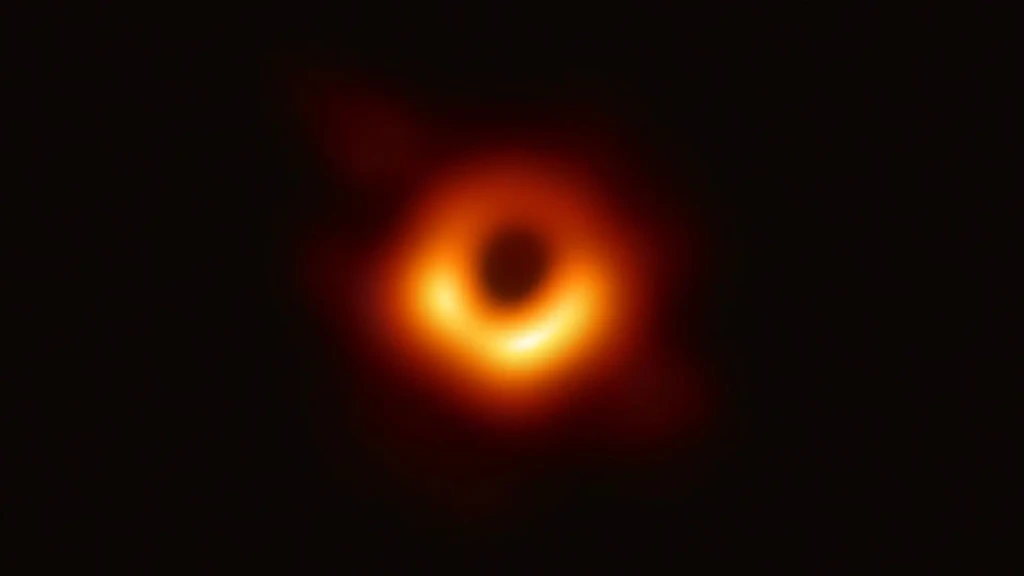
Created by Jeremy Schnittman, an astrophysicist at NASA’s Goddard Space Flight Center, this simulation features a supermassive black hole with 4.3 million times the mass of our Sun, equivalent to the one located at the center of our Milky Way galaxy.
“Stellar-mass black holes, which contain up to about 30 solar masses, possess much smaller event horizons and stronger tidal forces, which can rip apart approaching objects before they get to the horizon,” Schnittman said.
In this simulation, the black hole’s event horizon spans about 25 million kilometers, or about 17% of the distance from Earth to the Sun. The swirling cloud of hot, glowing gas you see around the dark pit, called an accretion disk surrounds it.
Schnittman explains that the camera takes three hours to fall to the event horizon and then reaches a one-dimensional point called a singularity, where the laws of physics as we know them cease to operate.
ALSO READ: Comet C/2026 A1 MAPS: What Are ‘Sun-Grazer’ Comets And Why Are They Special?
ALSO READ: Universe In A Bottle: How Lab Made Space Dust Will Shape Our Understanding Of The Cosmos