Blue Terra Journal

  • Home
  • Spaceflight
    SpaceflightShow More
    NASA's SR-1 Freedom spacecraft.
    What Is NASA’s SR-1 Freedom Mission? The First Nuclear Reactor In Space Explained
    March 27, 2026
    Artist's impression of a NASA Moon base.
    NASA Moon Base: How The US Will Spend $20 Billion On This Ambitious Project
    March 25, 2026
    Russia's Soyuz rocket ascending to space.
    Russia’s Progress Spacecraft Suffers Mystery Glitch On Its Way To ISS; What Happened?
    March 23, 2026
    Robert Goddard
    Celebrating Robert Goddard – The Man Who Changed Rocketry 100 Years Ago
    March 17, 2026
    International Space Station gets extension to beat China
    Watch Out China! US Proposes Extending International Space Station Lifespan To 2032
    March 10, 2026
  • Astronomy
    AstronomyShow More
    Meteor spotted over Houston.
    Video Captures 1-Ton Meteor Exploding Over Houston Skies, NASA Releases Statement
    March 22, 2026
    NASA black hole simulation
    Fall Into A Black Hole With This Incredibly Scary Simulation Made By NASA
    March 18, 2026
    Comet C/2026 A1 MAPS
    Comet C/2026 A1 MAPS: What Are ‘Sun-Grazer’ Comets And Why Are They Special?
    March 12, 2026
    Moon is safe from asteroid 2024 YR4.
    The Moon Is Safe! James Webb Space Telescope Rules Out Asteroid 2024 YR4’s Collision
    March 6, 2026
    NASA Moon orbiter
    NASA Prepares To Save Its Orbiter During Total Solar Eclipse On The Moon
    March 3, 2026
  • India
    IndiaShow More
    Shubhanshu Shukla aboard the ISS.
    ISRO Astronaut Shubhanshu Shukla Awarded Ashoka Chakra For Heroic Ax-4 Mission
    February 9, 2026
    ISRO's PSLV lifts off to space.
    ISRO’s PSLV Rocket Suffers Third Stage Failure After Successful Liftoff; Payloads Lost
    January 23, 2026
    Dhruva Space team at ISRO facility.
    India’s Dhruva Space To Launch 10 Missions, Including 1st Northeastern Satellite, On ISRO’s PSLV
    January 12, 2026
    ISRO's PSLV rocket
    ISRO To Seek Redemption With PSLV-C62 Mission Launch On January 12
    January 12, 2026
    ISRO SSLV
    ISRO’s SSLV Rocket Just Got Better After Latest Third Stage Test Fire
    December 31, 2025
  • Artemis
    ArtemisShow More
    NASA Artemis II crew
    NASA’s Christina Koch Turns ‘Space Plumber’ To Fix $30 Million Toilet On Artemis II Mission
    April 3, 2026
    NASA Orion spacecraft
    NASA’s Artemis II Astronauts Are Moon-Bound After Successful Trans-Lunar Injection Burn
    April 3, 2026
    NASA Artemis II lifts off.
    Artemis II Lifts Off! NASA Launches 4 Astronauts To The Moon After Over 50 Years
    April 2, 2026
    NASA's Artemis II astronauts
    NASA Artemis II Launch Live: Watch Humanity Return To The Moon On April 2
    April 2, 2026
    NASA Apollo 8 image
    NASA Artemis II: Why This Moon Mission Is Our Generation’s Apollo 8
    March 30, 2026
  • More
    • About
    • Privacy Policy
    • Terms
    • Contact

Blue Terra Journal

  • Home
  • Spaceflight
  • Astronomy
  • India
  • Artemis
Search
  • Pages
    • About
    • Contact
    • Privacy Policy
    • Terms

Home - Spaceflight - NASA’s Mars-Bound ESCAPADE Spacecraft Prepare For First Engine Burns

Spaceflight

NASA’s Mars-Bound ESCAPADE Spacecraft Prepare For First Engine Burns

Big days ahead!

Harsh Vardhan
Last updated: December 2, 2025 11:43 AM
Harsh Vardhan
Share
6 Min Read
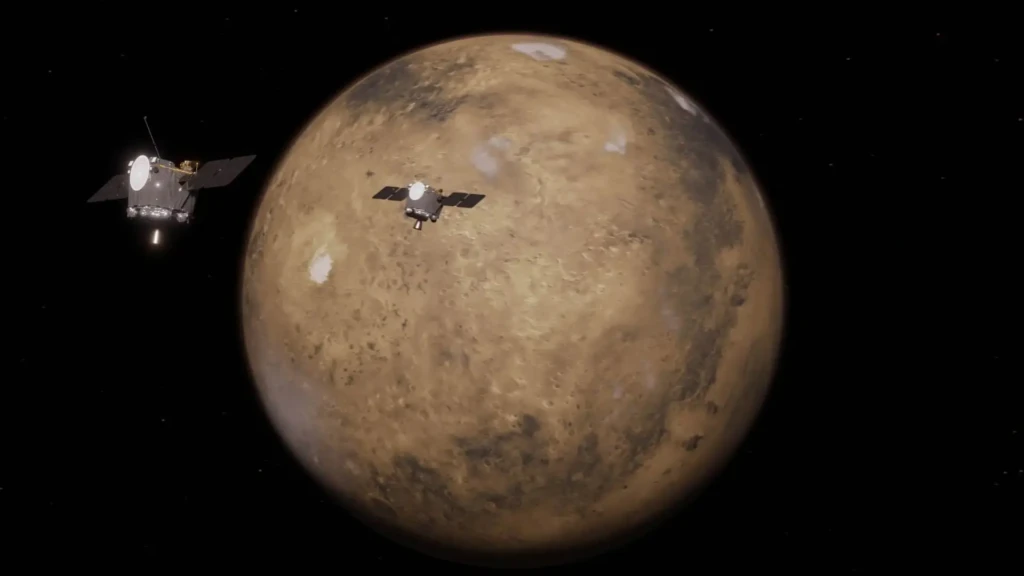
NASA ESCAPADE mission
Artist's impression of ESCAPADE orbiters around Mars. Image: NASA
SHARE

Contents
  • How do engine burns work?
  • ESCAPADE’s detour to Lagrange point

NASA’s ESCAPADE mission has a big day ahead. The two spacecraft Blue and Gold, built by Rocket Lab, will execute their first engine burns starting tomorrow (December 3) on their way to Mars. This ‘Trajectory Correction Maneuver’ will be the first of three major ones to be carried out by Rocket Lab, before they hand over the controls to University of California, Berkeley’s Space Sciences Lab, NASA’s partner in this mission.

Short for Escape and Plasma Acceleration and Dynamics Explorers, ESCAPADE launched on November 14 as the world’s first twin-spacecraft mission.

How do engine burns work?

The engine burn procedures are executed after mission teams complete a spacecraft’s commissioning – a process that gets all subsystems up and running. During this process, the spacecraft’s main engine or smaller, secondary thrusters are fired to correct its course in space. Big maneuvers require main engines to fire for a set duration of time to accelerate and slow down a spacecraft or change its trajectory.

ESCAPADE involves two orbiters named Blue and Gold, and the December 3 burn is likely to use the main engine for short-duration firing. According to Rocket Lab, Blue will ignite its engine for 15 seconds, using 2 kg of propellant to change the velocity by 11.5 meters per second.

So you’re in space and on the way to Mars, what next? Time to fire up the engines 🛰️🛰️

Now that Blue and Gold are commissioned, our spacecraft operators are turning their attention to propulsion systems in preparation for the first engine burns to set us on a precise course to… pic.twitter.com/jFr9VkKjtL

— Rocket Lab (@RocketLab) December 1, 2025

“This is our initial demonstration maneuver to verify all systems perform as expected. Our fault management limits will be at their tightest to be conservative, based on margined modelling of how we expect the systems to perform,” Rocket Lab said in a statement. The second line above means the team is keeping safety thresholds very tight because this is the first burn and they only have model-based predictions of how the engines will perform in vacuum. If there’s even the slightest anomaly, the burn will stop. 

Gold’s engines will be fired on December 8 or 9 to achieve the same result as Blue. One of the orbiters recently sent the first images from space. 
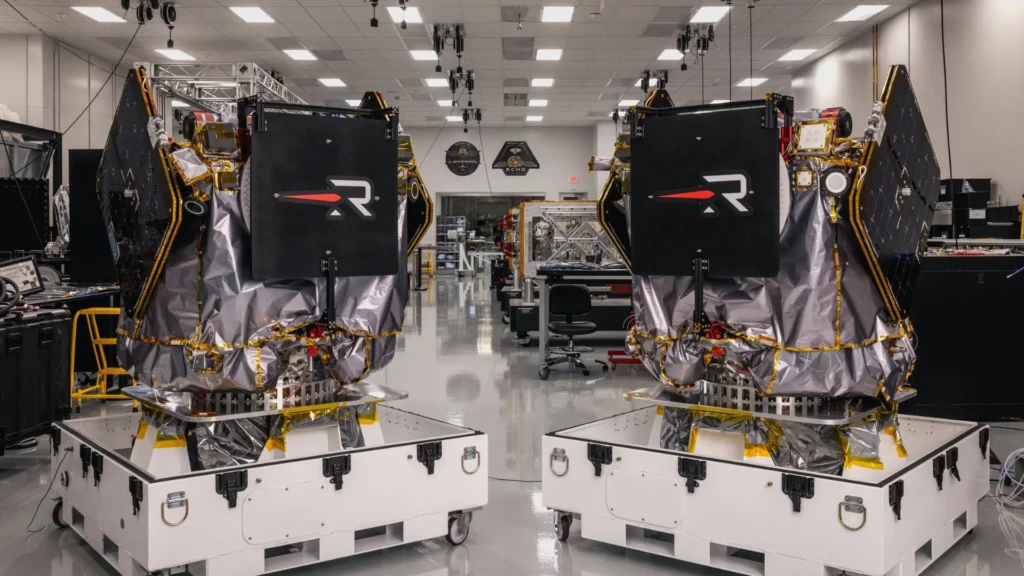
NASA ESCAPADE satellites.
NASA’s ESCAPADE satellites. Image: Rocket Lab

The second TCM of Blue and Gold is expected on December 11 and December 16, respectively. It will be a longer burn of 257 seconds to deliver 200 meters per second of delta V (change in velocity). Rocket Lab says this burn will reveal how strong the engines’ thrust is, how efficiently the fuel burns and how much propellant remains. If efficiency is high, Blue and Gold will be left with more propellant when they reach Mars. This will enable them to stay in the Martian orbit longer (because they could overcome orbital decay using engine burns) and help scientists collect more data.

The third burn is tentatively planned as a final clean-up maneuver, although it may not be needed. After this, Rocket Lab will hand over the mission to UC Berkley. A total of 37 burns are planned for ESCAPADE – 29 on the way to Mars and eight to adjust orbits around the planet.

ESCAPADE’s detour to Lagrange point

The ESCAPADE satellites are not directly going to Mars. They’re taking a detour to the second Earth-Sun Lagrange point where they’ll stay until next November. This will give mission teams time to fine-tune the spacecraft components until Earth and Mars get close in late 2026. Blue and Gold will then once again ignite their engines for a Trans-Mars Injection burn in November 2026 and kickstart their 10 month cruise phase to the red planet.

In September 2027, both orbiters will begin the Mars Orbit Insertion maneuvers to enter the Martian orbit. They will eventually occupy different orbits around Mars to study the interaction of the solar wind with the planet’s magnetosphere for a planned duration of 11 months. The objective is to find out how Mars lost its atmosphere and eventually its oceans, and whether Earth might share the same fate.

ALSO READ: NASA’s ESCAPADE Mission Is Off To Mars. What Happens Next?

ALSO READ: NASA’s ESCAPADE Mars Spacecraft Receives ‘First Light’ In Space; Images Released

TAGGED:ESCAPADEMarsNASARocket Lab
Share This Article
Facebook Pinterest Whatsapp Whatsapp LinkedIn Copy Link Print

Latest News

NASA Artemis II crew
NASA’s Christina Koch Turns ‘Space Plumber’ To Fix $30 Million Toilet On Artemis II Mission
Artemis
NASA Orion spacecraft
NASA’s Artemis II Astronauts Are Moon-Bound After Successful Trans-Lunar Injection Burn
Artemis
NASA Artemis II lifts off.
Artemis II Lifts Off! NASA Launches 4 Astronauts To The Moon After Over 50 Years
Artemis
NASA's Artemis II astronauts
NASA Artemis II Launch Live: Watch Humanity Return To The Moon On April 2
Artemis

You Might Also Like

NASA Boeing Starliner
Spaceflight

NASA Switches Boeing Starliner’s 2026 Crew Flight To Cargo-Only Mission

November 25, 2025
NASA milky way.
Astronomy

The Fermi Paradox: Why We’ve Never Seen Aliens

November 25, 2025
Blue Origin NS-37 mission
Spaceflight

Blue Origin’s New Shepard Director Replaces NS-38 Mission Crew Member After He Falls Sick

January 21, 2026
Jared Isaacman
Spaceflight

Jared Isaacman Is Back As Trump Renominates Him For NASA Head Post

November 9, 2025
© 2026, Blue Terra Journal
  • About
  • Privacy Policy
  • Terms
  • Contact
Welcome Back!

Sign in to your account

Username or Email Address
Password

Lost your password?