The James Webb Space Telescope has discovered the strongest evidence of an atmosphere around a rocky exoplanet, says NASA. The planet TOI-561 b, which is an ultra-hot super-Earth, also has an unusually low density which is puzzling scientists. The discovery has challenged the present understanding of such worlds that lose their atmospheres when they’re too close to their star.
Webb detected the strongest evidence yet for an atmosphere on a rocky planet outside of our solar system! Findings suggest ultra-hot super-Earth TOI-561 b is surrounded by a thick blanket of gases above a global magma ocean. https://t.co/d6g3z4pnUr pic.twitter.com/2VdiyU8LMs
— NASA Webb Telescope (@NASAWebb) December 11, 2025
In a study published in the Astrophysical Journal Letters, researchers noted that TOI-561 b is orbiting its star from a distance of just 1.6 million km and is tidally locked. Its one side always faces the star, causing it to exceed the melting temperature of a typical rock. With a radius 1.4 times greater than Earth’s, this planet completes one orbit in just 11 hours. Thanks to Webb, scientists now believe that TOI-561b, located 280 light-years away, is surrounded by a thick blanket of gases above a magma ocean.
What James Webb Space Telescope found
Johanna Teske of the Carnegie Science Earth and Planets Laboratory, and lead author of the study, explained that its anomalously low density is what really sets this planet apart. “It’s not a super-puff, but it is less dense than you would expect if it had an Earth-like composition,” Teske said in a statement.
The study team says its low density could be a result of TOI-561b having a relatively small iron core and mantle rock less dense than Earth’s. Besides, this planet orbits an iron-poor star which formed in the Milky Way’s ‘thick disk’ region, which may have a very different chemical environment. Interestingly, this star is estimated to be twice as old as the Sun.
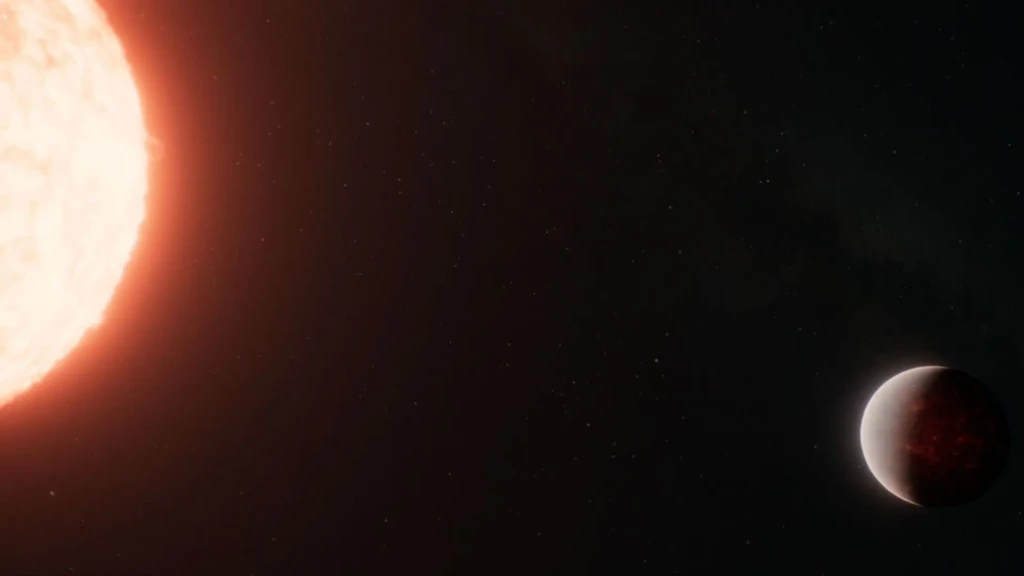
Apart from the density, scientists are surprised about the planet enveloped in an atmosphere despite enduring intense stellar radiation. To confirm if it indeed is blanketed with gases, Teske’s team used Webb’s NIRSpec (Near-Infrared Spectrograph) to determine its temperature. They found that in spite of TOI-561b’s closeness to the host star, its dayside temperature is around 1,800 degrees Celsius – far cooler than expected. The temperature should have been about 2,700 degrees Celsius if it really lacked an atmosphere.
“We really need a thick volatile-rich atmosphere to explain all the observations,” said Anjali Piette, coauthor from the UK’s University of Birmingham.
ALSO READ: NASA’s Webb Telescope Discovers 13 Billion Years Old Supernova; Breaks Own Record
One reason for the cooler temperature, researchers deduced, could be the exoplanet circulating heat onto the nightside, and strong winds cooling the dayside. Moreover, gases like water vapour may be absorbing some wavelengths of infrared light from the surface, before they penetrate the atmosphere and reach the telescope, making the planet look colder. If Webb detects less infrared light, a planet will appear cooler than it really is.
“We think there is an equilibrium between the magma ocean and the atmosphere. At the same time that gases are coming out of the planet to feed the atmosphere, the magma ocean is sucking them back into the interior,” said co-author Tim Lichtenberg. “This planet must be much, much more volatile-rich than Earth to explain the observations. It’s really like a wet lava ball.”
The observations were made under Webb’s General Observers Program 3860 wherein scientists observed the exoplanet complete nearly four orbits of its star over 37 hours. They are now looking to answer how a planet so close to a star can have such a substantial atmosphere.
ALSO READ: NASA’s Incredible Nancy Grace Roman Telescope Is Assembled – Here’s What It Will Do