Blue Terra Journal

  • Home
  • Spaceflight
    SpaceflightShow More
    SpaceX Starship
    SpaceX Starship’s 12th Test Flight Targeted On May 20; No Booster Catch This Time
    May 13, 2026
    SpaceX's Starship during launch rehearsal.
    SpaceX Completes Starship’s Launch Rehearsal For Flight 12 This Week; What To Expect?
    May 13, 2026
    China US rivalry reach new heights.
    ‘Rival’ China Is Unintentionally The Biggest Motivator For NASA’s Moon Ambitions
    April 28, 2026
    NASA Voyager 1 illustration
    NASA Shuts Down Another Voyager 1 Instrument; How Long Can This Spacecraft Last?
    April 22, 2026
    NASA's SR-1 Freedom spacecraft.
    What Is NASA’s SR-1 Freedom Mission? The First Nuclear Reactor In Space Explained
    March 27, 2026
  • Astronomy
    AstronomyShow More
    Artist's impression of NASA's Psyche spacecraft.
    NASA’s Psyche Spacecraft Will Zoom Past Mars Today On Its Way To Metal-Rich Asteroid
    May 15, 2026
    Comet MAPS image
    Video: Comet MAPS destroyed after plunging into the Sun; event caught by NASA missions
    April 18, 2026
    Apophis asteroid flyby
    ‘God Of Chaos’: Apophis Asteroid Will Fly Dangerously Close To Earth Exactly 5 Years From Now
    April 14, 2026
    Meteor spotted over Houston.
    Video Captures 1-Ton Meteor Exploding Over Houston Skies, NASA Releases Statement
    March 22, 2026
    NASA black hole simulation
    Fall Into A Black Hole With This Incredibly Scary Simulation Made By NASA
    March 18, 2026
  • India
    IndiaShow More
    Shubhanshu Shukla aboard the ISS.
    ISRO Astronaut Shubhanshu Shukla Awarded Ashoka Chakra For Heroic Ax-4 Mission
    February 9, 2026
    ISRO's PSLV lifts off to space.
    ISRO’s PSLV Rocket Suffers Third Stage Failure After Successful Liftoff; Payloads Lost
    January 23, 2026
    Dhruva Space team at ISRO facility.
    India’s Dhruva Space To Launch 10 Missions, Including 1st Northeastern Satellite, On ISRO’s PSLV
    January 12, 2026
    ISRO's PSLV rocket
    ISRO To Seek Redemption With PSLV-C62 Mission Launch On January 12
    January 12, 2026
    ISRO SSLV
    ISRO’s SSLV Rocket Just Got Better After Latest Third Stage Test Fire
    December 31, 2025
  • Artemis
    ArtemisShow More
    NASA Artemis II mission
    Welcome Home! NASA’s Artemis II Astronauts Are Back After Historic Moon Voyage
    April 22, 2026
    NASA Artemis II iPhone image
    iPhones Reigned Supreme On NASA’s Artemis II Moon Mission
    April 10, 2026
    Artemis II NASA
    All Eyes On Scary Artemis II Reentry As NASA Moon Mission Nears Completion
    April 9, 2026
    NASA Artemis II
    NASA Artemis II Crew Names Moon Crater ‘Carroll’ After Commander Reid Wiseman’s Late Wife
    April 7, 2026
    NASA Artemis II
    Watch: NASA Artemis II Astronauts Begin Flyby Of Moon’s Far Side For The First Time Ever
    April 9, 2026
  • More
    • About
    • Privacy Policy
    • Terms
    • Contact

Blue Terra Journal

  • Home
  • Spaceflight
  • Astronomy
  • India
  • Artemis
Search
  • Pages
    • About
    • Contact
    • Privacy Policy
    • Terms

Home - Astronomy - NASA’s Incredible Nancy Grace Roman Telescope Is Assembled – Here’s What It Will Do

Astronomy

NASA’s Incredible Nancy Grace Roman Telescope Is Assembled – Here’s What It Will Do

The telescope is on track for a 2026 launch.

Harsh Vardhan
Last updated: December 6, 2025 2:16 PM
Harsh Vardhan
Share
5 Min Read
NASA Artemis II
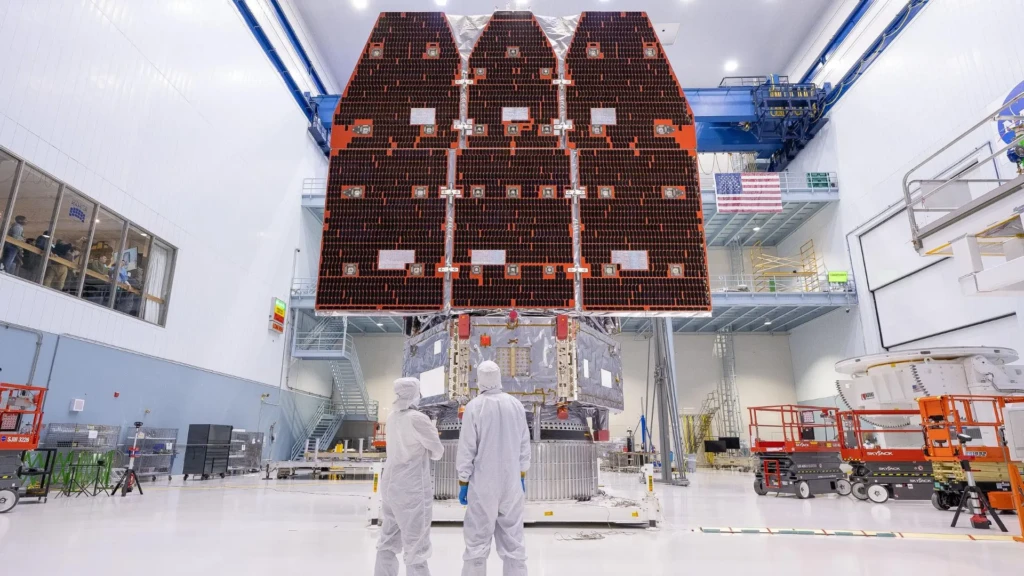
The Nancy Grace Roman Telescope at Goddard Space Flight Center. Image: NASA
SHARE

NASA has completed the construction of the Nancy Grace Roman Telescope that will soon change how we view the universe. The agency announced on Thursday that the telescope’s assembly was complete at Goddard Space Flight Center in Maryland, marking a major step toward key phases of testing. NASA says the telescope will be moved to its launch site at Kennedy Space Center after tests, and it’s on track to launch as early as fall 2026.

Rome wasn’t built in a day, but Roman just came together in one! The Nancy Grace Roman Space Telescope has finished final integration at the @NASAGoddard Space Flight Center.

Learn more about this historic milestone: https://t.co/KnOqjxoWEX

1/2 pic.twitter.com/DXGzJBauJ6

— Nancy Grace Roman Space Telescope (@NASARoman) December 4, 2025

The Roman telescope, named after NASA’s first chief astronomer, measures over 42 feet (12.7 meters) long and carries a primary mirror 2.4-meters in diameter. Despite weighing 80% lighter than Hubble telescope’s primary mirror, Roman’s will offer a field of view 100 times larger.

Here’s all you need to know about this game-changing observatory.

NASA’s powerful new eye on the universe

The Roman telescope is designed to answer fundamental questions about the dark universe, how common planetary systems like ours are and how many planets have potential to harbour life. The Roman telescope has a five-year primary mission and 75% of its operation will focus on conducting three surveys.
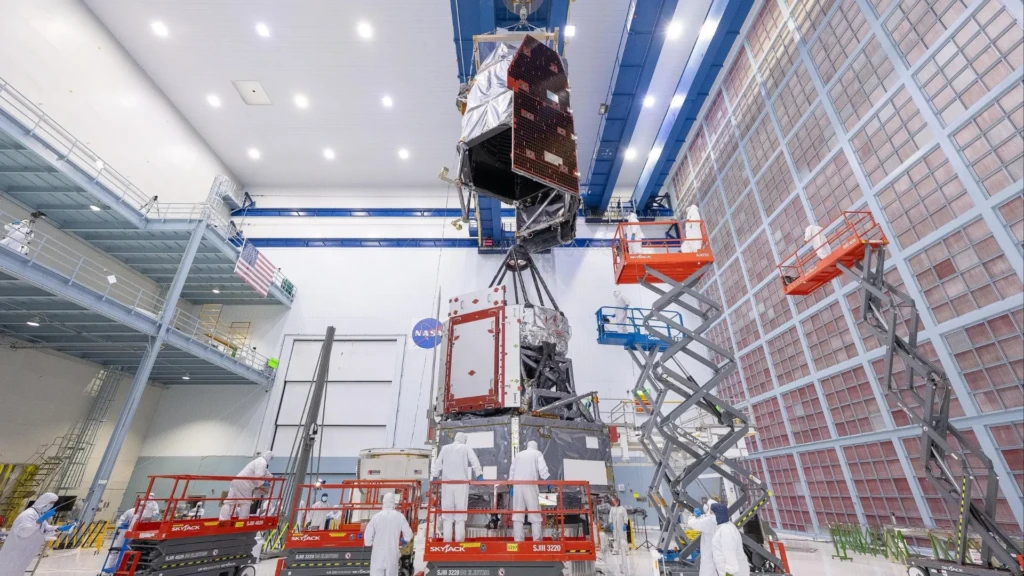
NASA Nancy Grace Roman Telescope
NASA’s Nancy Roman Grace Telescope at Goddard Space Flight Center. Image: NASA

First is the High-Latitude Wide-Area Survey to trace the evolution of the universe in order to probe dark matter. Dark matter and dark energy, which together form the dark universe, is believed to make up 95% of the known universe but they’re detectable only by their effects on observable matter. NASA says the Roman telescope will combine the powers of imaging and spectroscopy to discover more than a billion galaxies across a vast swath of space. It will observe a patch of the sky bigger than the apparent size of a full Moon.

Scientists expect that Roman will discover 100 billion stars, 80,000 supernovae (exploding stars), hundreds of forming planetary systems and more than 1,00,000 exoplanets. Roman is carrying two main instruments – the Wide Field Instrument and the Coronagraph Instrument. The Wide Field Instrument’s 288-megapixel camera will unveil the cosmos all the way from our solar system to near the edge of the observable universe, whereas the Coronagraph will carry out direct imaging of exoplanets by blocking the glare of stars they orbit.

The second called the High-Latitude Time-Domain Survey will observe the same region multiple times to notice changes in celestial objects over time. This survey will help study dark energy which scientists believe is accelerating the universe’s expansion.

The third survey is the Galactic Bulge Time-Domain Survey for the Milky Way. Roman will track hundreds of millions of stars in the heart of our galaxy in search of microlensing event – a phenomenon where the gravity of a foreground star briefly bends and magnifies the light of a background star. This process could reveal large exoplanets with orbits bigger than Earth’s around the Sun. Microlensing may also unveil rogue planets that are not bound to a star along with isolated black holes.

“With Roman now standing as a complete observatory, which keeps the mission on track for a potentially early launch, we are a major step closer to understanding the universe as never before,” Nicky Fox, associate administrator of NASA’s Science Mission Directorate, said in a statement.  The Roman telescope will be installed 1.5 million kilometers away from Earth at the second Earth-Sun Lagrange Point. It is the same spot where the James Webb Space Telescope is parked. Both telescopes are designed to gather infrared light, allowing them to peer deep into space, even through thick clouds of dust and gas.

ALSO READ: Alaknanda: Why This Ancient Spiral Galaxy’s Discovery By Indian Scientists Matters

ALSO READ: Asteroid Bennu Has More Than Just Ingredients Of Life – What NASA Found

TAGGED:Dark matterexoplanetsJames Webb Space TelescopeNancy Roman Grace TelescopeNASA
Share This Article
Facebook Pinterest Whatsapp Whatsapp LinkedIn Copy Link Print

Latest News

Artist's impression of NASA's Psyche spacecraft.
NASA’s Psyche Spacecraft Will Zoom Past Mars Today On Its Way To Metal-Rich Asteroid
Astronomy
SpaceX Starship
SpaceX Starship’s 12th Test Flight Targeted On May 20; No Booster Catch This Time
Spaceflight
SpaceX's Starship during launch rehearsal.
SpaceX Completes Starship’s Launch Rehearsal For Flight 12 This Week; What To Expect?
Spaceflight
China US rivalry reach new heights.
‘Rival’ China Is Unintentionally The Biggest Motivator For NASA’s Moon Ambitions
Spaceflight

You Might Also Like

NASA's SLS rocket at the Vehicle Assembly Building.
Artemis

Watch NASA’s SLS Rocket Roll Out To Launch Pad For Artemis II Moon Mission Today

January 19, 2026
University of Sydney space dust
Astronomy

Universe In A Bottle: How Lab Made Space Dust Will Shape Our Understanding Of The Cosmos

February 24, 2026
Robert Goddard
Spaceflight

Celebrating Robert Goddard – The Man Who Changed Rocketry 100 Years Ago

March 17, 2026
NASA's SLS rocket.
Artemis

Astronauts In Quarantine, Rocket Powered On – How NASA Is Preparing For Artemis II

February 3, 2026
© 2026, Blue Terra Journal
  • About
  • Privacy Policy
  • Terms
  • Contact
Welcome Back!

Sign in to your account

Username or Email Address
Password

Lost your password?