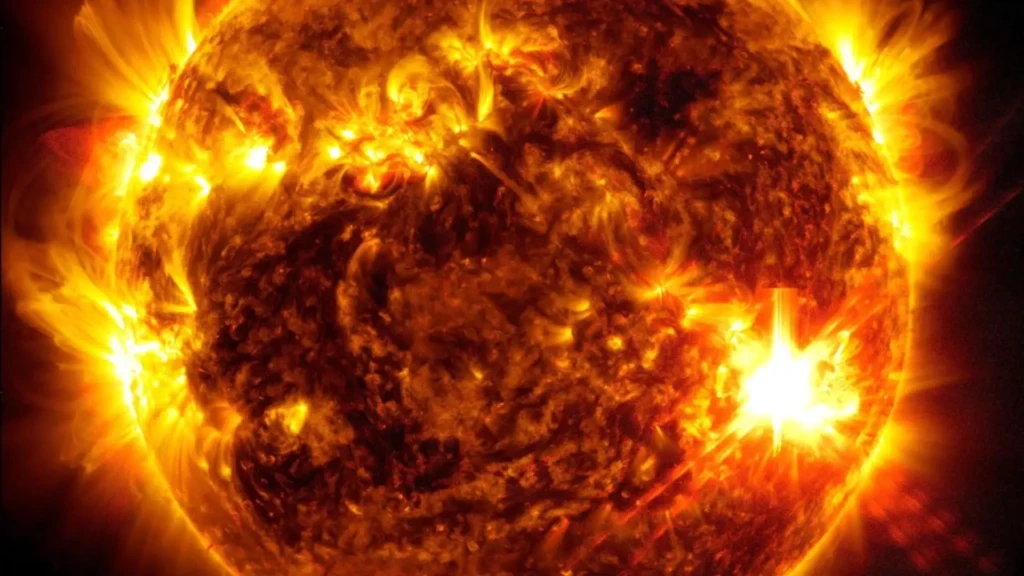
The year 2024 brought the strongest solar storm in more than two decades, effects of which were felt as far as Mars. Earth also had to bear the brunt of what has been named the Gannon’s storm that caused minor GPS disruptions, temporary radio blackouts and intense auroras far beyond the polar regions.
A team of Indian scientists, using ISRO‘s Aditya-L1 space observatory and six NASA space telescopes, have explained why the Gannon’s storm between May 10-14 last year was so extreme.
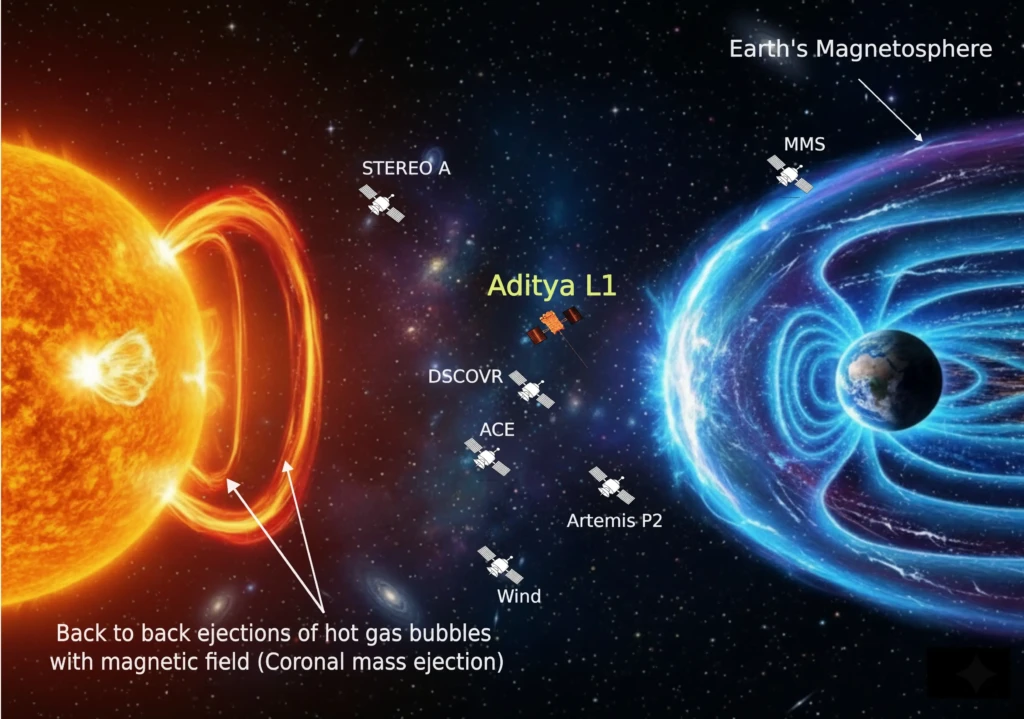
In the study published in the Astrophysical Journal Letters in September, researchers explained that there was a collision of two Coronal Mass Ejections (CMEs). The collision made the storm’s impact much stronger than expected and many satellites experienced charged solar particles hitting them at increased speed.
ISRO’s Aditya-L1 solves 2024 storm mystery
The coronal mass ejections occur when the Sun’s outer atmosphere layer – the corona – releases huge clouds of electrically charged particles called plasma. Weighing billions of tons, these clouds are sometimes pushed by solar winds and when they interact with the Earth’s magnetosphere, they cause a disturbance. This disturbance results in a geomagnetic storm. Fast CMEs can reach Earth in 15-18 hours whereas slower ones take 2-3 days.
Scientists explain that CMEs usually carry twisted “magnetic ropes” which interact with the magnetosphere when they extend to Earth. Some CMEs that are more explosive have highly twisted magnetic field structures and they get too stressed. Sometimes, these structures snap, like a rope breaking, and reconnect into a less tense configuration. This process of snapping and reconnecting is called magnetic reconnection.
But last year, two CMEs collided in space and they squeezed the magnetic field structures, causing one of the ‘ropes’ to snap and rejoin in new ways. In a statement, ISRO said that the area where the magnetic ropes were breaking and reconnecting was about 1.3 million kilometres across. The reconnection is said to have reversed the magnetic direction inside the storm, making it stronger than expected.
Apart from Aditya-L1, researchers used data from six NASA missions including Wind, ACE, THEMIS-C, STEREO-A, Magnetospheric Multiscale (MMS), and Deep Space Climate Observatory (DSCOVR).
“For the first time, researchers could study the same extreme solar storm from multiple vantage points in space. Thanks to precise magnetic field measurements from India’s Aditya-L1 mission, scientists were able to map this reconnection region,” ISRO said. “It was the first time such a giant magnetic breakup and rejoining had ever been seen inside a CME.”
ALSO READ: Earth Gets Another Geomagnetic Storm Warning After Strong Solar Eruption | Video
ALSO READ: How Do Auroras Form? Science Behind This Colourful Cosmic Phenomenon