Blue Terra Journal

  • Home
  • Spaceflight
    SpaceflightShow More
    NASA's SR-1 Freedom spacecraft.
    What Is NASA’s SR-1 Freedom Mission? The First Nuclear Reactor In Space Explained
    March 27, 2026
    Artist's impression of a NASA Moon base.
    NASA Moon Base: How The US Will Spend $20 Billion On This Ambitious Project
    March 25, 2026
    Russia's Soyuz rocket ascending to space.
    Russia’s Progress Spacecraft Suffers Mystery Glitch On Its Way To ISS; What Happened?
    March 23, 2026
    Robert Goddard
    Celebrating Robert Goddard – The Man Who Changed Rocketry 100 Years Ago
    March 17, 2026
    International Space Station gets extension to beat China
    Watch Out China! US Proposes Extending International Space Station Lifespan To 2032
    March 10, 2026
  • Astronomy
    AstronomyShow More
    Meteor spotted over Houston.
    Video Captures 1-Ton Meteor Exploding Over Houston Skies, NASA Releases Statement
    March 22, 2026
    NASA black hole simulation
    Fall Into A Black Hole With This Incredibly Scary Simulation Made By NASA
    March 18, 2026
    Comet C/2026 A1 MAPS
    Comet C/2026 A1 MAPS: What Are ‘Sun-Grazer’ Comets And Why Are They Special?
    March 12, 2026
    Moon is safe from asteroid 2024 YR4.
    The Moon Is Safe! James Webb Space Telescope Rules Out Asteroid 2024 YR4’s Collision
    March 6, 2026
    NASA Moon orbiter
    NASA Prepares To Save Its Orbiter During Total Solar Eclipse On The Moon
    March 3, 2026
  • India
    IndiaShow More
    Shubhanshu Shukla aboard the ISS.
    ISRO Astronaut Shubhanshu Shukla Awarded Ashoka Chakra For Heroic Ax-4 Mission
    February 9, 2026
    ISRO's PSLV lifts off to space.
    ISRO’s PSLV Rocket Suffers Third Stage Failure After Successful Liftoff; Payloads Lost
    January 23, 2026
    Dhruva Space team at ISRO facility.
    India’s Dhruva Space To Launch 10 Missions, Including 1st Northeastern Satellite, On ISRO’s PSLV
    January 12, 2026
    ISRO's PSLV rocket
    ISRO To Seek Redemption With PSLV-C62 Mission Launch On January 12
    January 12, 2026
    ISRO SSLV
    ISRO’s SSLV Rocket Just Got Better After Latest Third Stage Test Fire
    December 31, 2025
  • Artemis
    ArtemisShow More
    NASA Artemis II crew
    NASA’s Christina Koch Turns ‘Space Plumber’ To Fix $30 Million Toilet On Artemis II Mission
    April 3, 2026
    NASA Orion spacecraft
    NASA’s Artemis II Astronauts Are Moon-Bound After Successful Trans-Lunar Injection Burn
    April 3, 2026
    NASA Artemis II lifts off.
    Artemis II Lifts Off! NASA Launches 4 Astronauts To The Moon After Over 50 Years
    April 2, 2026
    NASA's Artemis II astronauts
    NASA Artemis II Launch Live: Watch Humanity Return To The Moon On April 2
    April 2, 2026
    NASA Apollo 8 image
    NASA Artemis II: Why This Moon Mission Is Our Generation’s Apollo 8
    March 30, 2026
  • More
    • About
    • Privacy Policy
    • Terms
    • Contact

Blue Terra Journal

  • Home
  • Spaceflight
  • Astronomy
  • India
  • Artemis
Search
  • Pages
    • About
    • Contact
    • Privacy Policy
    • Terms

Home - Astronomy - Comet 3I/ATLAS Will Get Closest To Earth On Dec 19 – Here’s What You Must Know

Astronomy

Comet 3I/ATLAS Will Get Closest To Earth On Dec 19 – Here’s What You Must Know

The comet will be 270 million km from Earth at its closest distance.

Harsh Vardhan
Last updated: December 20, 2025 8:32 PM
Harsh Vardhan
Share
5 Min Read
Comet 3I/ATLAS NASA Avi Loeb
Comet 3I/ATLAS captured post perihelion. Image: GeminiObs/NOIRLab/NSF/AURA/B. Bolin
SHARE

Contents
  • Comet 3I/ATLAS and its mysteries
  • Why study comet 3I/ATLAS?

The interstellar comet 3I/ATLAS is heading out of the inner solar system and is set to make its closest approach to Earth this week. According to the European Space Agency (ESA), the comet will be at around 270 million kilometres from Earth on December 19, offering scientists a closer look at its puzzling characteristics. 3I/ATLAS was discovered by the NASA-funded ATLAS (Asteroid Terrestrial-impact Last Alert System) survey telescope in Rio Hurtado, Chile on July 1.

Comet 3I/ATLAS
Comet 3I/ATLAS captured by Hubble telescope. Image: NASA

It soon became the third confirmed interstellar object to visit our solar system when astronomers calculated its extreme hyperbolic trajectory. Here’s all you need to know about this strange visitor.

Comet 3I/ATLAS and its mysteries

While NASA confirmed last month that 3I/ATLAS is indeed a comet and not a potential alien spacecraft (as suggested by Harvard scientist Avi Loeb), its characteristics are unusual. For one, it lacks a visible, millions of kilometres long tail in several pictures, which has led many to suspect that the comet may have an extraterrestrial origin. Besides, spectroscopic observations initially revealed that 3I/ATLAS had a higher nickel content than iron, unlike other comets, and a high nickel-to-cyanide ratio.

Dr. Cyrielle Opitom, astronomer at Scotland’s University of Edinburgh, who has published many papers on 3I/ATLAS based on observations of the European Southern Observatory’s (ESO) Very Large Telescope, explains in the video below that high nickel emission from the comet was “very surprising.”

Scientists determine the chemical makeup of a comet through spectroscopic data. Spectroscopy is the method of studying light that materials emit, absorb, transmit, or reflect. Light beams carry information (like a barcode) about the regions they’ve emerged from and areas they’ve travelled through. By analysing the ‘spectra’ or different wavelengths of light, spectroscopes can reveal what things are made of, how hot they are, how dense they are, and how fast they are moving in space.

Comet 3I/ATLAS
Comet 3I/ATLAS captured in X-ray by ESA’s XMM-Newton telescope. Image: ESA

Comet 3I/ATLAS has an icy nucleus few metres to a few kilometres wide, like all comets do, and has a cloud of gas and dust around the nucleus called the coma. Interestingly, spectroscopic measurements revealed that the comet’s composition changed as expected after it reached closest point to the Sun (perihelion) on October 29. Astrophysicist Suzanna Randall from the ESO says that its iron to nickel ratio is now similar to solar system comets.
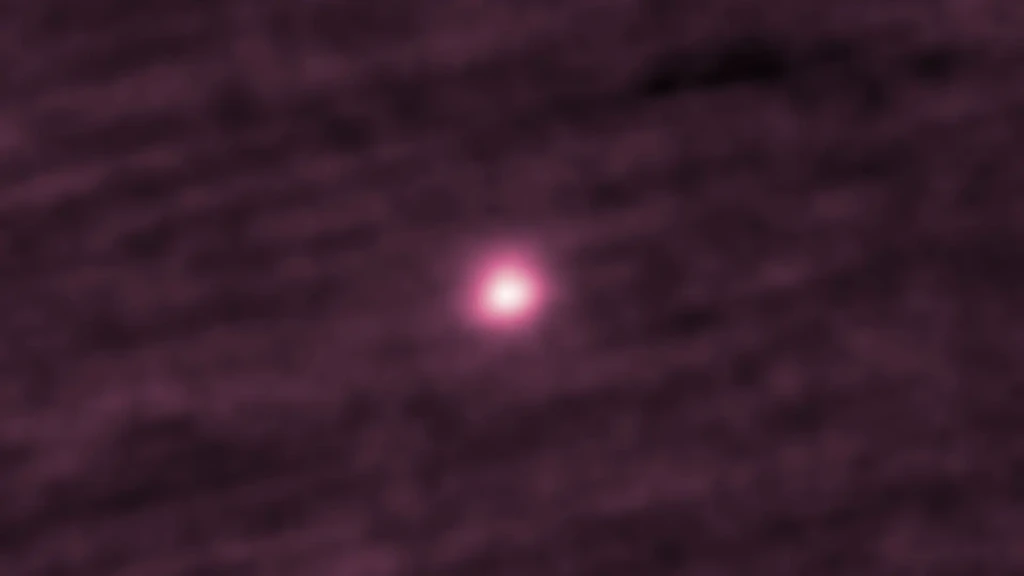
Comet 3I/ATLAS
Comet 3I/ATLAS photographed by STEREO-A telescope. Image: NASA

Another ‘anomaly’ highlighted by Loeb, was the comet’s unusual brightness after perihelion. This bolstered the theory of 3I/ATLAS being an alien spaceship. Opitom said that this is usual for comets that either undergo an explosion in the nucleus or fragmentation.

An ‘anti-tail’ was also cited as an anomaly, as a result of material spewing in the direction of the Sun. Loeb published a blog on the anti-tail today, saying it has grown longer than the distance between Earth and the Moon. According to Opitom, anti-tail forms because the radiation pressure from the Sun may not be strong enough to push large materials behind the comet.

ALSO READ: ESA Drops Surprise Preview Of Comet 3I/ATLAS Images From JUICE Spacecraft

Why study comet 3I/ATLAS?

Comets like 3I/ATLAS, especially the interstellar ones, carry information about other star systems. ESA says that 3I/ATLAS might be billions of years old, possibly older than our solar system, and its analysis could reveal what environments it was formed in.

There are two other comets – 1I/Oumuamua and 2I/Borisov – that visited our solar system in 2017 and 2019, respectively but none are being studied as extensively as 3I/ATLAS. Notably, Loeb had posited that Oumuamua may also be an alien spacecraft, but it wasn’t.

Meanwhile, NASA and ESA along with other institutions are preparing to point there telescopes to get a better look at 3I/ATLAS. The former recently released pictures taken by numerous spacecraft and space telescopes.

ALSO READ: Interstellar Comet 3I/ATLAS Captured In Ghostly X-ray Image By ESA Telescope

TAGGED:Comet 3I/ATLASESANASASpace
Share This Article
Facebook Pinterest Whatsapp Whatsapp LinkedIn Copy Link Print

Latest News

NASA Artemis II crew
NASA’s Christina Koch Turns ‘Space Plumber’ To Fix $30 Million Toilet On Artemis II Mission
Artemis
NASA Orion spacecraft
NASA’s Artemis II Astronauts Are Moon-Bound After Successful Trans-Lunar Injection Burn
Artemis
NASA Artemis II lifts off.
Artemis II Lifts Off! NASA Launches 4 Astronauts To The Moon After Over 50 Years
Artemis
NASA's Artemis II astronauts
NASA Artemis II Launch Live: Watch Humanity Return To The Moon On April 2
Artemis

You Might Also Like

Blue Origin NS-37 mission
Spaceflight

Blue Origin To Attempt Launch Of NS-37 Mission With Six Humans Again On Dec 20

December 20, 2025
Menstruation cups
Spaceflight

Menstruation Cups May Be The Giant Leap Needed For Women’s Health In Space

December 12, 2025
Alaknanda galaxy gravitational lensing
Astronomy

What is ‘Gravitational Lensing’ That Made Alaknanda Galaxy’s Discovery Possible?

December 18, 2025
Comet 3I/ATLAS NASA Avi Loeb
Astronomy

What Does The CIA Know About Comet 3I/ATLAS? Avi Loeb Seeks Answers

January 28, 2026
© 2026, Blue Terra Journal
  • About
  • Privacy Policy
  • Terms
  • Contact
Welcome Back!

Sign in to your account

Username or Email Address
Password

Lost your password?