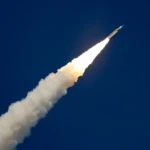
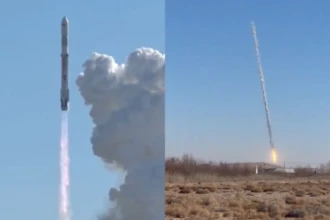
Blue Origin’s New Glenn booster has returned to Port Canaveral four days after launching from Cape Canaveral Space Force Station in Florida. It lifted off on November 14 with NASA’s ESCAPADE Mars spacecraft on its second mission ever, and the booster aced the landing on the second attempt after January.
The booster named ‘Never Tell Me The Odds’ arrived at the port on a fully autonomous barge named Jacklyn that was stationed about 604 kilometres offshore. The 380-feet-long barge served as the landing pad of the 188-feet-tall Booster which scripted history on November 14. Blue Origin CEO Dave Limp said in a company statement, “It turns out Never Tell Me The Odds had perfect odds — never before in history has a booster this large nailed the landing on the second try.“

Jeff Bezos, Blue Origin’s billionaire founder, had shared a video on X of the booster’s epic landing on the barge. “Good overview of the landing. We nominally target a few hundred feet away from Jacklyn to avoid a severe impact if engines fail to start or start slowly” Bezos posted on November 14. “We’ll incrementally reduce that conservatism over time. We are all excited and grateful for yesterday. Amazing performance by the team! Gradatim Ferociter.”

Today he posted a couple of pictures of the booster back at Port Canaveral, one of them featuring him standing next to it.
Several spaceflight fans were amazed by the booster’s clean appearance despite blazing toward Earth after launch, as opposed to SpaceX’s Falcon boosters that get covered in soot as they descend. This is because New Glenn uses a combination of liquid methane and liquid oxygen which burns cleaner and produces almost no soot whereas Falcon rockets use refined kerosene with liquid oxygen.
The ESCAPADE launch, or NG-2 as Blue Origin called it, was a major leap in the company’s goal of achieving rocket reusability. It says that New Glenn’s first stage is designed for a minimum of 25 flights, so it’s likely to be refurbished and reused soon for the next high-stakes mission.
ALSO READ: NASA’s ESCAPADE Mission Is Off To Mars. What Happens Next?
ALSO READ: ESCAPADE: Why It May Be NASA’s Most Important Mars Mission In Years