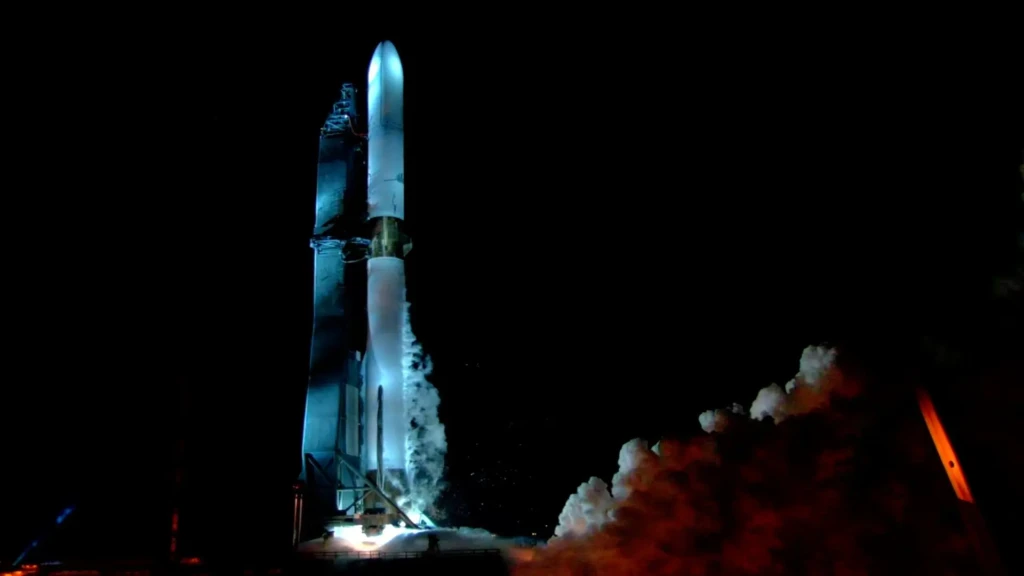
Billionaire Jeff Bezos’s space company Blue Origin is gearing up for one of its biggest missions to date. It is all set to launch NASA’s ESCAPADE spacecraft to Mars atop the New Glenn rocket at 2:45 pm EST (1:15 am IST) on November 10 from Cape Canaveral Space Force Station in Florida. This will mark the rocket’s second flight since its successful debut in January.
Apart from launching the one-of-a-kind mission, Blue Origin will also attempt to land the New Glenn booster in the Atlantic Ocean, something which only SpaceX has achieved so far.
Love seeing New Glenn’s seven BE-4 engines come alive! Congratulations to Team Blue on today’s hotfire. We extended the hotfire duration this time to simulate the landing burn sequence by shutting down the non-gimballed engines after ramping down to 50 percent thrust, then… pic.twitter.com/iu0y6yYAnG
— Dave Limp (@davill) October 31, 2025
About the New Glenn rocket
The New Glenn rocket is Blue Origin’s heaviest and it’s named after John Glenn, the first American to orbit Earth in 1962. Standing 321 feet or 98 metres tall, New Glenn is currently the second tallest rocket after SpaceX’s 400-feet-tall Starship.
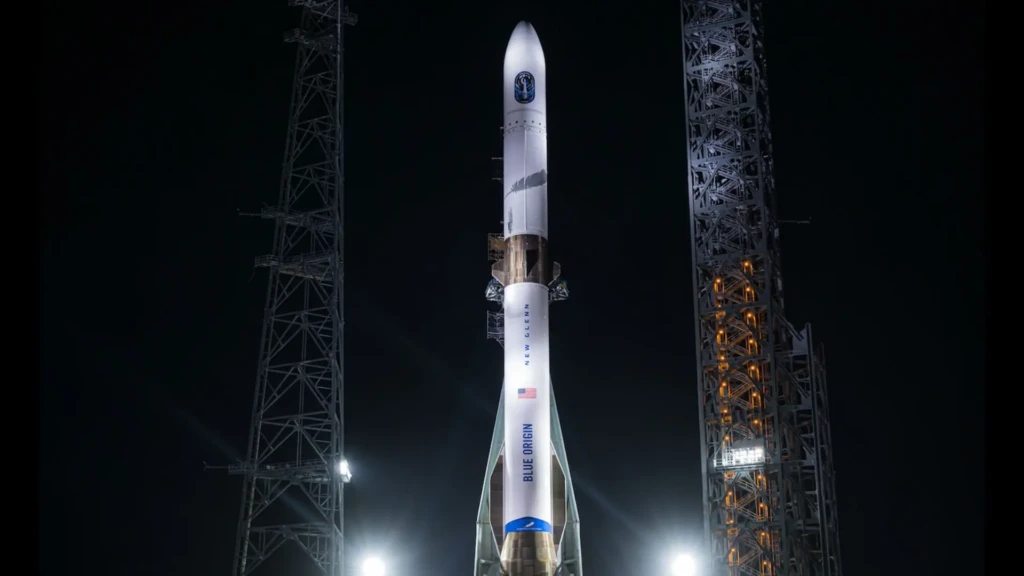
New Glenn’s first stage reusable booster is powered by seven BE-4 engines, each capable of generating 5,50,000 lbf (2,450 kN) of peak thrust at sea level. According to Blue Origin, the booster is designed for a minimum of 25 flights.
The second stage has two BE-3 engines with 1,75,000 lbf (778 kN) of peak vacuum thrust capacity each. These engines enable it to carry 45 metric tons of payload to low-Earth orbit and 13 metric tons to geostationary transfer orbit.
ALSO READ: Trouble For Blue Origin, SpaceX As US Government Shutdown Restricts Rocket Launches
How will the booster land?
The landing sequence of the 188-feet-tall (57.4 metres) booster will begin after it separates from the second stage carrying the ESCAPADE spacecraft. Similar to New Glenn’s first flight, the stage separation will occur at an altitude of about 70 kilometres, and the booster will reorient itself over the Atlantic Ocean to land.
Jacklyn departed for New Glenn’s second launch last night. Watch how our landing platform vessel supports booster recovery. pic.twitter.com/ymUXdY12LY
— Blue Origin (@blueorigin) November 6, 2025
This process is same as the one SpaceX follows, which involves sending an autonomous landing platform out to the sea. Blue Origin’s platform named Jacklyn is already stationed in the ocean, waiting for the booster to descend.
Once it touches down, recovery team will begin the operations to secure the booster and continue their four-day journey back to Port Canaveral.
About the ESCAPADE mission
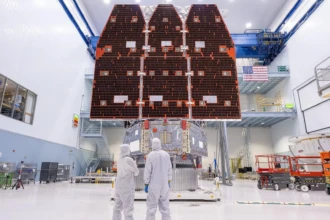
The ESCAPADE (Escape and Plasma Acceleration and Dynamics Explorers) mission is designed to study the interaction between the solar wind and the red planet’s hybrid magnetosphere. With this data, scientists hope to find out how Mars lost its atmosphere and became a desolate world we know today. Tap here to read more.
The mission actually includes two satellites, built by Rocket Lab, that will orbit Mars for 11 months after they reach the planet in 2027. Interestingly, both satellites will spend a year at the Lagrange Point 2 (1.5 million kilometres from Earth) until the next Earth-Mars transfer window opens in late 2026. Thereafter, they will begin their 10 months-long journey to the red planet.
ALSO READ: ESCAPADE: Why It May Be NASA’s Most Important Mars Mission In Years