Blue Terra Journal

  • Home
  • Spaceflight
    SpaceflightShow More
    NASA's SR-1 Freedom spacecraft.
    What Is NASA’s SR-1 Freedom Mission? The First Nuclear Reactor In Space Explained
    March 27, 2026
    Artist's impression of a NASA Moon base.
    NASA Moon Base: How The US Will Spend $20 Billion On This Ambitious Project
    March 25, 2026
    Russia's Soyuz rocket ascending to space.
    Russia’s Progress Spacecraft Suffers Mystery Glitch On Its Way To ISS; What Happened?
    March 23, 2026
    Robert Goddard
    Celebrating Robert Goddard – The Man Who Changed Rocketry 100 Years Ago
    March 17, 2026
    International Space Station gets extension to beat China
    Watch Out China! US Proposes Extending International Space Station Lifespan To 2032
    March 10, 2026
  • Astronomy
    AstronomyShow More
    Meteor spotted over Houston.
    Video Captures 1-Ton Meteor Exploding Over Houston Skies, NASA Releases Statement
    March 22, 2026
    NASA black hole simulation
    Fall Into A Black Hole With This Incredibly Scary Simulation Made By NASA
    March 18, 2026
    Comet C/2026 A1 MAPS
    Comet C/2026 A1 MAPS: What Are ‘Sun-Grazer’ Comets And Why Are They Special?
    March 12, 2026
    Moon is safe from asteroid 2024 YR4.
    The Moon Is Safe! James Webb Space Telescope Rules Out Asteroid 2024 YR4’s Collision
    March 6, 2026
    NASA Moon orbiter
    NASA Prepares To Save Its Orbiter During Total Solar Eclipse On The Moon
    March 3, 2026
  • India
    IndiaShow More
    Shubhanshu Shukla aboard the ISS.
    ISRO Astronaut Shubhanshu Shukla Awarded Ashoka Chakra For Heroic Ax-4 Mission
    February 9, 2026
    ISRO's PSLV lifts off to space.
    ISRO’s PSLV Rocket Suffers Third Stage Failure After Successful Liftoff; Payloads Lost
    January 23, 2026
    Dhruva Space team at ISRO facility.
    India’s Dhruva Space To Launch 10 Missions, Including 1st Northeastern Satellite, On ISRO’s PSLV
    January 12, 2026
    ISRO's PSLV rocket
    ISRO To Seek Redemption With PSLV-C62 Mission Launch On January 12
    January 12, 2026
    ISRO SSLV
    ISRO’s SSLV Rocket Just Got Better After Latest Third Stage Test Fire
    December 31, 2025
  • Artemis
    ArtemisShow More
    NASA Artemis II crew
    NASA’s Christina Koch Turns ‘Space Plumber’ To Fix $30 Million Toilet On Artemis II Mission
    April 3, 2026
    NASA Orion spacecraft
    NASA’s Artemis II Astronauts Are Moon-Bound After Successful Trans-Lunar Injection Burn
    April 3, 2026
    NASA Artemis II lifts off.
    Artemis II Lifts Off! NASA Launches 4 Astronauts To The Moon After Over 50 Years
    April 2, 2026
    NASA's Artemis II astronauts
    NASA Artemis II Launch Live: Watch Humanity Return To The Moon On April 2
    April 2, 2026
    NASA Apollo 8 image
    NASA Artemis II: Why This Moon Mission Is Our Generation’s Apollo 8
    March 30, 2026
  • More
    • About
    • Privacy Policy
    • Terms
    • Contact

Blue Terra Journal

  • Home
  • Spaceflight
  • Astronomy
  • India
  • Artemis
Search
  • Pages
    • About
    • Contact
    • Privacy Policy
    • Terms

Home - Artemis - Artemis II Lifts Off! NASA Launches 4 Astronauts To The Moon After Over 50 Years

Artemis

Artemis II Lifts Off! NASA Launches 4 Astronauts To The Moon After Over 50 Years

Godspeed Artemis II!

Blue Terra Journal
Last updated: April 2, 2026 5:35 AM
Blue Terra Journal
Share
6 Min Read
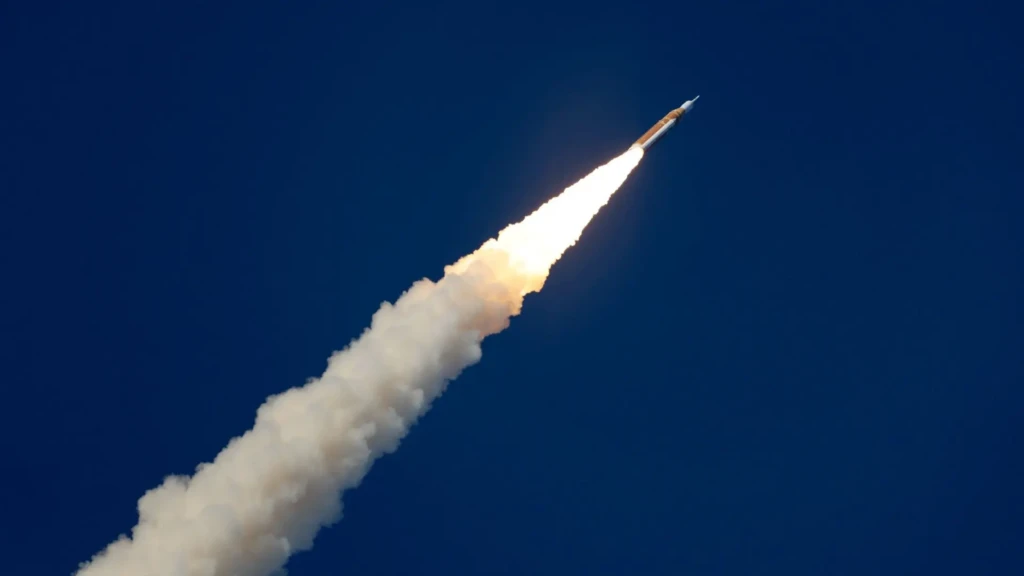
NASA Artemis II lifts off.
The SLS rocket lifts off with Artemis II astronauts. Image: NASA
SHARE


Contents
  • NASA’s journey to the Moon
  • Records are meant to be broken

Four astronauts have finally blasted off to the Moon kickstarting the historic Artemis II Moon mission. The Space Launch System (SLS) rocket lifted off in the early hours of April 2 at 4:05 am IST from the Kennedy Space Center, putting an end to years of delay. This was the second time this 322-feet-tall vehicle roared to life since Artemis I, the uncrewed mission from 2022.

Flying aboard the Orion spacecraft are NASA astronauts Reid Wiseman (commander), Victor Glover (pilot) and Christina Koch (specialist) and Canadian Space Agency’s Jeremy Hansen (specialist) who will perform a flyby of the Moon and return in approximately 10 days.

Liftoff.

The Artemis II mission launched from @NASAKennedy at 6:35pm ET (2235 UTC), propelling four astronauts on a journey around the Moon.

Artemis II will pave the way for future Moon landings, as well as the next giant leap — astronauts on Mars. pic.twitter.com/ENQA4RTqAc

— NASA (@NASA) April 1, 2026

This mission involves neither orbiting nor landing on the Moon as the primary objective here is to validate life support systems of the Orion spacecraft in deep space environment. The astronauts will also conduct several experiments focused on human health and space radiation.

NASA’s journey to the Moon

Orion is currently under Earth’s influence and it will soon achieve an elliptical orbit of approximately 44,525 x 185 km for critical system checkouts before slinging to the Moon. Here the crew will undergo a manual piloting test called the proximity operations demonstration wherein the astronauts will transition the spacecraft to manual mode.

NASA's Artemis II astronauts
Artemis II astronauts Jeremy Hansen, Christina Koch, Victor Glover and Reid Wiseman (left to right). Image: NASA

The astronauts will then hand over the control back to mission controllers and get busy with verifying spacecraft system performance including that of the of the life support systems.

While in Earth orbit, the crew will also test the communication and navigation systems to confirm they are ready for the trip. If all goes well, these operations will take at least one day for completion. These procedures in a high orbit is necessary to give the crew time to confirm all systems are functioning nominally before committing to the lunar journey.

Once the checkout procedures are complete, Orion will perform a translunar injection burn, wherein it’s service module will propel it to an outbound trip around the far side of the Moon. The journey will take approximately four days.

Records are meant to be broken

Artemis II is setting records right from the start and several more will be broken by the time the mission ends. Koch is the first woman to fly on a lunar mission whereas Glover is now the first person of colour to launch to the Moon. Hansen, a Canadian national, on the other hand, is the first non-US citizen who will fly farther than any other crewed mission in history, that too on a lunar flight.

The Artemis II crew is boarding Orion.

Reid, Victor, Christina, and Jeremy are taking their seats atop the most powerful manned rocket ever built. They have trained for years for this moment, and now they are preparing to execute a mission that will take us back around the Moon… pic.twitter.com/kzwwdGSaAe

— NASA Administrator Jared Isaacman (@NASAAdmin) April 1, 2026

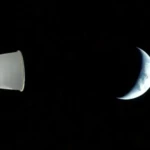
Orion will take the crew approximately 7,403 kilometres beyond the far side of the Moon, breaking the record for the longest distance travelled by humans set during Apollo 13 in 1970 (about 4,00,171 km). Wiseman and team will also be the first humans to see the far side of the Moon in person and will take photographs and provide observations of the Moon’s surface during the multi-hour flyby. At the time of the flyby, NASA says, the region will be partially illuminated, offering an enhanced view of surface ridges, slopes and crater rims that are often difficult to detect under full illumination.

Artemis II has launched 53 years after the last lunar mission Apollo 17 – which took off in December 1972. With a crew of four, this is the most number of astronauts who will travel so far from home at once.

One might even compare this to the Apollo 8 mission of 1968 that was the world’s first crewed flight to leave Earth orbit and later set the stage for the first Moon landing in 1969. Artemis II has similar responsibilities i.e. to validate technologies incorporated in the Orion spacecraft that will take American astronauts back to the Moon during Artemis IV possibly in 2028.

ALSO READ: Cakes, Smoothies, Tortillas: NASA’s Delightful Space Menu Designed For Artemis II Astronauts

ALSO READ: NASA’s Artemis II Astronauts Will Launch With Smartphones To The Moon, So Will Other Fliers
TAGGED:Artemis IImoonNASAOrion spacecraftSLS Rocket
Share This Article
Facebook Pinterest Whatsapp Whatsapp LinkedIn Copy Link Print

Latest News

NASA Artemis II crew
NASA’s Christina Koch Turns ‘Space Plumber’ To Fix $30 Million Toilet On Artemis II Mission
Artemis
NASA Orion spacecraft
NASA’s Artemis II Astronauts Are Moon-Bound After Successful Trans-Lunar Injection Burn
Artemis
NASA's Artemis II astronauts
NASA Artemis II Launch Live: Watch Humanity Return To The Moon On April 2
Artemis
NASA Apollo 8 image
NASA Artemis II: Why This Moon Mission Is Our Generation’s Apollo 8
Artemis

You Might Also Like

NASA's SR-1 Freedom spacecraft.
Spaceflight

What Is NASA’s SR-1 Freedom Mission? The First Nuclear Reactor In Space Explained

March 27, 2026
Jared Isaacman.
Artemis

Jared Isaacman May Be The Best Thing That Happened For NASA

November 18, 2025
NASA Artemis II mission
Artemis

Artemis II Delayed Again! NASA To Remove SLS Rocket From Launch Pad Due To Second Stage Problem

March 14, 2026
NASA milky way.
Astronomy

The Fermi Paradox: Why We’ve Never Seen Aliens

November 25, 2025
© 2026, Blue Terra Journal
  • About
  • Privacy Policy
  • Terms
  • Contact
Welcome Back!

Sign in to your account

Username or Email Address
Password

Lost your password?