Blue Terra Journal

  • Home
  • Spaceflight
    SpaceflightShow More
    NASA's SR-1 Freedom spacecraft.
    What Is NASA’s SR-1 Freedom Mission? The First Nuclear Reactor In Space Explained
    March 27, 2026
    Artist's impression of a NASA Moon base.
    NASA Moon Base: How The US Will Spend $20 Billion On This Ambitious Project
    March 25, 2026
    Russia's Soyuz rocket ascending to space.
    Russia’s Progress Spacecraft Suffers Mystery Glitch On Its Way To ISS; What Happened?
    March 23, 2026
    Robert Goddard
    Celebrating Robert Goddard – The Man Who Changed Rocketry 100 Years Ago
    March 17, 2026
    International Space Station gets extension to beat China
    Watch Out China! US Proposes Extending International Space Station Lifespan To 2032
    March 10, 2026
  • Astronomy
    AstronomyShow More
    Meteor spotted over Houston.
    Video Captures 1-Ton Meteor Exploding Over Houston Skies, NASA Releases Statement
    March 22, 2026
    NASA black hole simulation
    Fall Into A Black Hole With This Incredibly Scary Simulation Made By NASA
    March 18, 2026
    Comet C/2026 A1 MAPS
    Comet C/2026 A1 MAPS: What Are ‘Sun-Grazer’ Comets And Why Are They Special?
    March 12, 2026
    Moon is safe from asteroid 2024 YR4.
    The Moon Is Safe! James Webb Space Telescope Rules Out Asteroid 2024 YR4’s Collision
    March 6, 2026
    NASA Moon orbiter
    NASA Prepares To Save Its Orbiter During Total Solar Eclipse On The Moon
    March 3, 2026
  • India
    IndiaShow More
    Shubhanshu Shukla aboard the ISS.
    ISRO Astronaut Shubhanshu Shukla Awarded Ashoka Chakra For Heroic Ax-4 Mission
    February 9, 2026
    ISRO's PSLV lifts off to space.
    ISRO’s PSLV Rocket Suffers Third Stage Failure After Successful Liftoff; Payloads Lost
    January 23, 2026
    Dhruva Space team at ISRO facility.
    India’s Dhruva Space To Launch 10 Missions, Including 1st Northeastern Satellite, On ISRO’s PSLV
    January 12, 2026
    ISRO's PSLV rocket
    ISRO To Seek Redemption With PSLV-C62 Mission Launch On January 12
    January 12, 2026
    ISRO SSLV
    ISRO’s SSLV Rocket Just Got Better After Latest Third Stage Test Fire
    December 31, 2025
  • Artemis
    ArtemisShow More
    NASA Artemis II crew
    NASA’s Christina Koch Turns ‘Space Plumber’ To Fix $30 Million Toilet On Artemis II Mission
    April 3, 2026
    NASA Orion spacecraft
    NASA’s Artemis II Astronauts Are Moon-Bound After Successful Trans-Lunar Injection Burn
    April 3, 2026
    NASA Artemis II lifts off.
    Artemis II Lifts Off! NASA Launches 4 Astronauts To The Moon After Over 50 Years
    April 2, 2026
    NASA's Artemis II astronauts
    NASA Artemis II Launch Live: Watch Humanity Return To The Moon On April 2
    April 2, 2026
    NASA Apollo 8 image
    NASA Artemis II: Why This Moon Mission Is Our Generation’s Apollo 8
    March 30, 2026
  • More
    • About
    • Privacy Policy
    • Terms
    • Contact

Blue Terra Journal

  • Home
  • Spaceflight
  • Astronomy
  • India
  • Artemis
Search
  • Pages
    • About
    • Contact
    • Privacy Policy
    • Terms

Home - Spaceflight - Has MAVEN Mars Orbiter Met Its End? NASA Says It Was Rotating Unexpectedly

Spaceflight

Has MAVEN Mars Orbiter Met Its End? NASA Says It Was Rotating Unexpectedly

Rescue efforts have been unsuccessful, says NASA.

Harsh Vardhan
Last updated: December 27, 2025 9:48 PM
Harsh Vardhan
Share
4 Min Read
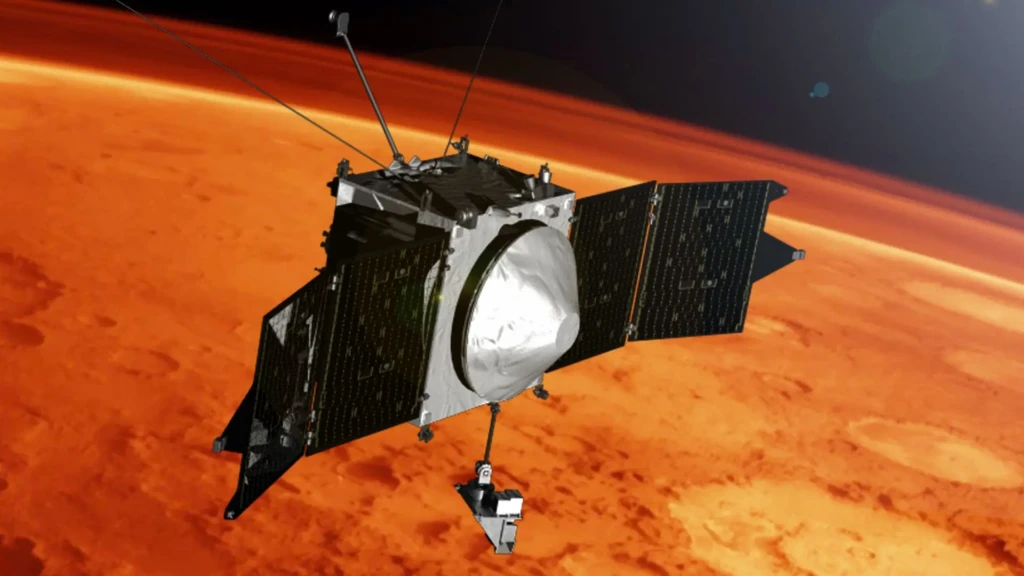
NASA's MAVEN orbiter
Artist's impression of the MAVEN orbiter. Image: NASA
SHARE

NASA says efforts to rescue the MAVEN Mars Orbiter are underway after the spacecraft unexpectedly went offline earlier this month. In a statement released on Monday, the agency said that attempts to reestablish communications have been unsuccessful so far.

Last week, it was revealed that MAVEN went off grid after it emerged from behind Mars on December 6. On the same day, mission team received fragment of a tracking data which suggested that the spacecraft is behaving abnormally.
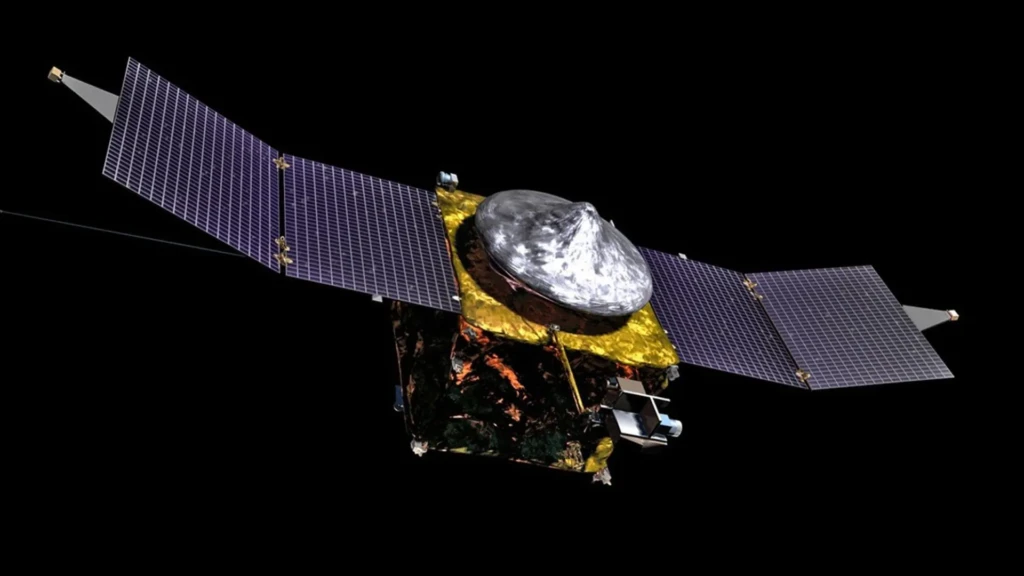
Mars MAVEN Orbiter
Artist’s impression of the MAVEN orbiter. Image: NASA

“Analysis of that signal suggests that the MAVEN spacecraft was rotating in an unexpected manner when it emerged from behind Mars. Further, the frequency of the tracking signal suggests MAVEN’s orbit trajectory may have changed,” NASA stated. “The team continues to analyze tracking data to understand the most likely scenarios leading to the loss of signal. Efforts to reestablish contact with MAVEN also continue.”

NASA exchanges signal with MAVEN using the Deep Space Network which is an array of giant radio antennas in California (US), Canberra (Australia) and Madrid (Spain). Launched in November 2013, MAVEN orbits Mars in a highly elliptical orbit of 4500X150 km. It was recently used to photograph the interstellar comet 3I/ATLAS as it made a close pass from Mars. 
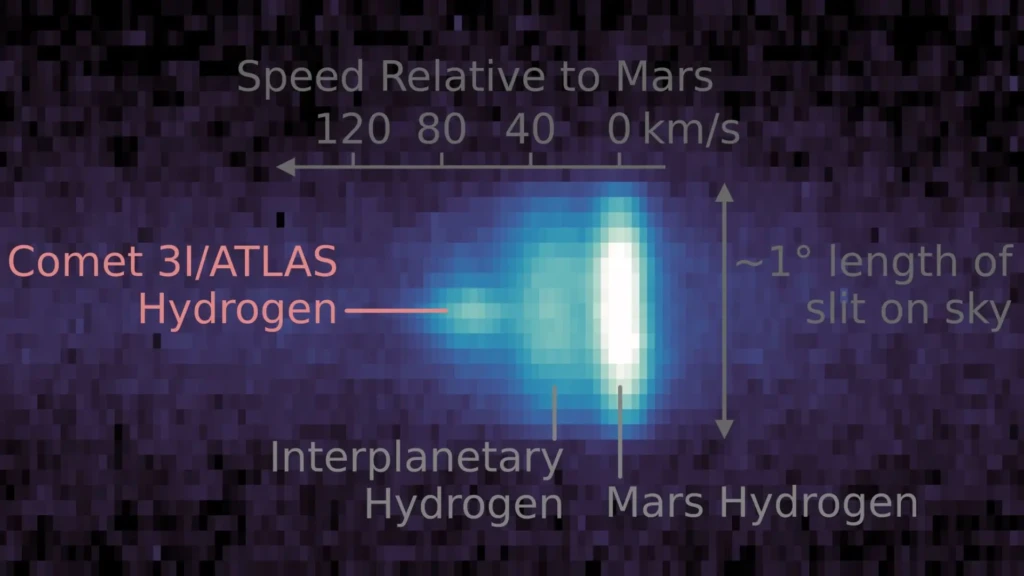
NASA Mars MAVEN
MAVEN captured Comet 3I/ATLAS and Mars’s hydrogen emission. Image: NASA

Apart from its primary objective of studying the Martian atmosphere and climate, it also relays data from two NASA rovers – Perseverance and Curiosity. Three other orbiters – Mars Reconnaissance Orbiter, Mars Odyssey and the European Space Agency’s ExoMars Trace Gas Orbiter – serve the same purpose and NASA might use them until MAVEN comes online.

“NASA is also working to mitigate the effect of the MAVEN anomaly on surface operations for NASA’s Perseverance and Curiosity rovers,” the agency said adding that it “is arranging additional passes from the remaining orbiters, and the Perseverance and Curiosity teams have adjusted their daily planning activities to continue their science missions.”

The MAVEN Mars mission

The Mars Atmosphere and Volatile EvolutioN or MAVEN orbiter was launched as the first mission to understand the Martian atmosphere. It is designed to investigate three primary questions regarding the current state of the upper Martian atmosphere, how gases escape from it and how much of these gases have been lost over time.

In order to answer these questions, MAVEN is determining the structure and composition of the Martian atmosphere including the clouds and the physical and chemical processes that control the loss of gases using a suite of nine instruments. 

Planned for just one year of primary science mission, MAVEN was in its 11th year of operations since it entered Mars orbit in 2014. However, the orbiter seems to be wearing out as the years pass.

ALSO READ: NASA Has 11 Reasons To Send Astronauts To Mars – Including Finding Life, Says Report

ALSO READ: Neil deGrasse Tyson Shares The Only Reasons Humans May Reach Mars

TAGGED:MarsMAVEN OrbiterNASASpace
Share This Article
Facebook Pinterest Whatsapp Whatsapp LinkedIn Copy Link Print

Latest News

NASA Artemis II crew
NASA’s Christina Koch Turns ‘Space Plumber’ To Fix $30 Million Toilet On Artemis II Mission
Artemis
NASA Orion spacecraft
NASA’s Artemis II Astronauts Are Moon-Bound After Successful Trans-Lunar Injection Burn
Artemis
NASA Artemis II lifts off.
Artemis II Lifts Off! NASA Launches 4 Astronauts To The Moon After Over 50 Years
Artemis
NASA's Artemis II astronauts
NASA Artemis II Launch Live: Watch Humanity Return To The Moon On April 2
Artemis

You Might Also Like

Blue Origin's New Shepard spacecraft.
Spaceflight

Blue Origin’s First Space Tourism Mission Of 2026 Targeted For Launch On Jan. 22

January 23, 2026
Elon Musk SpaceX
Spaceflight

Elon Musk Confirms SpaceX Is Going Public. Will It Affect His Mars Plan?

January 2, 2026
NASA Artemis II mission
Artemis

Artemis II Delayed Again! NASA To Remove SLS Rocket From Launch Pad Due To Second Stage Problem

March 14, 2026
Mars NASA ISRO
Spaceflight

From Moon & Mars Missions To Starship Flights, A Recap Of 2025’s Biggest Spaceflight Moments

January 8, 2026
© 2026, Blue Terra Journal
  • About
  • Privacy Policy
  • Terms
  • Contact
Welcome Back!

Sign in to your account

Username or Email Address
Password

Lost your password?