Blue Terra Journal

  • Home
  • Spaceflight
    SpaceflightShow More
    NASA's MAVEN orbiter
    NASA’s MAVEN Orbiter Confirmed Dead On Mars; What Did It Achieve In 11 Years?
    June 5, 2026
    Blue Origin's New Glenn rocket.
    What Blue Origin’s New Glenn Explosion Means For NASA And Its Moon Ambitions
    June 10, 2026
    Elon Musk SpaceX Starship
    Elon Musk’s SpaceX launches new Starship V3 on 12th mission, but it wasn’t flawless
    June 5, 2026
    SpaceX Starship
    SpaceX Starship’s 12th Test Flight Targeted On May 20; No Booster Catch This Time
    May 31, 2026
    SpaceX's Starship during launch rehearsal.
    SpaceX Completes Starship’s Launch Rehearsal For Flight 12 This Week; What To Expect?
    May 13, 2026
  • Astronomy
    AstronomyShow More
    The galactic bulge by Euclid telescope. Credit: European Space Agency
    This Euclid Telescope Image Of Milky Way’s Centre With 60 Million Stars May Break Your Brain
    June 27, 2026
    UFO videos shared by US government
    UFO Alert! US Government Releases New Videos Of Glowing Orbs Floating In The Sky
    June 13, 2026
    Meteor over Mayon volcano
    Watch: Flashy Green Meteor Streaks Over Erupting Volcano In The Philippines
    May 27, 2026
    Artist's impression of NASA's Psyche spacecraft.
    NASA’s Psyche Spacecraft Will Zoom Past Mars Today On Its Way To Metal-Rich Asteroid
    May 15, 2026
    Comet MAPS image
    Video: Comet MAPS destroyed after plunging into the Sun; event caught by NASA missions
    April 18, 2026
  • India
    IndiaShow More
    Shubhanshu Shukla aboard the ISS.
    ISRO Astronaut Shubhanshu Shukla Awarded Ashoka Chakra For Heroic Ax-4 Mission
    February 9, 2026
    ISRO's PSLV lifts off to space.
    ISRO’s PSLV Rocket Suffers Third Stage Failure After Successful Liftoff; Payloads Lost
    January 23, 2026
    Dhruva Space team at ISRO facility.
    India’s Dhruva Space To Launch 10 Missions, Including 1st Northeastern Satellite, On ISRO’s PSLV
    January 12, 2026
    ISRO's PSLV rocket
    ISRO To Seek Redemption With PSLV-C62 Mission Launch On January 12
    January 12, 2026
    ISRO SSLV
    ISRO’s SSLV Rocket Just Got Better After Latest Third Stage Test Fire
    December 31, 2025
  • Artemis
    ArtemisShow More
    NASA Artemis III crew
    NASA Artemis III: Meet The Astronauts Who Will Set The Stage For 2028 Moon Landing
    June 10, 2026
    Blue Origin's New Glenn rocket.
    What Blue Origin’s New Glenn Explosion Means For NASA And Its Moon Ambitions
    June 10, 2026
    NASA Artemis II mission
    Welcome Home! NASA’s Artemis II Astronauts Are Back After Historic Moon Voyage
    April 22, 2026
    NASA Artemis II iPhone image
    iPhones Reigned Supreme On NASA’s Artemis II Moon Mission
    April 10, 2026
    Artemis II NASA
    All Eyes On Scary Artemis II Reentry As NASA Moon Mission Nears Completion
    April 9, 2026
  • More
    • About
    • Privacy Policy
    • Terms
    • Contact

Blue Terra Journal

  • Home
  • Spaceflight
  • Astronomy
  • India
  • Artemis
Search
  • Pages
    • About
    • Contact
    • Privacy Policy
    • Terms

Home - Spaceflight - NASA’s Mars Orbiter MAVEN Has Suddenly Gone Offline – Here’s What We Know

Spaceflight

NASA’s Mars Orbiter MAVEN Has Suddenly Gone Offline – Here’s What We Know

The orbiter was last contacted on December 6.

Harsh Vardhan
Last updated: December 16, 2025 9:59 PM
Harsh Vardhan
Share
4 Min Read
NASA"s Mars MAVEN Orbiter
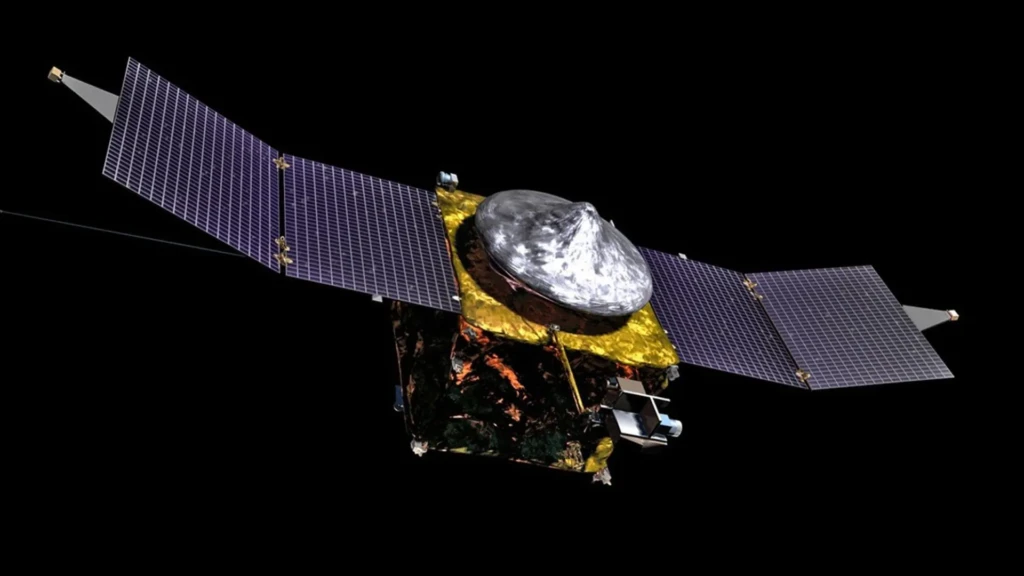
Artist's impression of the MAVEN orbiter. Image: NASA
SHARE

NASA says its Mars Atmosphere and Volatile EvolutioN or MAVEN orbiter has gone offline. The spacecraft team is said to have experienced a loss of signal from the orbiter on December 6, after it emerged from behind Mars. NASA said that it is investigating the anomaly that sent MAVEN offline.

NASA Teams Work MAVEN Spacecraft Signal Loss

NASA’S MAVEN (Mars Atmosphere and Volatile EvolutioN) spacecraft, in orbit around Mars, experienced a loss of signal with ground stations on Earth on Dec. 6. Telemetry from MAVEN had showed all subsystems working normally before it… pic.twitter.com/Sm45hXnOPA

— NASA Watch (@NASAWatch) December 10, 2025

“NASA’s MAVEN (Mars Atmosphere and Volatile EvolutioN) spacecraft, in orbit around Mars, experienced a loss of signal with ground stations on Earth on Dec. 6. Telemetry from MAVEN had showed all subsystems working normally before it orbited behind the Red Planet,” NASA said in a statement. “After the spacecraft emerged from behind Mars, NASA’s Deep Space Network did not observe a signal. The spacecraft and operations teams are investigating the anomaly to address the situation. More information will be shared once it becomes available.“

The MAVEN orbiter

MAVEN launched to Mars in November 2013 and entered the Martian orbit in September 2014. The orbiter measures 11.4 metres in length and 2.29 metres wide, and is equipped with a suite of nine instruments. Its objective is to determine the amount and types of gas particles escaping the Martian atmosphere today, the processes that govern the escape, and how the Martian climate has evolved due to these processes. 
NASA Mars MAVEN
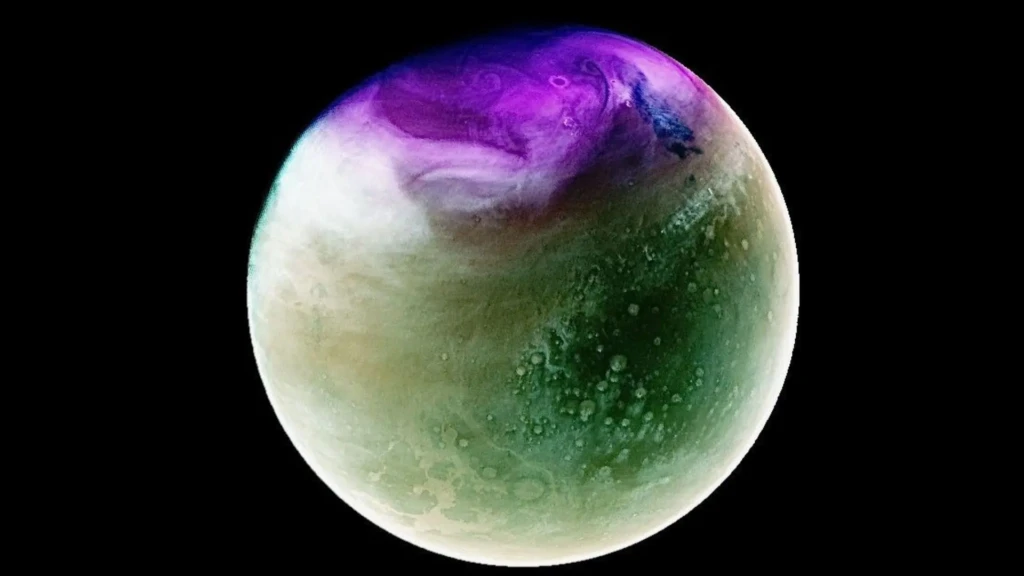
Mars captured by MAVEN orbiter. Image: NASA

MAVEN is orbiting Mars in a highly elliptical 4,500 by 150 kilometers orbit and apart from observing the red planet, it serves as a data relay for the Perseverance and Curiosity rovers. 

As of today, there are a total of six orbiters that are studying Mars. NASA has two other spacecraft – Mars Reconnaissance Orbiter and 2001 Mars Odyssey, the longest-running mission. The European Space Agency (ESA) also operates two spacecraft – ExoMars Trace Gas Orbiter and Mars Express – which are together mapping the surface, taking high-resolution pictures and characterising the Martian climate.
NASA Mars MAVEN
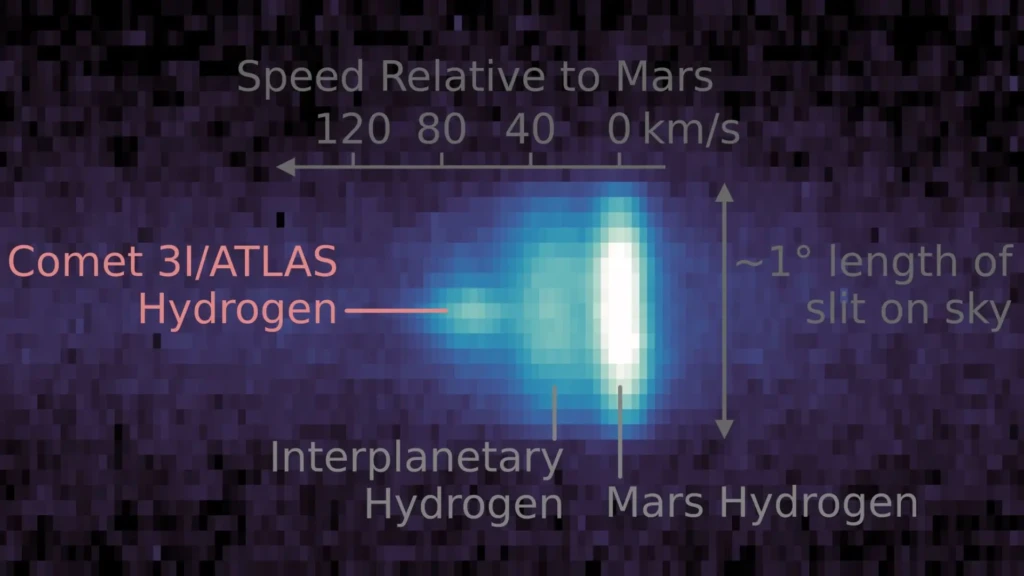
MAVEN captured Comet 3I/ATLAS and Mars’s hydrogen emission. Image: NASA

Both NASA and ESA recently employed their Mars orbiters to take images of the interstellar comet 3I/ATLAS when it made its closest approach to the red planet on October 3. MAVEN used its Imaging Ultraviolet Spectrograph to take the comet’s pictures in ultraviolet light, distinguishing the hydrogen emission from 3I/ATLAS, Mars and the hydrogen flowing through our solar system.

ALSO READ: NASA Rover Has Recorded Electric Sparks In Dust Devils On Mars; Here’s The Audio

ALSO READ: NASA Has 11 Reasons To Send Astronauts To Mars – Including Finding Life, Says Report

TAGGED:Comet 3I/ATLASMarsMAVENNASA
Share This Article
Facebook Pinterest Whatsapp Whatsapp LinkedIn Copy Link Print

Latest News

The galactic bulge by Euclid telescope. Credit: European Space Agency
This Euclid Telescope Image Of Milky Way’s Centre With 60 Million Stars May Break Your Brain
Astronomy
UFO videos shared by US government
UFO Alert! US Government Releases New Videos Of Glowing Orbs Floating In The Sky
Astronomy
NASA Artemis III crew
NASA Artemis III: Meet The Astronauts Who Will Set The Stage For 2028 Moon Landing
Artemis
NASA's MAVEN orbiter
NASA’s MAVEN Orbiter Confirmed Dead On Mars; What Did It Achieve In 11 Years?
Spaceflight

You Might Also Like

NASA Crew-12 astronauts
Spaceflight

Welcome Aboard! Watch Astronauts Welcome NASA’s Crew-12 On International Space Station

February 21, 2026
NASA SLS
Artemis

Decoding NASA’s SLS Moon Rocket: A Powerful Launcher With A High Price Tag

December 26, 2025
NASA Artemis 2
Artemis

NASA’s Artemis 2 Crew Completes Countdown Rehearsal Ahead Of 2026 Moon Mission

December 21, 2025
Comet 3I/ATLAS NASA Avi Loeb
Astronomy

Comet 3I/ATLAS Entered The Oort Cloud 8000 Years Ago. What Was Earth Like Then?

December 15, 2025
© 2026, Blue Terra Journal
  • About
  • Privacy Policy
  • Terms
  • Contact
Welcome Back!

Sign in to your account

Username or Email Address
Password

Lost your password?