Blue Terra Journal

  • Home
  • Spaceflight
    SpaceflightShow More
    SpaceX Dragon spacecraft for NASA's Crew-12 mission.
    SpaceX Rolls Out Dragon Spacecraft For NASA’s Crew-12 Mission While Falcon 9 Remains Grounded
    February 4, 2026
    NASA partners with Axiom Space
    NASA And Axiom Space Announce 5th Private Crew Mission To International Space Station In 2027
    February 1, 2026
    Blue Origin Mark 1 lander.
    Blue Origin Halts New Shepard Missions For At Least 2 Years To Land Humans On The Moon
    February 1, 2026
    SpaceX Starship on flight 11.
    SpaceX CEO Elon Musk Reveals When Starship Will Launch On Next Test Flight
    January 29, 2026
    NOAA's SOLAR-1 observatory.
    NOAA’s Sun Spying SOLAR-1 Observatory Reaches Its Destination 1.5 Million Km From Earth
    January 31, 2026
  • Astronomy
    AstronomyShow More
    Voyager 1 illustration
    NASA’s Voyager 1 Will Be One Light-Day Away From Earth In 2026 – What This Means
    January 26, 2026
    Auroras triggered by CMEs.
    Auroras Flood The Night Skies After Largest Solar Radiation Storm In Over 20 Years | Photos
    January 20, 2026
    Hubble discovers Cloud-9.
    Hubble Telescope Uncovers New Object ‘Cloud-9’ – A ‘Failed Galaxy’ With No Stars
    January 13, 2026
    SpaceX launches NASA telescope.
    SpaceX Launches NASA’s Exoplanet Exploring Telescope Pandora On Twilight Mission
    January 19, 2026
    Comet 3I/ATLAS by Hubble telescope
    Comet 3I/ATLAS Is Not An Alien Spacecraft – This Research Likely Confirms It
    January 10, 2026
  • India
    IndiaShow More
    Shubhanshu Shukla aboard the ISS.
    ISRO Astronaut Shubhanshu Shukla Awarded Ashoka Chakra For Heroic Ax-4 Mission
    January 25, 2026
    ISRO's PSLV lifts off to space.
    ISRO’s PSLV Rocket Suffers Third Stage Failure After Successful Liftoff; Payloads Lost
    January 23, 2026
    Dhruva Space team at ISRO facility.
    India’s Dhruva Space To Launch 10 Missions, Including 1st Northeastern Satellite, On ISRO’s PSLV
    January 12, 2026
    ISRO's PSLV rocket
    ISRO To Seek Redemption With PSLV-C62 Mission Launch On January 12
    January 12, 2026
    ISRO SSLV
    ISRO’s SSLV Rocket Just Got Better After Latest Third Stage Test Fire
    December 31, 2025
  • Artemis
    ArtemisShow More
    NASA's Artemis II SLS Rocket
    NASA Delays Artemis II Moon Mission Launch To March – Here’s Why
    February 3, 2026
    NASA's SLS rocket.
    Astronauts In Quarantine, Rocket Powered On – How NASA Is Preparing For Artemis II
    February 3, 2026
    NASA's Artemis II crew
    Inside Artemis II: How NASA Will Study Astronaut Health And Deep Space Radiation
    January 30, 2026
    NASA's SLS rocket at launch pad.
    NASA’s Artemis II To Carry Relic Of Humanity’s First Flight And More To The Moon
    January 27, 2026
    NASA's SLS rocket
    NASA’s SLS Rocket Rolls Out To The Launch Pad For Artemis II – Here’s What’s Next
    January 27, 2026
  • More
    • About
    • Privacy Policy
    • Terms
    • Contact

Blue Terra Journal

  • Home
  • Spaceflight
  • Astronomy
  • India
  • Artemis
Search
  • Pages
    • About
    • Contact
    • Privacy Policy
    • Terms

Home - Astronomy - NASA’s Parker Solar Probe Saw Something Strange On The Sun – All About It

Astronomy

NASA’s Parker Solar Probe Saw Something Strange On The Sun – All About It

Harsh Vardhan
Last updated: December 15, 2025 12:34 PM
Harsh Vardhan
Share
4 Min Read
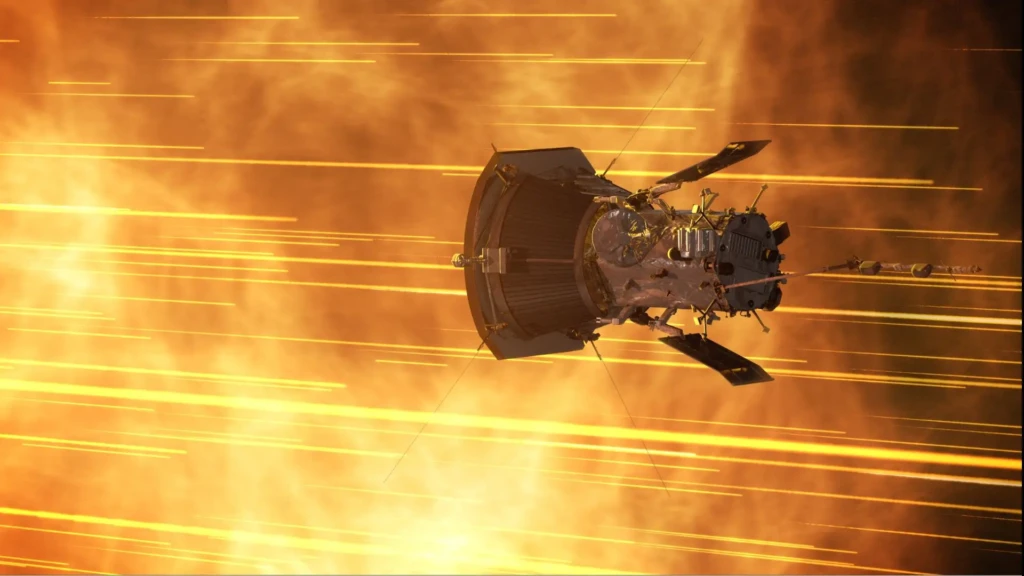
NASA Parker Solar Probe
Artist's impression of the Parker Solar Probe. Image: NASA
SHARE

NASA’s Parker Solar Probe has revealed new details about a strange phenomenon during a solar storm. While making its closest ever pass in December 2024, Parker observed from a distance of 6.1 million km, that some of the material ejected from the Sun is falling back into it – something which scientists call an “inflow.”

This phenomenon, NASA says, is related to a coronal mass ejection or CME event which is triggered by twisted magnetic field lines explosively snapping and realigning in a process called magnetic reconnection. During this explosion, an immense cloud of charged particles and magnetic field are expelled from the Sun, and they create geomagnetic storms upon interaction with Earth.

Did you know the Sun can reuse its energy? ☀️ ♻️

Images captured as NASA’s Parker Solar Probe made its record-breaking closest approach to the Sun in December 2024 have now revealed new details about how the Sun can recycle some of its magnetic energy — potentially redirecting… pic.twitter.com/deDEsep3lx

— NASA Solar System (@NASASolarSystem) December 11, 2025

“We’ve previously seen hints that material can fall back into the Sun this way, but to see it with this clarity is amazing,” Nour Rawafi, the project scientist for Parker Solar Probe, said in a statement. “This is a really fascinating, eye-opening glimpse into how the Sun continuously recycles its coronal magnetic fields and material.”

Researchers have detailed the inflow process in a study published in the Astrophysical Journal Letters on December 11. The findings, they say, could provide invaluable insights into how the CME-driven release of magnetic fields affect not only the planets, but also the Sun.

NASA probe uncovers mysterious phenomenon

While the Parker probe didn’t discover the inflow, images collected by its Wide-Field Imager for Solar Probe (WISPR) have allowed scientists to make precise measurements about the inflow process, such as the speed and size of the blobs of material pulled back into the Sun. 
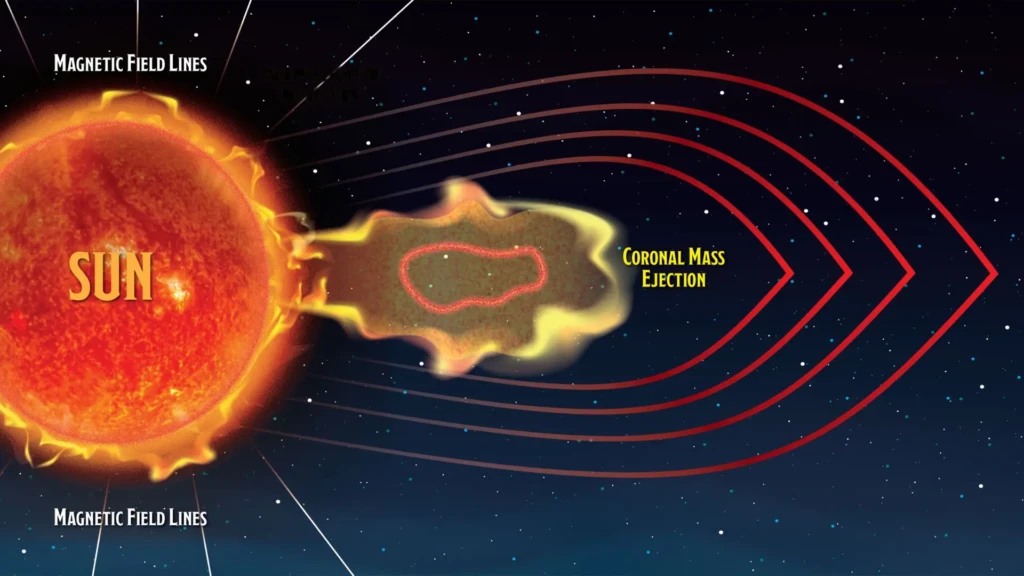
NASA Parker solar probe
Artist’s impression of a coronal mass ejection. Image: NASA

An inflow is caused due to the reconnection process. When a CME occurs, it expands outward and causes nearby magnetic field lines to tear apart. The torn field lines quickly mend themselves and create separate loops. While some of them travel away from the Sun, others realign and reconnect, falling back into the Sun. Angelos Vourlidas, WISPR project scientist, said that the inflow recycles its magnetic field and reshapes the solar atmosphere in subtle ways.

“The magnetic reconfiguration caused by inflows may be enough to point a secondary CME a few degrees in a different direction,” Vourlidas said. “That’s enough to be the difference between a CME crashing into Mars versus sweeping by the planet with no or little effects.”

Every bit of data collected by Parker or other space-based observatories like SOHO (Solar and Heliospheric Observatory) and STEREO (Solar Terrestrial Relations Observatory) will improve models of space weather and the Sun’s complex magnetic environment. They will ultimately help predict the impact of space weather across the solar system.

As the Sun moves toward solar minimum in its 11-year cycle, space weather scenes could get more dramatic, said Rawafi.

ALSO READ: ISRO’s Aditya-L1 And NASA Missions Uncover Reason Behind 2024 Solar Storm Fury

ALSO READ: How Do Auroras Form? Science Behind This Colourful Cosmic Phenomenon

TAGGED:NASAParker Solar ProbeSpaceSun
Share This Article
Facebook Pinterest Whatsapp Whatsapp LinkedIn Copy Link Print

Latest News

SpaceX Dragon spacecraft for NASA's Crew-12 mission.
SpaceX Rolls Out Dragon Spacecraft For NASA’s Crew-12 Mission While Falcon 9 Remains Grounded
Spaceflight
NASA's Artemis II SLS Rocket
NASA Delays Artemis II Moon Mission Launch To March – Here’s Why
Artemis
NASA's SLS rocket.
Astronauts In Quarantine, Rocket Powered On – How NASA Is Preparing For Artemis II
Artemis
NASA partners with Axiom Space
NASA And Axiom Space Announce 5th Private Crew Mission To International Space Station In 2027
Spaceflight

You Might Also Like

NASA Artemis 2
Artemis

NASA Stacks Artemis 2 Spacecraft On Moon Rocket; Here’s What’s Next

December 4, 2025
SpaceX Starship Artemis 3
Artemis

Artemis 3 Delayed To 2028? Report Says SpaceX’s Starship May Hurt NASA Again

December 5, 2025
NASA spherex
Astronomy

NASA Releases Insane Cosmic Map Made By Its Brand New SPHEREx Telescope

January 5, 2026
NASA Artemis II
Artemis

Send Your Name To The Moon For Free On NASA’s Artemis II Mission — Here’s How

December 29, 2025
© 2026, Blue Terra Journal
  • About
  • Privacy Policy
  • Terms
  • Contact
Welcome Back!

Sign in to your account

Username or Email Address
Password

Lost your password?