Blue Terra Journal

  • Home
  • Spaceflight
    SpaceflightShow More
    SpaceX Starship
    SpaceX Starship’s 12th Test Flight Targeted On May 20; No Booster Catch This Time
    May 13, 2026
    SpaceX's Starship during launch rehearsal.
    SpaceX Completes Starship’s Launch Rehearsal For Flight 12 This Week; What To Expect?
    May 13, 2026
    China US rivalry reach new heights.
    ‘Rival’ China Is Unintentionally The Biggest Motivator For NASA’s Moon Ambitions
    April 28, 2026
    NASA Voyager 1 illustration
    NASA Shuts Down Another Voyager 1 Instrument; How Long Can This Spacecraft Last?
    April 22, 2026
    NASA's SR-1 Freedom spacecraft.
    What Is NASA’s SR-1 Freedom Mission? The First Nuclear Reactor In Space Explained
    March 27, 2026
  • Astronomy
    AstronomyShow More
    Artist's impression of NASA's Psyche spacecraft.
    NASA’s Psyche Spacecraft Will Zoom Past Mars Today On Its Way To Metal-Rich Asteroid
    May 15, 2026
    Comet MAPS image
    Video: Comet MAPS destroyed after plunging into the Sun; event caught by NASA missions
    April 18, 2026
    Apophis asteroid flyby
    ‘God Of Chaos’: Apophis Asteroid Will Fly Dangerously Close To Earth Exactly 5 Years From Now
    April 14, 2026
    Meteor spotted over Houston.
    Video Captures 1-Ton Meteor Exploding Over Houston Skies, NASA Releases Statement
    March 22, 2026
    NASA black hole simulation
    Fall Into A Black Hole With This Incredibly Scary Simulation Made By NASA
    March 18, 2026
  • India
    IndiaShow More
    Shubhanshu Shukla aboard the ISS.
    ISRO Astronaut Shubhanshu Shukla Awarded Ashoka Chakra For Heroic Ax-4 Mission
    February 9, 2026
    ISRO's PSLV lifts off to space.
    ISRO’s PSLV Rocket Suffers Third Stage Failure After Successful Liftoff; Payloads Lost
    January 23, 2026
    Dhruva Space team at ISRO facility.
    India’s Dhruva Space To Launch 10 Missions, Including 1st Northeastern Satellite, On ISRO’s PSLV
    January 12, 2026
    ISRO's PSLV rocket
    ISRO To Seek Redemption With PSLV-C62 Mission Launch On January 12
    January 12, 2026
    ISRO SSLV
    ISRO’s SSLV Rocket Just Got Better After Latest Third Stage Test Fire
    December 31, 2025
  • Artemis
    ArtemisShow More
    NASA Artemis II mission
    Welcome Home! NASA’s Artemis II Astronauts Are Back After Historic Moon Voyage
    April 22, 2026
    NASA Artemis II iPhone image
    iPhones Reigned Supreme On NASA’s Artemis II Moon Mission
    April 10, 2026
    Artemis II NASA
    All Eyes On Scary Artemis II Reentry As NASA Moon Mission Nears Completion
    April 9, 2026
    NASA Artemis II
    NASA Artemis II Crew Names Moon Crater ‘Carroll’ After Commander Reid Wiseman’s Late Wife
    April 7, 2026
    NASA Artemis II
    Watch: NASA Artemis II Astronauts Begin Flyby Of Moon’s Far Side For The First Time Ever
    April 9, 2026
  • More
    • About
    • Privacy Policy
    • Terms
    • Contact

Blue Terra Journal

  • Home
  • Spaceflight
  • Astronomy
  • India
  • Artemis
Search
  • Pages
    • About
    • Contact
    • Privacy Policy
    • Terms

Home - Astronomy - ISRO’s Aditya-L1 And NASA Missions Uncover Reason Behind 2024 Solar Storm Fury

Astronomy

ISRO’s Aditya-L1 And NASA Missions Uncover Reason Behind 2024 Solar Storm Fury

Seven missions teamed up to solve 2024 solar storm mystery.

Harsh Vardhan
Last updated: December 13, 2025 12:18 PM
Harsh Vardhan
Share
3 Min Read
ISRO Aditya-L1
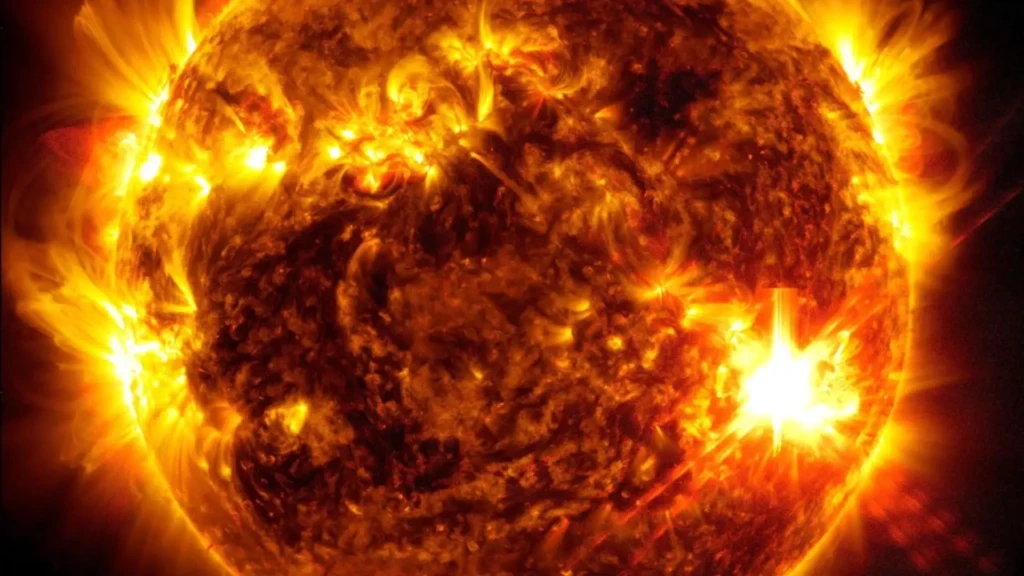
Solar flare captured by NASA's Solar Dynamics Observatory, May 10, 2024. Image: NASA
SHARE

The year 2024 brought the strongest solar storm in more than two decades, effects of which were felt as far as Mars. Earth also had to bear the brunt of what has been named the Gannon’s storm that caused minor GPS disruptions, temporary radio blackouts and intense auroras far beyond the polar regions.

A team of Indian scientists, using ISRO‘s Aditya-L1 space observatory and six NASA space telescopes, have explained why the Gannon’s storm between May 10-14 last year was so extreme.
ISRO Aditya-L1
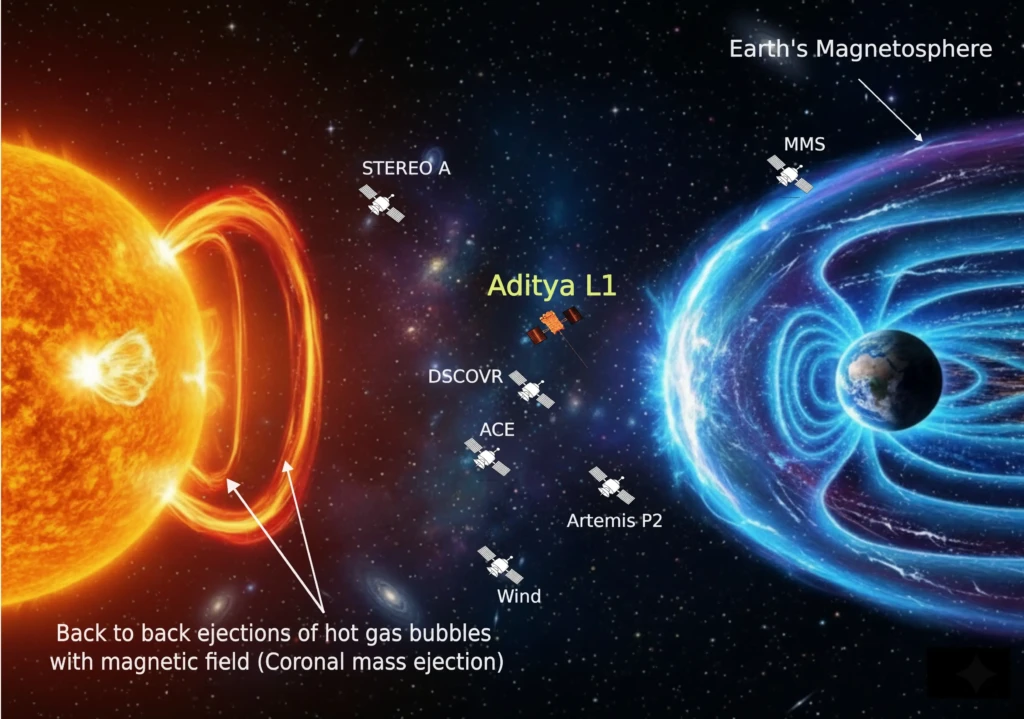
Artist’s impression of Aditya-L1 and NASA observatories in space. Image: ISRO

In the study published in the Astrophysical Journal Letters in September, researchers explained that there was a collision of two Coronal Mass Ejections (CMEs). The collision made the storm’s impact much stronger than expected and many satellites experienced charged solar particles hitting them at increased speed.

ISRO’s Aditya-L1 solves 2024 storm mystery

The coronal mass ejections occur when the Sun’s outer atmosphere layer – the corona – releases huge clouds of electrically charged particles called plasma. Weighing billions of tons, these clouds are sometimes pushed by solar winds and when they interact with the Earth’s magnetosphere, they cause a disturbance. This disturbance results in a geomagnetic storm. Fast CMEs can reach Earth in 15-18 hours whereas slower ones take 2-3 days. 

Scientists explain that CMEs usually carry twisted “magnetic ropes” which interact with the magnetosphere when they extend to Earth. Some CMEs that are more explosive have highly twisted magnetic field structures and they get too stressed. Sometimes, these structures snap, like a rope breaking, and reconnect into a less tense configuration. This process of snapping and reconnecting is called magnetic reconnection.

But last year, two CMEs collided in space and they squeezed the magnetic field structures, causing one of the ‘ropes’ to snap and rejoin in new ways. In a statement, ISRO said that the area where the magnetic ropes were breaking and reconnecting was about 1.3 million kilometres across. The reconnection is said to have reversed the magnetic direction inside the storm, making it stronger than expected.

Apart from Aditya-L1, researchers used data from six NASA missions including Wind, ACE, THEMIS-C, STEREO-A, Magnetospheric Multiscale (MMS), and Deep Space Climate Observatory (DSCOVR).

“For the first time, researchers could study the same extreme solar storm from multiple vantage points in space. Thanks to precise magnetic field measurements from India’s Aditya-L1 mission, scientists were able to map this reconnection region,” ISRO said. “It was the first time such a giant magnetic breakup and rejoining had ever been seen inside a CME.”

ALSO READ: Earth Gets Another Geomagnetic Storm Warning After Strong Solar Eruption | Video

ALSO READ: How Do Auroras Form? Science Behind This Colourful Cosmic Phenomenon
TAGGED:Aditya-L1AurorasISRONASASolar Storm
Share This Article
Facebook Pinterest Whatsapp Whatsapp LinkedIn Copy Link Print

Latest News

Artist's impression of NASA's Psyche spacecraft.
NASA’s Psyche Spacecraft Will Zoom Past Mars Today On Its Way To Metal-Rich Asteroid
Astronomy
SpaceX Starship
SpaceX Starship’s 12th Test Flight Targeted On May 20; No Booster Catch This Time
Spaceflight
SpaceX's Starship during launch rehearsal.
SpaceX Completes Starship’s Launch Rehearsal For Flight 12 This Week; What To Expect?
Spaceflight
China US rivalry reach new heights.
‘Rival’ China Is Unintentionally The Biggest Motivator For NASA’s Moon Ambitions
Spaceflight

You Might Also Like

NASA's Crew-12 astronauts
Spaceflight

NASA-SpaceX Delay Crew-12 Mission Again Due To High Winds; Launch Now Targeted For Feb. 13

February 13, 2026
NASA Crew-12 astronauts
Spaceflight

Welcome Aboard! Watch Astronauts Welcome NASA’s Crew-12 On International Space Station

February 21, 2026
NASA's Crew-11 astronauts
Spaceflight

NASA’s Crew-11 Astronaut Shares Update Ahead Of ISS Evacuation; ‘We’re All OK’

January 12, 2026
ISRO Gaganyaan drop test.
India

ISRO Completes Parachute Air Drop Test Of Gaganyaan Crew Module | Video

November 21, 2025
© 2026, Blue Terra Journal
  • About
  • Privacy Policy
  • Terms
  • Contact
Welcome Back!

Sign in to your account

Username or Email Address
Password

Lost your password?