Blue Terra Journal

  • Home
  • Spaceflight
    SpaceflightShow More
    NASA's SR-1 Freedom spacecraft.
    What Is NASA’s SR-1 Freedom Mission? The First Nuclear Reactor In Space Explained
    March 27, 2026
    Artist's impression of a NASA Moon base.
    NASA Moon Base: How The US Will Spend $20 Billion On This Ambitious Project
    March 25, 2026
    Russia's Soyuz rocket ascending to space.
    Russia’s Progress Spacecraft Suffers Mystery Glitch On Its Way To ISS; What Happened?
    March 23, 2026
    Robert Goddard
    Celebrating Robert Goddard – The Man Who Changed Rocketry 100 Years Ago
    March 17, 2026
    International Space Station gets extension to beat China
    Watch Out China! US Proposes Extending International Space Station Lifespan To 2032
    March 10, 2026
  • Astronomy
    AstronomyShow More
    Meteor spotted over Houston.
    Video Captures 1-Ton Meteor Exploding Over Houston Skies, NASA Releases Statement
    March 22, 2026
    NASA black hole simulation
    Fall Into A Black Hole With This Incredibly Scary Simulation Made By NASA
    March 18, 2026
    Comet C/2026 A1 MAPS
    Comet C/2026 A1 MAPS: What Are ‘Sun-Grazer’ Comets And Why Are They Special?
    March 12, 2026
    Moon is safe from asteroid 2024 YR4.
    The Moon Is Safe! James Webb Space Telescope Rules Out Asteroid 2024 YR4’s Collision
    March 6, 2026
    NASA Moon orbiter
    NASA Prepares To Save Its Orbiter During Total Solar Eclipse On The Moon
    March 3, 2026
  • India
    IndiaShow More
    Shubhanshu Shukla aboard the ISS.
    ISRO Astronaut Shubhanshu Shukla Awarded Ashoka Chakra For Heroic Ax-4 Mission
    February 9, 2026
    ISRO's PSLV lifts off to space.
    ISRO’s PSLV Rocket Suffers Third Stage Failure After Successful Liftoff; Payloads Lost
    January 23, 2026
    Dhruva Space team at ISRO facility.
    India’s Dhruva Space To Launch 10 Missions, Including 1st Northeastern Satellite, On ISRO’s PSLV
    January 12, 2026
    ISRO's PSLV rocket
    ISRO To Seek Redemption With PSLV-C62 Mission Launch On January 12
    January 12, 2026
    ISRO SSLV
    ISRO’s SSLV Rocket Just Got Better After Latest Third Stage Test Fire
    December 31, 2025
  • Artemis
    ArtemisShow More
    NASA Artemis II crew
    NASA’s Christina Koch Turns ‘Space Plumber’ To Fix $30 Million Toilet On Artemis II Mission
    April 3, 2026
    NASA Orion spacecraft
    NASA’s Artemis II Astronauts Are Moon-Bound After Successful Trans-Lunar Injection Burn
    April 3, 2026
    NASA Artemis II lifts off.
    Artemis II Lifts Off! NASA Launches 4 Astronauts To The Moon After Over 50 Years
    April 2, 2026
    NASA's Artemis II astronauts
    NASA Artemis II Launch Live: Watch Humanity Return To The Moon On April 2
    April 2, 2026
    NASA Apollo 8 image
    NASA Artemis II: Why This Moon Mission Is Our Generation’s Apollo 8
    March 30, 2026
  • More
    • About
    • Privacy Policy
    • Terms
    • Contact

Blue Terra Journal

  • Home
  • Spaceflight
  • Astronomy
  • India
  • Artemis
Search
  • Pages
    • About
    • Contact
    • Privacy Policy
    • Terms

Home - Astronomy - James Webb Space Telescope Finds Strongest Clues Of Atmosphere On A Scorching Super-Earth

Astronomy

James Webb Space Telescope Finds Strongest Clues Of Atmosphere On A Scorching Super-Earth

One year on this planet lasts just 11 hours.

Harsh Vardhan
Last updated: December 12, 2025 2:58 PM
Harsh Vardhan
Share
5 Min Read
James Webb Space Telescope NASA
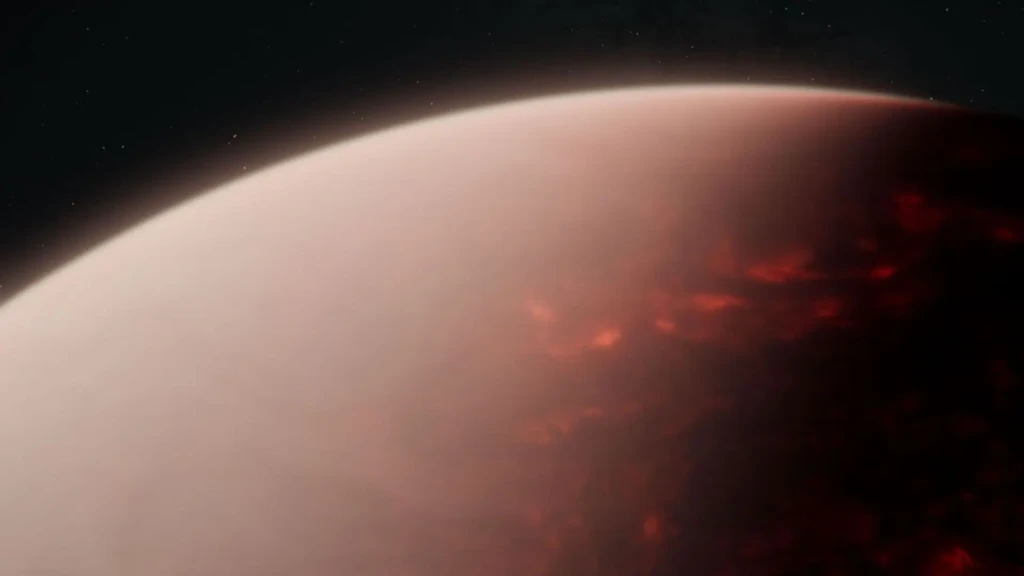
Artist's impression of the exoplanet TOI-561b. Image NASA
SHARE

The James Webb Space Telescope has discovered the strongest evidence of an atmosphere around a rocky exoplanet, says NASA. The planet TOI-561 b, which is an ultra-hot super-Earth, also has an unusually low density which is puzzling scientists. The discovery has challenged the present understanding of such worlds that lose their atmospheres when they’re too close to their star.

Webb detected the strongest evidence yet for an atmosphere on a rocky planet outside of our solar system! Findings suggest ultra-hot super-Earth TOI-561 b is surrounded by a thick blanket of gases above a global magma ocean. https://t.co/d6g3z4pnUr pic.twitter.com/2VdiyU8LMs

— NASA Webb Telescope (@NASAWebb) December 11, 2025

In a study published in the Astrophysical Journal Letters, researchers noted that TOI-561 b is orbiting its star from a distance of just 1.6 million km and is tidally locked. Its one side always faces the star, causing it to exceed the melting temperature of a typical rock. With a radius 1.4 times greater than Earth’s, this planet completes one orbit in just 11 hours. Thanks to Webb, scientists now believe that TOI-561b, located 280 light-years away, is surrounded by a thick blanket of gases above a magma ocean.

What James Webb Space Telescope found

Johanna Teske of the Carnegie Science Earth and Planets Laboratory, and lead author of the study, explained that its anomalously low density is what really sets this planet apart. “It’s not a super-puff, but it is less dense than you would expect if it had an Earth-like composition,” Teske said in a statement.

The study team says its low density could be a result of TOI-561b having a relatively small iron core and mantle rock less dense than Earth’s. Besides, this planet orbits an iron-poor star which formed in the Milky Way’s ‘thick disk’ region, which may have a very different chemical environment. Interestingly, this star is estimated to be twice as old as the Sun.
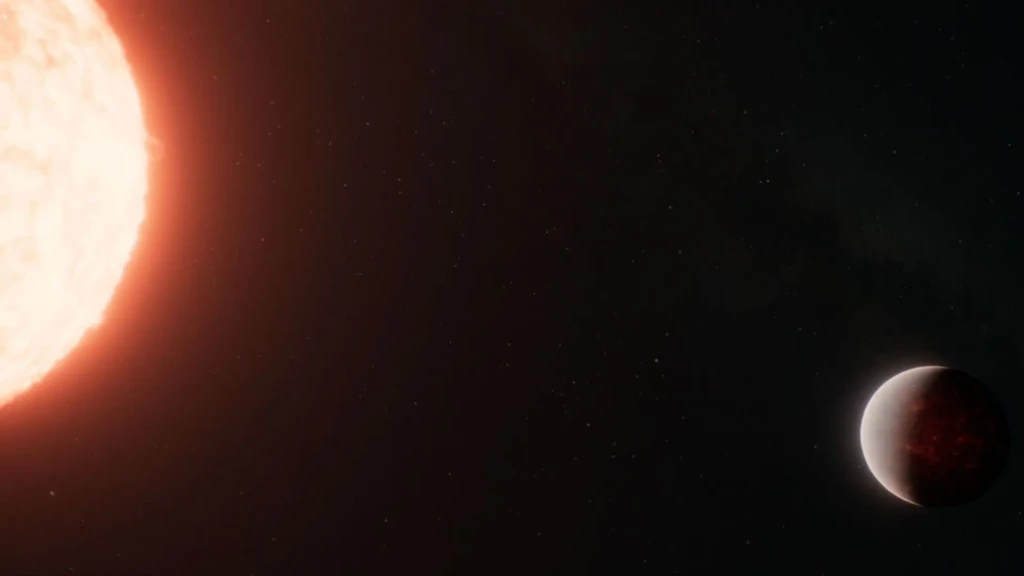
James Webb Space Telescope NASA
Artist’s impression of exoplanet TOI-561b around its star. Image: NASA

Apart from the density, scientists are surprised about the planet enveloped in an atmosphere despite enduring intense stellar radiation. To confirm if it indeed is blanketed with gases, Teske’s team used Webb’s NIRSpec (Near-Infrared Spectrograph) to determine its temperature. They found that in spite of TOI-561b’s closeness to the host star, its dayside temperature is around 1,800 degrees Celsius – far cooler than expected. The temperature should have been about 2,700 degrees Celsius if it really lacked an atmosphere.

“We really need a thick volatile-rich atmosphere to explain all the observations,” said Anjali Piette, coauthor from the UK’s University of Birmingham.

ALSO READ: NASA’s Webb Telescope Discovers 13 Billion Years Old Supernova; Breaks Own Record

One reason for the cooler temperature, researchers deduced, could be the exoplanet circulating heat onto the nightside, and strong winds cooling the dayside. Moreover, gases like water vapour may be absorbing some wavelengths of infrared light from the surface, before they penetrate the atmosphere and reach the telescope, making the planet look colder. If Webb detects less infrared light, a planet will appear cooler than it really is.

“We think there is an equilibrium between the magma ocean and the atmosphere. At the same time that gases are coming out of the planet to feed the atmosphere, the magma ocean is sucking them back into the interior,” said co-author Tim Lichtenberg. “This planet must be much, much more volatile-rich than Earth to explain the observations. It’s really like a wet lava ball.”

The observations were made under Webb’s General Observers Program 3860 wherein scientists observed the exoplanet complete nearly four orbits of its star over 37 hours. They are now looking to answer how a planet so close to a star can have such a substantial atmosphere.

ALSO READ: NASA’s Incredible Nancy Grace Roman Telescope Is Assembled – Here’s What It Will Do

TAGGED:ExoplanetJames Webb Space TelescopeNASASpace
Share This Article
Facebook Pinterest Whatsapp Whatsapp LinkedIn Copy Link Print

Latest News

NASA Artemis II crew
NASA’s Christina Koch Turns ‘Space Plumber’ To Fix $30 Million Toilet On Artemis II Mission
Artemis
NASA Orion spacecraft
NASA’s Artemis II Astronauts Are Moon-Bound After Successful Trans-Lunar Injection Burn
Artemis
NASA Artemis II lifts off.
Artemis II Lifts Off! NASA Launches 4 Astronauts To The Moon After Over 50 Years
Artemis
NASA's Artemis II astronauts
NASA Artemis II Launch Live: Watch Humanity Return To The Moon On April 2
Artemis

You Might Also Like

Comet Wierzchoś
Astronomy

A Hefty Green Comet Just Flew By Earth. Here’s How You Can Still Spot It

February 20, 2026
NASA Japan
Spaceflight

NASA Lends Support To Japan After H3 Rocket Failure; Here’s What Went Wrong

December 23, 2025
Blue Origin's New Glenn rocket.
Spaceflight

Blue Origin Targets Nov 13 To Launch New Glenn For NASA’s ESCAPADE Mission

November 12, 2025
NASA Artemis 2
Artemis

Artemis 2 Explained: NASA’s First Crewed Moon Mission Since 1972

November 17, 2025
© 2026, Blue Terra Journal
  • About
  • Privacy Policy
  • Terms
  • Contact
Welcome Back!

Sign in to your account

Username or Email Address
Password

Lost your password?