Blue Terra Journal

  • Home
  • Spaceflight
    SpaceflightShow More
    SpaceX Dragon spacecraft for NASA's Crew-12 mission.
    SpaceX Rolls Out Dragon Spacecraft For NASA’s Crew-12 Mission While Falcon 9 Remains Grounded
    February 4, 2026
    NASA partners with Axiom Space
    NASA And Axiom Space Announce 5th Private Crew Mission To International Space Station In 2027
    February 1, 2026
    Blue Origin Mark 1 lander.
    Blue Origin Halts New Shepard Missions For At Least 2 Years To Land Humans On The Moon
    February 1, 2026
    SpaceX Starship on flight 11.
    SpaceX CEO Elon Musk Reveals When Starship Will Launch On Next Test Flight
    January 29, 2026
    NOAA's SOLAR-1 observatory.
    NOAA’s Sun Spying SOLAR-1 Observatory Reaches Its Destination 1.5 Million Km From Earth
    January 31, 2026
  • Astronomy
    AstronomyShow More
    Voyager 1 illustration
    NASA’s Voyager 1 Will Be One Light-Day Away From Earth In 2026 – What This Means
    January 26, 2026
    Auroras triggered by CMEs.
    Auroras Flood The Night Skies After Largest Solar Radiation Storm In Over 20 Years | Photos
    January 20, 2026
    Hubble discovers Cloud-9.
    Hubble Telescope Uncovers New Object ‘Cloud-9’ – A ‘Failed Galaxy’ With No Stars
    January 13, 2026
    SpaceX launches NASA telescope.
    SpaceX Launches NASA’s Exoplanet Exploring Telescope Pandora On Twilight Mission
    January 19, 2026
    Comet 3I/ATLAS by Hubble telescope
    Comet 3I/ATLAS Is Not An Alien Spacecraft – This Research Likely Confirms It
    January 10, 2026
  • India
    IndiaShow More
    Shubhanshu Shukla aboard the ISS.
    ISRO Astronaut Shubhanshu Shukla Awarded Ashoka Chakra For Heroic Ax-4 Mission
    January 25, 2026
    ISRO's PSLV lifts off to space.
    ISRO’s PSLV Rocket Suffers Third Stage Failure After Successful Liftoff; Payloads Lost
    January 23, 2026
    Dhruva Space team at ISRO facility.
    India’s Dhruva Space To Launch 10 Missions, Including 1st Northeastern Satellite, On ISRO’s PSLV
    January 12, 2026
    ISRO's PSLV rocket
    ISRO To Seek Redemption With PSLV-C62 Mission Launch On January 12
    January 12, 2026
    ISRO SSLV
    ISRO’s SSLV Rocket Just Got Better After Latest Third Stage Test Fire
    December 31, 2025
  • Artemis
    ArtemisShow More
    NASA's Artemis II SLS Rocket
    NASA Delays Artemis II Moon Mission Launch To March – Here’s Why
    February 3, 2026
    NASA's SLS rocket.
    Astronauts In Quarantine, Rocket Powered On – How NASA Is Preparing For Artemis II
    February 3, 2026
    NASA's Artemis II crew
    Inside Artemis II: How NASA Will Study Astronaut Health And Deep Space Radiation
    January 30, 2026
    NASA's SLS rocket at launch pad.
    NASA’s Artemis II To Carry Relic Of Humanity’s First Flight And More To The Moon
    January 27, 2026
    NASA's SLS rocket
    NASA’s SLS Rocket Rolls Out To The Launch Pad For Artemis II – Here’s What’s Next
    January 27, 2026
  • More
    • About
    • Privacy Policy
    • Terms
    • Contact

Blue Terra Journal

  • Home
  • Spaceflight
  • Astronomy
  • India
  • Artemis
Search
  • Pages
    • About
    • Contact
    • Privacy Policy
    • Terms

Home - Spaceflight - NASA’s Mars-Bound ESCAPADE Spacecraft Prepare For First Engine Burns

Spaceflight

NASA’s Mars-Bound ESCAPADE Spacecraft Prepare For First Engine Burns

Big days ahead!

Harsh Vardhan
Last updated: December 2, 2025 11:43 AM
Harsh Vardhan
Share
6 Min Read
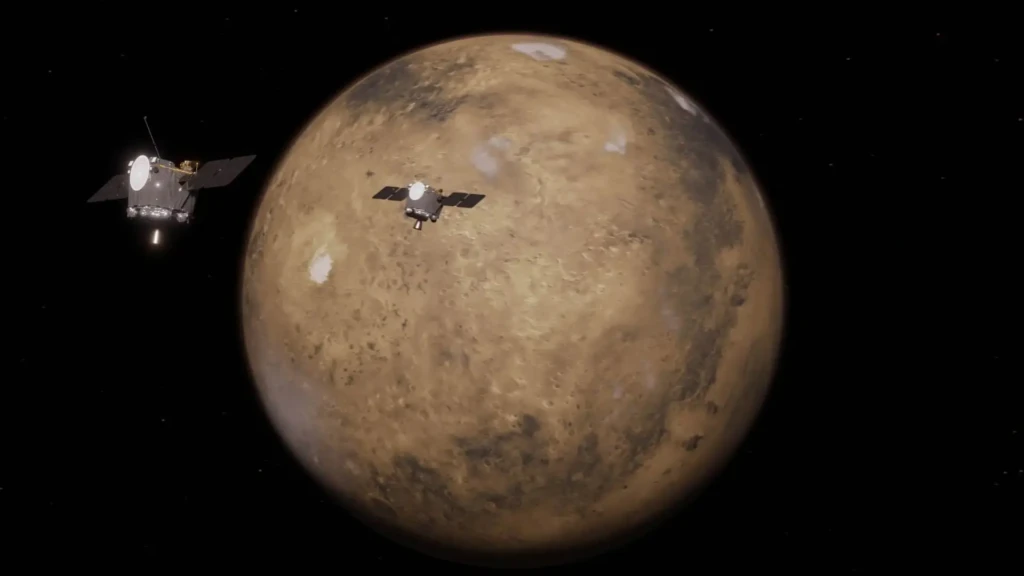
NASA ESCAPADE mission
Artist's impression of ESCAPADE orbiters around Mars. Image: NASA
SHARE

Contents
  • How do engine burns work?
  • ESCAPADE’s detour to Lagrange point

NASA’s ESCAPADE mission has a big day ahead. The two spacecraft Blue and Gold, built by Rocket Lab, will execute their first engine burns starting tomorrow (December 3) on their way to Mars. This ‘Trajectory Correction Maneuver’ will be the first of three major ones to be carried out by Rocket Lab, before they hand over the controls to University of California, Berkeley’s Space Sciences Lab, NASA’s partner in this mission.

Short for Escape and Plasma Acceleration and Dynamics Explorers, ESCAPADE launched on November 14 as the world’s first twin-spacecraft mission.

How do engine burns work?

The engine burn procedures are executed after mission teams complete a spacecraft’s commissioning – a process that gets all subsystems up and running. During this process, the spacecraft’s main engine or smaller, secondary thrusters are fired to correct its course in space. Big maneuvers require main engines to fire for a set duration of time to accelerate and slow down a spacecraft or change its trajectory.

ESCAPADE involves two orbiters named Blue and Gold, and the December 3 burn is likely to use the main engine for short-duration firing. According to Rocket Lab, Blue will ignite its engine for 15 seconds, using 2 kg of propellant to change the velocity by 11.5 meters per second.

So you’re in space and on the way to Mars, what next? Time to fire up the engines 🛰️🛰️

Now that Blue and Gold are commissioned, our spacecraft operators are turning their attention to propulsion systems in preparation for the first engine burns to set us on a precise course to… pic.twitter.com/jFr9VkKjtL

— Rocket Lab (@RocketLab) December 1, 2025

“This is our initial demonstration maneuver to verify all systems perform as expected. Our fault management limits will be at their tightest to be conservative, based on margined modelling of how we expect the systems to perform,” Rocket Lab said in a statement. The second line above means the team is keeping safety thresholds very tight because this is the first burn and they only have model-based predictions of how the engines will perform in vacuum. If there’s even the slightest anomaly, the burn will stop. 

Gold’s engines will be fired on December 8 or 9 to achieve the same result as Blue. One of the orbiters recently sent the first images from space. 
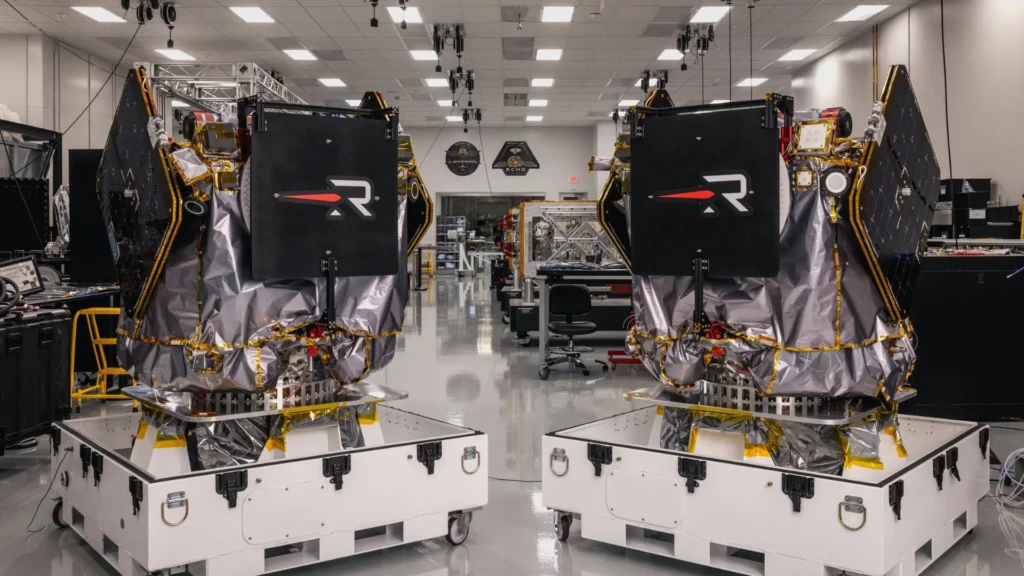
NASA ESCAPADE satellites.
NASA’s ESCAPADE satellites. Image: Rocket Lab

The second TCM of Blue and Gold is expected on December 11 and December 16, respectively. It will be a longer burn of 257 seconds to deliver 200 meters per second of delta V (change in velocity). Rocket Lab says this burn will reveal how strong the engines’ thrust is, how efficiently the fuel burns and how much propellant remains. If efficiency is high, Blue and Gold will be left with more propellant when they reach Mars. This will enable them to stay in the Martian orbit longer (because they could overcome orbital decay using engine burns) and help scientists collect more data.

The third burn is tentatively planned as a final clean-up maneuver, although it may not be needed. After this, Rocket Lab will hand over the mission to UC Berkley. A total of 37 burns are planned for ESCAPADE – 29 on the way to Mars and eight to adjust orbits around the planet.

ESCAPADE’s detour to Lagrange point

The ESCAPADE satellites are not directly going to Mars. They’re taking a detour to the second Earth-Sun Lagrange point where they’ll stay until next November. This will give mission teams time to fine-tune the spacecraft components until Earth and Mars get close in late 2026. Blue and Gold will then once again ignite their engines for a Trans-Mars Injection burn in November 2026 and kickstart their 10 month cruise phase to the red planet.

In September 2027, both orbiters will begin the Mars Orbit Insertion maneuvers to enter the Martian orbit. They will eventually occupy different orbits around Mars to study the interaction of the solar wind with the planet’s magnetosphere for a planned duration of 11 months. The objective is to find out how Mars lost its atmosphere and eventually its oceans, and whether Earth might share the same fate.

ALSO READ: NASA’s ESCAPADE Mission Is Off To Mars. What Happens Next?

ALSO READ: NASA’s ESCAPADE Mars Spacecraft Receives ‘First Light’ In Space; Images Released

TAGGED:ESCAPADEMarsNASARocket Lab
Share This Article
Facebook Pinterest Whatsapp Whatsapp LinkedIn Copy Link Print

Latest News

SpaceX Dragon spacecraft for NASA's Crew-12 mission.
SpaceX Rolls Out Dragon Spacecraft For NASA’s Crew-12 Mission While Falcon 9 Remains Grounded
Spaceflight
NASA's Artemis II SLS Rocket
NASA Delays Artemis II Moon Mission Launch To March – Here’s Why
Artemis
NASA's SLS rocket.
Astronauts In Quarantine, Rocket Powered On – How NASA Is Preparing For Artemis II
Artemis
NASA partners with Axiom Space
NASA And Axiom Space Announce 5th Private Crew Mission To International Space Station In 2027
Spaceflight

You Might Also Like

Perseverance rover NASA
Astronomy

How Long Could The Perseverance Rover Last On Mars? NASA Answers

December 30, 2025
Menstruation cups
Spaceflight

Menstruation Cups May Be The Giant Leap Needed For Women’s Health In Space

December 12, 2025
Voyager 1 illustration
Astronomy

NASA’s Voyager 1 Will Be One Light-Day Away From Earth In 2026 – What This Means

January 26, 2026
NASA Artemis 2 Orion spacecraft.
Artemis

Artemis 2: Unraveling NASA Orion Capsule – Humanity’s Ride To The Moon

November 26, 2025
© 2026, Blue Terra Journal
  • About
  • Privacy Policy
  • Terms
  • Contact
Welcome Back!

Sign in to your account

Username or Email Address
Password

Lost your password?