Blue Terra Journal

  • Home
  • Spaceflight
    SpaceflightShow More
    SpaceX Dragon spacecraft for NASA's Crew-12 mission.
    SpaceX Rolls Out Dragon Spacecraft For NASA’s Crew-12 Mission While Falcon 9 Remains Grounded
    February 4, 2026
    NASA partners with Axiom Space
    NASA And Axiom Space Announce 5th Private Crew Mission To International Space Station In 2027
    February 1, 2026
    Blue Origin Mark 1 lander.
    Blue Origin Halts New Shepard Missions For At Least 2 Years To Land Humans On The Moon
    February 1, 2026
    SpaceX Starship on flight 11.
    SpaceX CEO Elon Musk Reveals When Starship Will Launch On Next Test Flight
    January 29, 2026
    NOAA's SOLAR-1 observatory.
    NOAA’s Sun Spying SOLAR-1 Observatory Reaches Its Destination 1.5 Million Km From Earth
    January 31, 2026
  • Astronomy
    AstronomyShow More
    Voyager 1 illustration
    NASA’s Voyager 1 Will Be One Light-Day Away From Earth In 2026 – What This Means
    January 26, 2026
    Auroras triggered by CMEs.
    Auroras Flood The Night Skies After Largest Solar Radiation Storm In Over 20 Years | Photos
    January 20, 2026
    Hubble discovers Cloud-9.
    Hubble Telescope Uncovers New Object ‘Cloud-9’ – A ‘Failed Galaxy’ With No Stars
    January 13, 2026
    SpaceX launches NASA telescope.
    SpaceX Launches NASA’s Exoplanet Exploring Telescope Pandora On Twilight Mission
    January 19, 2026
    Comet 3I/ATLAS by Hubble telescope
    Comet 3I/ATLAS Is Not An Alien Spacecraft – This Research Likely Confirms It
    January 10, 2026
  • India
    IndiaShow More
    Shubhanshu Shukla aboard the ISS.
    ISRO Astronaut Shubhanshu Shukla Awarded Ashoka Chakra For Heroic Ax-4 Mission
    January 25, 2026
    ISRO's PSLV lifts off to space.
    ISRO’s PSLV Rocket Suffers Third Stage Failure After Successful Liftoff; Payloads Lost
    January 23, 2026
    Dhruva Space team at ISRO facility.
    India’s Dhruva Space To Launch 10 Missions, Including 1st Northeastern Satellite, On ISRO’s PSLV
    January 12, 2026
    ISRO's PSLV rocket
    ISRO To Seek Redemption With PSLV-C62 Mission Launch On January 12
    January 12, 2026
    ISRO SSLV
    ISRO’s SSLV Rocket Just Got Better After Latest Third Stage Test Fire
    December 31, 2025
  • Artemis
    ArtemisShow More
    NASA's Artemis II SLS Rocket
    NASA Delays Artemis II Moon Mission Launch To March – Here’s Why
    February 3, 2026
    NASA's SLS rocket.
    Astronauts In Quarantine, Rocket Powered On – How NASA Is Preparing For Artemis II
    February 3, 2026
    NASA's Artemis II crew
    Inside Artemis II: How NASA Will Study Astronaut Health And Deep Space Radiation
    January 30, 2026
    NASA's SLS rocket at launch pad.
    NASA’s Artemis II To Carry Relic Of Humanity’s First Flight And More To The Moon
    January 27, 2026
    NASA's SLS rocket
    NASA’s SLS Rocket Rolls Out To The Launch Pad For Artemis II – Here’s What’s Next
    January 27, 2026
  • More
    • About
    • Privacy Policy
    • Terms
    • Contact

Blue Terra Journal

  • Home
  • Spaceflight
  • Astronomy
  • India
  • Artemis
Search
  • Pages
    • About
    • Contact
    • Privacy Policy
    • Terms

Home - Astronomy - What Webb Telescope’s Triple-Star System Discovery Reveals About The Universe

Astronomy

What Webb Telescope’s Triple-Star System Discovery Reveals About The Universe

'This is a one-of-a-kind system.'

Abhishek Raval
Last updated: November 22, 2025 8:52 PM
Abhishek Raval
Share
5 Min Read
Webb telescope wolf-rayet
Wolf-Rayet star system Apep captured by Webb telescope. Image: NASA
SHARE

NASA’s James Webb Space Telescope (JWST) captured a remarkable image of a rare triple-star system, revealing a tightly bound two Wolf–Rayet (WR) stars wrapped in four expanding dust shells. Wolf-Rayets are a rare and extreme class of very massive, hot and luminous stars that are in a late stage of stellar evolution. These stars have extremely powerful stellar winds that strip away their outer layers, exposing the hotter helium-rich core beneath.

The discovery may hold clues into how massive stars die, and why some evolve into supernovae and the even rarer gamma-ray bursts (GRB) — ‘the most luminous explosions in the cosmos,’ according to NASA. The mid-infrared image, released on November 20, features the system named ‘Apep’ lying 8,000 light years away in the Norma constellation. It features four serpentine spiral shells, each expanding beyond the next in precisely the same pattern. The fourth shell, scientists noted,  is almost transparent at the edges of Webb’s image.

Webb refined our view of Apep, a star system consisting of two rare Wolf-Rayet stars and a supermassive third star, which is slicing holes in the dusty shells its companions are creating. https://t.co/JxT8TnNPbR pic.twitter.com/fPfwrlcoOS

— NASA Webb Telescope (@NASAWebb) November 19, 2025

Prior to Webb, ground-based telescopes showed only one shell because of their limited infrared abilities. Webb has also confirmed that this system has three gravitationally bound stars (two Wolf-Rayets and one massive supergiant star). Scientists have known about the third star since 2018 but Webb proved it has a gravitational influence on the WR binary.

According to NASA, dust ejected by the two Wolf-Rayets is being slashed by this supergiant, which carves holes into each expanding cloud of dust from its wider orbit.
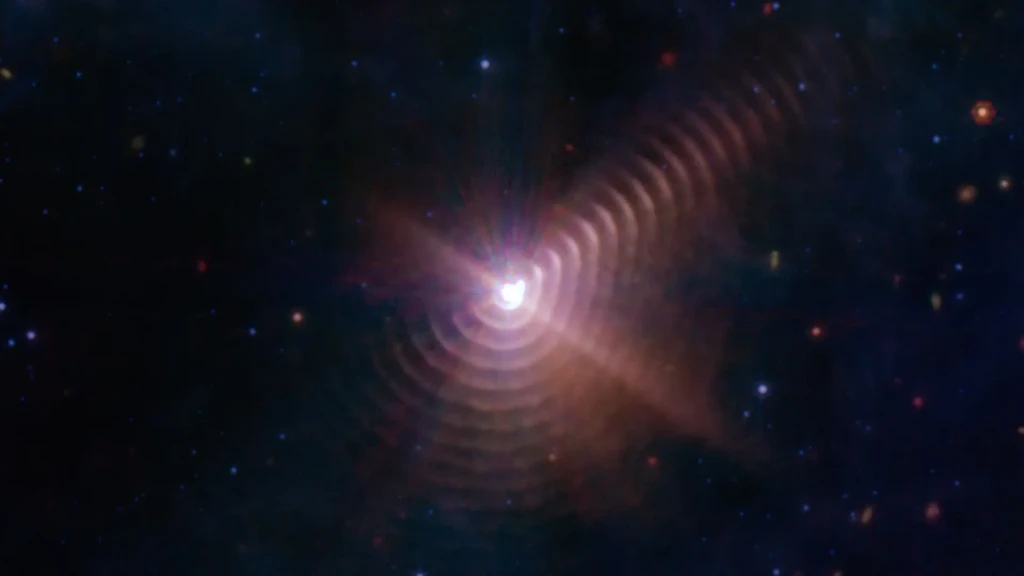
Webb telescope wolf-rayet
The Wolf-Rayet 140 star captured by Webb telescope, 2022. Image: NASA

It is estimated that the shells were emitted by the Wolf-Rayets in the Apep system (a nod to the Egyptian god of chaos) over the last 700 years ago. Combining Webb’s data with the European Southern Observatory’s Very Large Telescope (VLT) in Chile, astronomers discovered that the Wolf-Rayet pair passed by each other once every 190 years. At some point in their orbit, they pass closely for 25 years which results in the formation of dust shells. 

ALSO READ: What Are Interstellar Comets And What Makes Them Special?

‘One-of-a-kind system’

Emphasising the importance of the discovery, Ryan White, a PhD student at Macquarie University in Sydney, Australia said in a statement, “This is a one-of-a-kind system with an incredibly rare orbital period. The next longest orbit for a dusty Wolf-Rayet binary is about 30 years. Most have orbits between two and 10 years.”

The WR stars are throwing out dust at a massive scale – 1,200 to 2,000 miles per second (2,000 to 3,000 kilometers per second). NASA says their dust shell is mainly made of amorphous carbon. These dust particles retain a higher temperature even as they coast far away from the star and despite emitting faint light, they can be easily detected by Webb’s Mid-Infrared Instrument (MIRI).
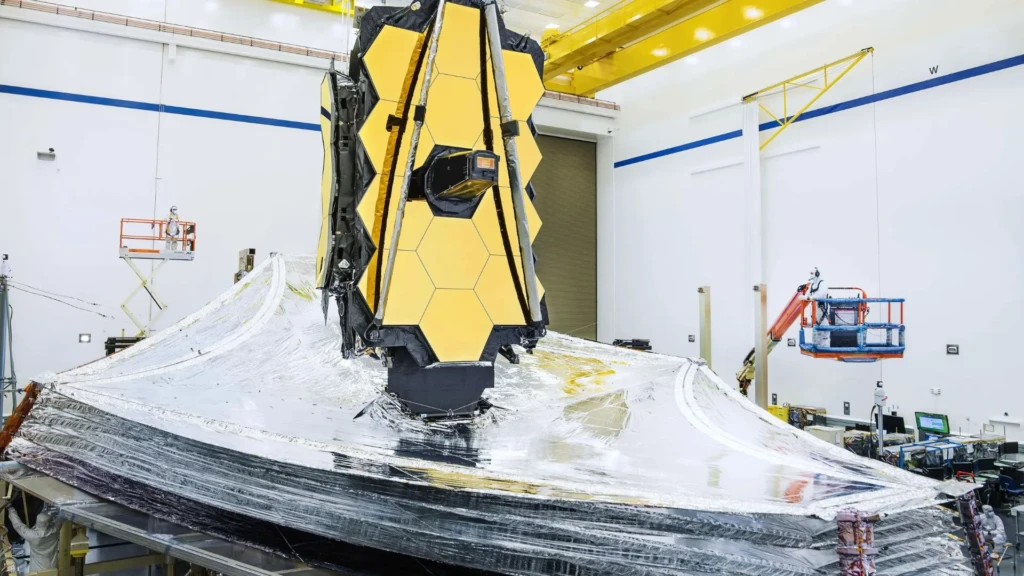
NASA Webb Telescope
An unfurled James Webb Space Telescope. Image: NASA

Having likely shed most of their mass, the Wolf-Rayet stars are estimated to be around 10-20 times the mass of the Sun, whereas the supergiant is around 40-50 times more massive.

The Apep star system has the potential to unravel several phenomena that have long puzzled astronomers. For instance, it can help scientists understand how dust forms in the late stages of stellar evolution and eventually contribute to the formation of planets and even life. Webb’s infrared data could also reveal the chemical makeup of this dust, some of which may be similar to the building blocks of life on Earth.

This discovery is significant because there are only a thousand systems like Apep estimated to exist in the Milky Way. Moreover, Apep is the only one out of a few hundred binary systems observed to date whose both stars are Wolf-Rayets; most of them in our galaxy only contain one. 

ALSO READ: Massive Coronal Mass Ejection Spotted On Another Star For The First Time

TAGGED:James Webb Space TelescopeMilky Way galaxyNASAWebb Telescope
Share This Article
Facebook Pinterest Whatsapp Whatsapp LinkedIn Copy Link Print

Latest News

SpaceX Dragon spacecraft for NASA's Crew-12 mission.
SpaceX Rolls Out Dragon Spacecraft For NASA’s Crew-12 Mission While Falcon 9 Remains Grounded
Spaceflight
NASA's Artemis II SLS Rocket
NASA Delays Artemis II Moon Mission Launch To March – Here’s Why
Artemis
NASA's SLS rocket.
Astronauts In Quarantine, Rocket Powered On – How NASA Is Preparing For Artemis II
Artemis
NASA partners with Axiom Space
NASA And Axiom Space Announce 5th Private Crew Mission To International Space Station In 2027
Spaceflight

You Might Also Like

Comet 3I/ATLAS
Astronomy

Comet 3I/ATLAS Live Tracking: How To Keep An Eye On This Interstellar Visitor?

January 5, 2026
Comet 3I/ATLAS NASA Avi Loeb
Astronomy

Comet 3I/ATLAS Will Get Closest To Earth On Dec 19 – Here’s What You Must Know

December 20, 2025
NASA Artemis 1.
Artemis

Artemis 1 Launch Anniversary: Revisiting NASA’s Historic Moon Mission

November 17, 2025
Space debris.
Spaceflight

China’s Shenzhou-20 Mission Crisis Exposes Growing Menace Of Space Debris

November 15, 2025
© 2026, Blue Terra Journal
  • About
  • Privacy Policy
  • Terms
  • Contact
Welcome Back!

Sign in to your account

Username or Email Address
Password

Lost your password?