Blue Terra Journal

  • Home
  • Spaceflight
    SpaceflightShow More
    SpaceX Dragon spacecraft for NASA's Crew-12 mission.
    SpaceX Rolls Out Dragon Spacecraft For NASA’s Crew-12 Mission While Falcon 9 Remains Grounded
    February 4, 2026
    NASA partners with Axiom Space
    NASA And Axiom Space Announce 5th Private Crew Mission To International Space Station In 2027
    February 1, 2026
    Blue Origin Mark 1 lander.
    Blue Origin Halts New Shepard Missions For At Least 2 Years To Land Humans On The Moon
    February 1, 2026
    SpaceX Starship on flight 11.
    SpaceX CEO Elon Musk Reveals When Starship Will Launch On Next Test Flight
    January 29, 2026
    NOAA's SOLAR-1 observatory.
    NOAA’s Sun Spying SOLAR-1 Observatory Reaches Its Destination 1.5 Million Km From Earth
    January 31, 2026
  • Astronomy
    AstronomyShow More
    Voyager 1 illustration
    NASA’s Voyager 1 Will Be One Light-Day Away From Earth In 2026 – What This Means
    January 26, 2026
    Auroras triggered by CMEs.
    Auroras Flood The Night Skies After Largest Solar Radiation Storm In Over 20 Years | Photos
    January 20, 2026
    Hubble discovers Cloud-9.
    Hubble Telescope Uncovers New Object ‘Cloud-9’ – A ‘Failed Galaxy’ With No Stars
    January 13, 2026
    SpaceX launches NASA telescope.
    SpaceX Launches NASA’s Exoplanet Exploring Telescope Pandora On Twilight Mission
    January 19, 2026
    Comet 3I/ATLAS by Hubble telescope
    Comet 3I/ATLAS Is Not An Alien Spacecraft – This Research Likely Confirms It
    January 10, 2026
  • India
    IndiaShow More
    Shubhanshu Shukla aboard the ISS.
    ISRO Astronaut Shubhanshu Shukla Awarded Ashoka Chakra For Heroic Ax-4 Mission
    January 25, 2026
    ISRO's PSLV lifts off to space.
    ISRO’s PSLV Rocket Suffers Third Stage Failure After Successful Liftoff; Payloads Lost
    January 23, 2026
    Dhruva Space team at ISRO facility.
    India’s Dhruva Space To Launch 10 Missions, Including 1st Northeastern Satellite, On ISRO’s PSLV
    January 12, 2026
    ISRO's PSLV rocket
    ISRO To Seek Redemption With PSLV-C62 Mission Launch On January 12
    January 12, 2026
    ISRO SSLV
    ISRO’s SSLV Rocket Just Got Better After Latest Third Stage Test Fire
    December 31, 2025
  • Artemis
    ArtemisShow More
    NASA's SLS rocket.
    NASA’s Artemis II Rocket Plagued By Leaks Again; Administrator Jared Isaacman Reacts
    February 5, 2026
    NASA's Artemis II SLS Rocket
    NASA Delays Artemis II Moon Mission Launch To March – Here’s Why
    February 3, 2026
    NASA's SLS rocket.
    Astronauts In Quarantine, Rocket Powered On – How NASA Is Preparing For Artemis II
    February 3, 2026
    NASA's Artemis II crew
    Inside Artemis II: How NASA Will Study Astronaut Health And Deep Space Radiation
    January 30, 2026
    NASA's SLS rocket at launch pad.
    NASA’s Artemis II To Carry Relic Of Humanity’s First Flight And More To The Moon
    January 27, 2026
  • More
    • About
    • Privacy Policy
    • Terms
    • Contact

Blue Terra Journal

  • Home
  • Spaceflight
  • Astronomy
  • India
  • Artemis
Search
  • Pages
    • About
    • Contact
    • Privacy Policy
    • Terms

Home - Artemis - Artemis 2 Explained: NASA’s First Crewed Moon Mission Since 1972

Artemis

Artemis 2 Explained: NASA’s First Crewed Moon Mission Since 1972

The stakes are high!

Harsh Vardhan
Last updated: November 17, 2025 1:54 PM
Harsh Vardhan
Share
6 Min Read
NASA Artemis 2
NASA's Artemis 2 mission astronauts. Image: NASA
SHARE

Contents
  • The Artemis 2 mission
  • The launch and the journey
  • The way back home

We might just be a few months away from watching humans launch to the Moon. NASA‘s next crewed lunar mission – Artemis 2 – is reportedly set for launch in February 2026, sooner than the previous target in April. While none of the four astronauts on this mission will land on the Moon, their trip around it will test critical technologies both on the Space Launch System (SLS) rocket and the Orion spacecraft.

The Artemis 2 mission

Artemis 2 is the second lunar mission of NASA’s Artemis Program. Having tested the SLS rocket’s performance during Artemis 1 in November 2022, Artemis 2 will focus on validating Orion’s systems in actual deep space environment with humans onboard.

The crew members are commander Reid Wiseman, pilot Victor Glover and two mission specialists – Christina Koch and Jeremy Hansen. Artemis 2 will prove that Orion’s life support systems are reliable and robust for long duration missions while allowing the crew to practice essential operations in microgravity. It will be the first crew mission launching to the Moon since Apollo 17 in 1972 and includes the first female astronaut selected for a lunar trip.

The Artemis 2 crew.
Artemis 2 astronauts Christina Koch (left), Reid Wiseman (sitting), Victor Glover, Jeremy Hansen (right). Image: NASA

The Orion spacecraft encountered some issues like communication blackouts during Artemis 1 and its heatshield got damaged more than expected during re-entry. Since then, NASA has worked to fill the gaps and make Orion human rated.  

The launch and the journey

Artemis 2 will launch atop the SLS from NASA’s Kennedy Space Center in Florida and the rocket’s upper stage, while still attached to Orion, will circle the Earth twice. This is to ensure the spacecraft’s systems are working as expected before they escape Earth’s orbit.
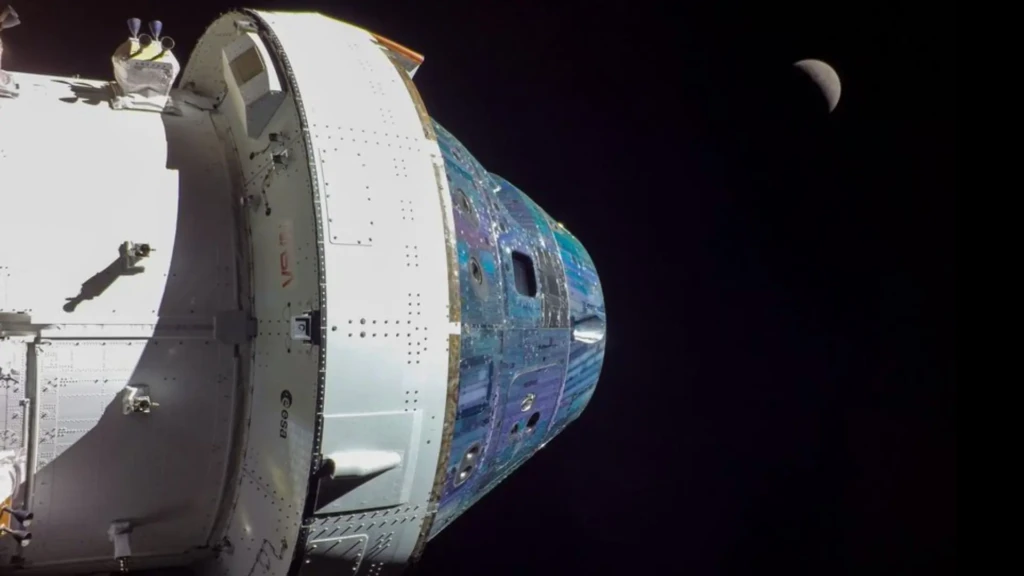
The Orion spacecraft.
The Orion spacecraft on its lunar journey during Artemis 1. Image: NASA

The first orbit (an ellipse about 185 km X 2,253 km) will last 90 minutes and the second orbit, a larger one, will take approximately 23.5 hours (altitude 185 km X 74,030 km). The second orbital manoeuvre will enable Orion to achieve enough speed to fly toward the Moon. During the initial stages, the crew will test Orion’s hardware and software performance after it separates from SLS rocket’s upper stage. This will prepare NASA for critical rendezvous, proximity operations and docking, as well as undocking operations in lunar orbit during Artemis 3.

NASA's SLS rocket.
The Space Launch System (SLS) rocket. Image: NASA

After the proximity operations demonstrations, the crew will handover Orion’s control to mission controllers at the Johnson Space Center, remove their spacesuits and spend the rest of the mission in plain clothes. They will don the spacesuits again during re-entry. On their way to the Moon, the astronauts will assess Orion’s life support systems that generate breathable air and remove carbon dioxide and water vapour from the capsule when the crew is awake and asleep.

ALSO READ: What Are Interstellar Comets And What Makes Them Special?

“A change between the suit mode and cabin mode in the life support system, as well as performance of the system during exercise and sleep periods, will confirm the full range of life support system capabilities and ensure readiness for the lunar flyby portion of the mission,” NASA stated. Orion’s communication and navigation systems will also be tested in Earth orbit and when it briefly flies beyond GPS satellites’ range to allow an early checkout of NASA’s Deep Space Network (DSN). The DSN is what mission controllers will rely on to communicate with the crew when it’s near and around the Moon.

Orion will then finally perform a translunar injection burn that will send the crew on a 4-day outbound lunar journey. Artemis 2 flight director Jeff Radigan said per BBC, “They’re going at least 5,000 nautical miles (9,200km) past the Moon which is much higher than previous missions have gone.”

The way back home

The return journey will also take about four days and the entire mission will last 10 days. On the way back, NASA says Orion will follow a fuel-efficient trajectory as it will be pulled naturally by Earth’s gravity instead of relying on propulsion. The spacecraft will then re-enter Earth’s atmosphere and use its parachute system for a safe splashdown in the ocean. 

Artemis 2 will set the stage for Artemis 3, the landing mission, which is targeted for 2027. However, there are concerns about delays due to slow development of SpaceX‘s Starship which will take astronauts to the lunar surface.

ALSO READ: NASA’s ESCAPADE Mission Is Off To Mars. What Happens Next?

TAGGED:ArtemisArtemis 2moonNASAOrionSLS RocketSpaceStarship
Share This Article
Facebook Pinterest Whatsapp Whatsapp LinkedIn Copy Link Print

Latest News

NASA's SLS rocket.
NASA’s Artemis II Rocket Plagued By Leaks Again; Administrator Jared Isaacman Reacts
Artemis
SpaceX Dragon spacecraft for NASA's Crew-12 mission.
SpaceX Rolls Out Dragon Spacecraft For NASA’s Crew-12 Mission While Falcon 9 Remains Grounded
Spaceflight
NASA's Artemis II SLS Rocket
NASA Delays Artemis II Moon Mission Launch To March – Here’s Why
Artemis
NASA's SLS rocket.
Astronauts In Quarantine, Rocket Powered On – How NASA Is Preparing For Artemis II
Artemis

You Might Also Like

NASA ESCAPADE mission
Spaceflight

NASA’s Mars-Bound ESCAPADE Spacecraft Prepare For First Engine Burns

December 2, 2025
NASA spherex
Astronomy

NASA Releases Insane Cosmic Map Made By Its Brand New SPHEREx Telescope

January 5, 2026
Comet 3I/ATLAS pre-perihelion.
Astronomy

Comet 3I/ATLAS Is NOT Changing Colours, But Sudden Brightness Remains A Mystery

November 19, 2025
Saturn NASA
Astronomy

Saturn’s Rings Have Disappeared Again Due To This Cosmic Illusion

November 24, 2025
© 2026, Blue Terra Journal
  • About
  • Privacy Policy
  • Terms
  • Contact
Welcome Back!

Sign in to your account

Username or Email Address
Password

Lost your password?