Blue Terra Journal

  • Home
  • Spaceflight
    SpaceflightShow More
    SpaceX Dragon spacecraft for NASA's Crew-12 mission.
    SpaceX Rolls Out Dragon Spacecraft For NASA’s Crew-12 Mission While Falcon 9 Remains Grounded
    February 4, 2026
    NASA partners with Axiom Space
    NASA And Axiom Space Announce 5th Private Crew Mission To International Space Station In 2027
    February 1, 2026
    Blue Origin Mark 1 lander.
    Blue Origin Halts New Shepard Missions For At Least 2 Years To Land Humans On The Moon
    February 1, 2026
    SpaceX Starship on flight 11.
    SpaceX CEO Elon Musk Reveals When Starship Will Launch On Next Test Flight
    January 29, 2026
    NOAA's SOLAR-1 observatory.
    NOAA’s Sun Spying SOLAR-1 Observatory Reaches Its Destination 1.5 Million Km From Earth
    January 31, 2026
  • Astronomy
    AstronomyShow More
    Voyager 1 illustration
    NASA’s Voyager 1 Will Be One Light-Day Away From Earth In 2026 – What This Means
    January 26, 2026
    Auroras triggered by CMEs.
    Auroras Flood The Night Skies After Largest Solar Radiation Storm In Over 20 Years | Photos
    January 20, 2026
    Hubble discovers Cloud-9.
    Hubble Telescope Uncovers New Object ‘Cloud-9’ – A ‘Failed Galaxy’ With No Stars
    January 13, 2026
    SpaceX launches NASA telescope.
    SpaceX Launches NASA’s Exoplanet Exploring Telescope Pandora On Twilight Mission
    January 19, 2026
    Comet 3I/ATLAS by Hubble telescope
    Comet 3I/ATLAS Is Not An Alien Spacecraft – This Research Likely Confirms It
    January 10, 2026
  • India
    IndiaShow More
    Shubhanshu Shukla aboard the ISS.
    ISRO Astronaut Shubhanshu Shukla Awarded Ashoka Chakra For Heroic Ax-4 Mission
    January 25, 2026
    ISRO's PSLV lifts off to space.
    ISRO’s PSLV Rocket Suffers Third Stage Failure After Successful Liftoff; Payloads Lost
    January 23, 2026
    Dhruva Space team at ISRO facility.
    India’s Dhruva Space To Launch 10 Missions, Including 1st Northeastern Satellite, On ISRO’s PSLV
    January 12, 2026
    ISRO's PSLV rocket
    ISRO To Seek Redemption With PSLV-C62 Mission Launch On January 12
    January 12, 2026
    ISRO SSLV
    ISRO’s SSLV Rocket Just Got Better After Latest Third Stage Test Fire
    December 31, 2025
  • Artemis
    ArtemisShow More
    NASA's SLS rocket.
    NASA’s Artemis II Rocket Plagued By Leaks Again; Administrator Jared Isaacman Reacts
    February 5, 2026
    NASA's Artemis II SLS Rocket
    NASA Delays Artemis II Moon Mission Launch To March – Here’s Why
    February 3, 2026
    NASA's SLS rocket.
    Astronauts In Quarantine, Rocket Powered On – How NASA Is Preparing For Artemis II
    February 3, 2026
    NASA's Artemis II crew
    Inside Artemis II: How NASA Will Study Astronaut Health And Deep Space Radiation
    January 30, 2026
    NASA's SLS rocket at launch pad.
    NASA’s Artemis II To Carry Relic Of Humanity’s First Flight And More To The Moon
    January 27, 2026
  • More
    • About
    • Privacy Policy
    • Terms
    • Contact

Blue Terra Journal

  • Home
  • Spaceflight
  • Astronomy
  • India
  • Artemis
Search
  • Pages
    • About
    • Contact
    • Privacy Policy
    • Terms

Home - Astronomy - Comet 3I/ATLAS Vs Comet Lemmon: Why The Former Has No Tail Post Perihelion

Astronomy

Comet 3I/ATLAS Vs Comet Lemmon: Why The Former Has No Tail Post Perihelion

Harsh Vardhan
Last updated: November 20, 2025 4:43 PM
Harsh Vardhan
Share
4 Min Read
image 13 1
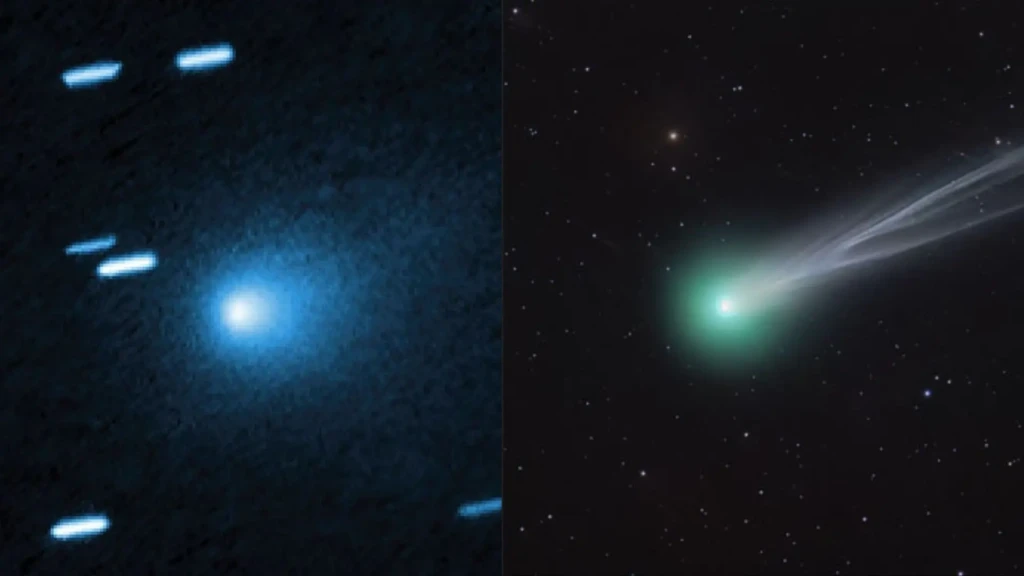
Tail-less Comet 3I/ATLAS (left) and Comet Lemmon (right). Image: NASA
SHARE

The interstellar Comet 3I/ATLAS is on its way out of the inner solar system after passing its closest point to the Sun (perihelion) on October 30. Observations reveal that it is currently behind the Sun on its hyperbolic trajectory and will offer better views from Earth again during its closest approach to our planet on December 19. However, the most puzzling characteristic of this interstellar visitor is a lack of tail despite reaching perihelion.
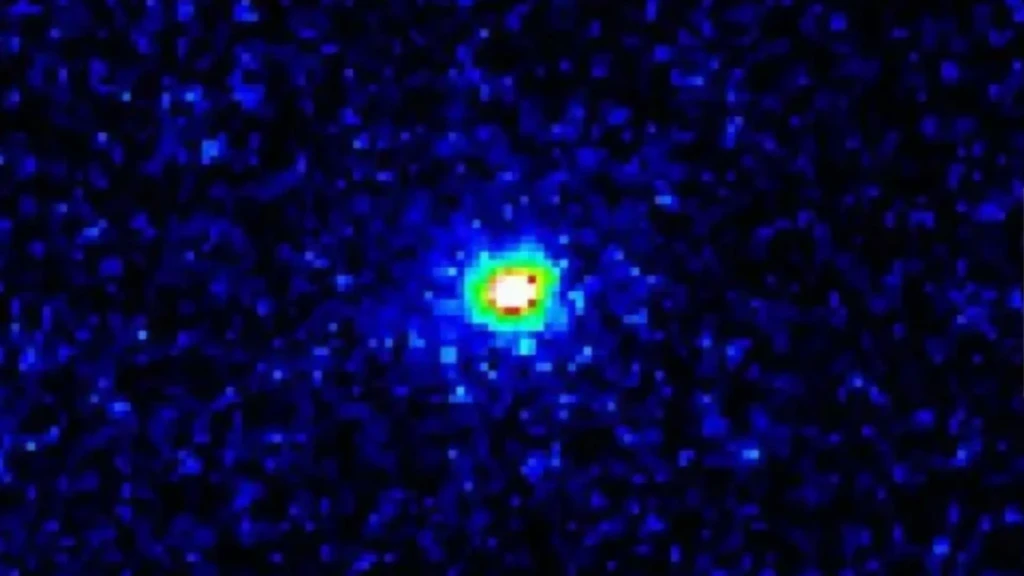
image 10
Comet 3I/ATLAS captured post-perihelion on November 5. Image: R. Naves Observatory

Comets are composed of ice, dust and gas and as sunlight heats them up, the ice sublimates and gets released along with gas and dust to create a tail. That’s something that has been observed on the native Comet Lemmon, designated C/2025 A6, which was discovered on January 3 and will reach perihelion on November 8. Several pictures of the Comet have surfaced in the past few weeks as it moved in its 1,350 year orbit with a tail millions of kilometres long.
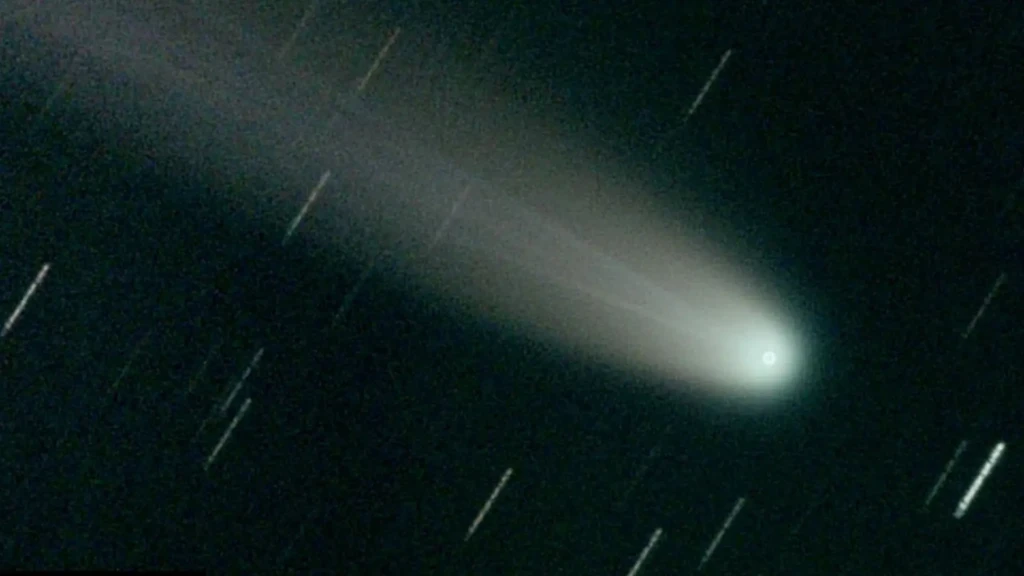
image 9
Comet Lemmon captured on November 3, five days before perihelion. Image: R. Naves Observatory

Dr. Avi Loeb, a physicist at Harvard University, shared new pictures captured by Spain’s R. Naves Observatory highlighting the lack of a cometary tail on 3I/ATLAS. Loeb has divided the scientific community for suggesting, based on almost a dozen anomalies he has flagged, that this comet could be alien technology.

ALSO READ: China’s Mars Orbiter Snapped Comet 3I/ATLAS. What Did It See?

Why doesn’t Comet 3I/ATLAS have a tail?

Most scientists are trying to find a natural explaination for 3I/ATLAS’s lack of cometary tail while steering clear of the alien theory. According to the SETI Institute, which is dedicated to finding life beyond Earth, spectroscopic measurements have revealed that Comet 3I/ATLAS’s coma (cloud of gas and dust surrounding the nucleus) is dominated by carbon dioxide or CO2.
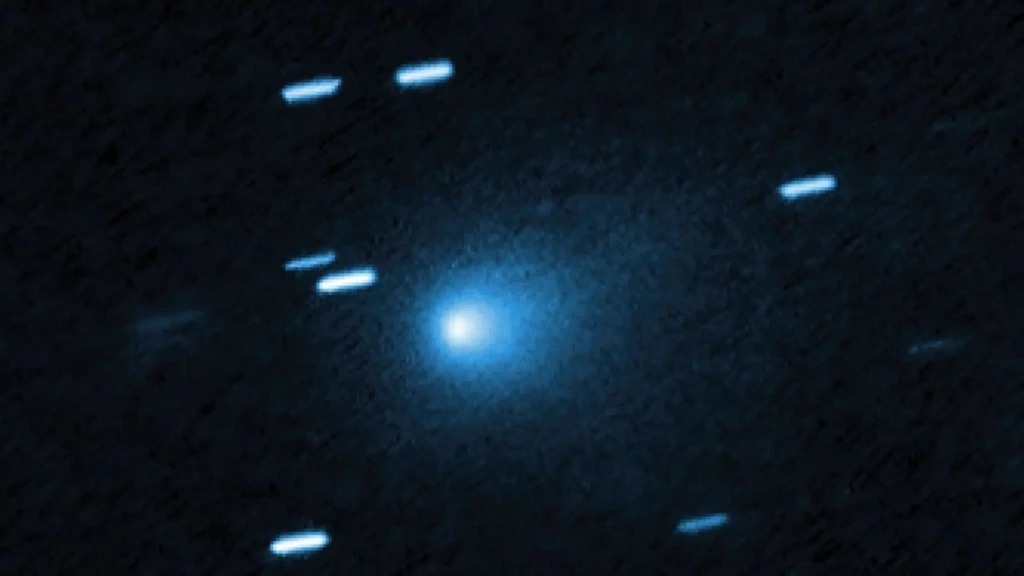
image 11
Comet 3I/ATLAS captured by Hubble space telescope on July 21. Image: NASA

Its gas plume also has minimal traces of water, just 4% by mass, says Loeb. Since carbon dioxide behaves differently, its ice turns into gas directly (that’s sublimation) and causes evaporative cooling on the surface by absorbing heat. Since this lowers the local temperature, the water-ice doesn’t sublimate, leaving no tail behind. Normally, comets also achieve acceleration as they reach perihelion because the ejecting gases act as thrusters. Surprisingly, 3I/ATLAS is accelerating without a tail.

Another possible explanation from SETI is – “Over millions of years in interstellar space, cosmic radiation can alter ice chemistry, producing physical behaviors distinct from those seen in native comets.”

On the other hand, Loeb argues citing his calculations that the comet must have lost more than 13% of its mass near perihelion. “For a typical comet, this should have resulted in a massive coma with dust and gas that would have been pushed by the solar radiation pressure and the solar wind to the shape of a typical cometary tail pointing away from the Sun. No such tail is visible in the new images from November 5, 2025,” he wrote in his blog.

The apparent lack of a tail, Loeb says, could provide an alternative explanation for 3I/ATLAS’s acceleration, possibly a non-human propulsion mechanism. He also stated that future observations from various telescopes on December 19, when the comet gets close to Earth, will provide a clear picture on what’s causing 3I/ATLAS’s acceleration.

ALSO READ: Comet 3I/ATLAS: Should We Take Avi Loeb’s Alien Theory Seriously?

TAGGED:Avi LoebComet 3I/ATLASComet LemmonScienceSpace
Share This Article
Facebook Pinterest Whatsapp Whatsapp LinkedIn Copy Link Print

Latest News

NASA's SLS rocket.
NASA’s Artemis II Rocket Plagued By Leaks Again; Administrator Jared Isaacman Reacts
Artemis
SpaceX Dragon spacecraft for NASA's Crew-12 mission.
SpaceX Rolls Out Dragon Spacecraft For NASA’s Crew-12 Mission While Falcon 9 Remains Grounded
Spaceflight
NASA's Artemis II SLS Rocket
NASA Delays Artemis II Moon Mission Launch To March – Here’s Why
Artemis
NASA's SLS rocket.
Astronauts In Quarantine, Rocket Powered On – How NASA Is Preparing For Artemis II
Artemis

You Might Also Like

image
Astronomy

Japan’s Akatsuki Orbiter Goes Silent Forever Ending Our Venus Presence

November 6, 2025
NASA Artemis 2
Artemis

Artemis 2 Explained: NASA’s First Crewed Moon Mission Since 1972

November 17, 2025
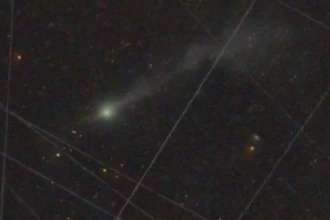
Comet 3I/ATLAS post perihelion. Image: Virtual Telescope
Astronomy

Comet 3I/ATLAS Live: How To Watch This Interstellar Visitor From Earth On Dec 19?

December 20, 2025
Blue Origin's NS-38 mission crew member.
Spaceflight

Blue Origin Launches New Shepard Spacecraft With Six Humans On NS-38 Mission

January 28, 2026
© 2026, Blue Terra Journal
  • About
  • Privacy Policy
  • Terms
  • Contact
Welcome Back!

Sign in to your account

Username or Email Address
Password

Lost your password?