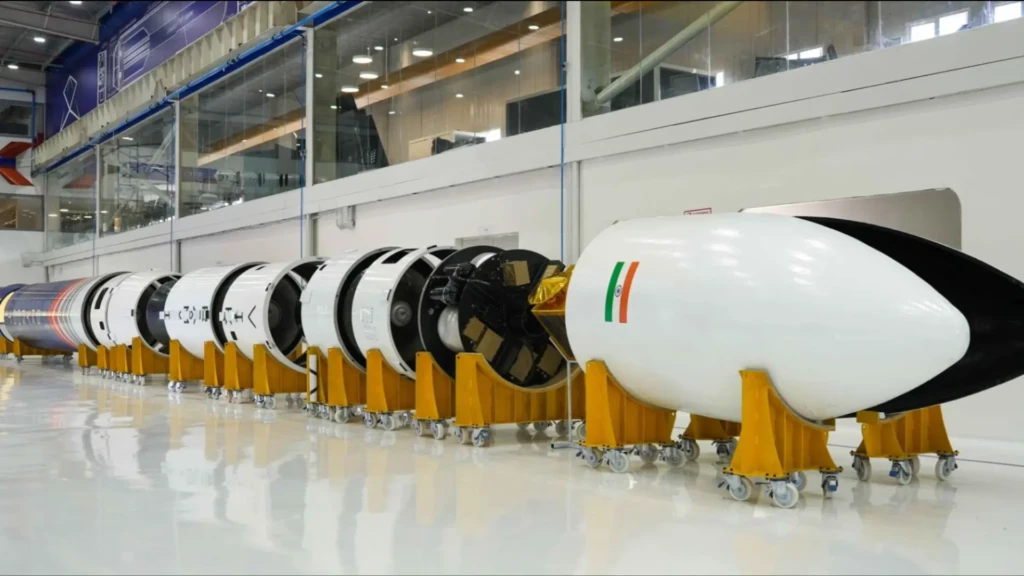
Prime Minister Narendra Modi inaugurated Hyderabad-based Skyroot Aerospace‘s Infinity Campus on Thursday and unveiled the company’s Vikram-I rocket designed for low-cost satellite launches. Named after father of India’s space programme, Dr. Vikram Sarabhai, Vikram-I builds on the success of of Vikram-S, which launched as India’s first private rocket during the Prarambh mission in November 2022.
Vikram-I: India’s first private commercial rocket
Vikram-I is a four-stage rocket that is built for dedicated and rideshare launches and custom orbital deployment of small satellites. The launch vehicle stands 20 meters tall and 1.7 meters in diameter, and its payload capacity depends on orbit type, inclination and mission profile [up to 350 kg to LEO and up to 260 kg to Sun-synchronous orbit, per Skyroot].
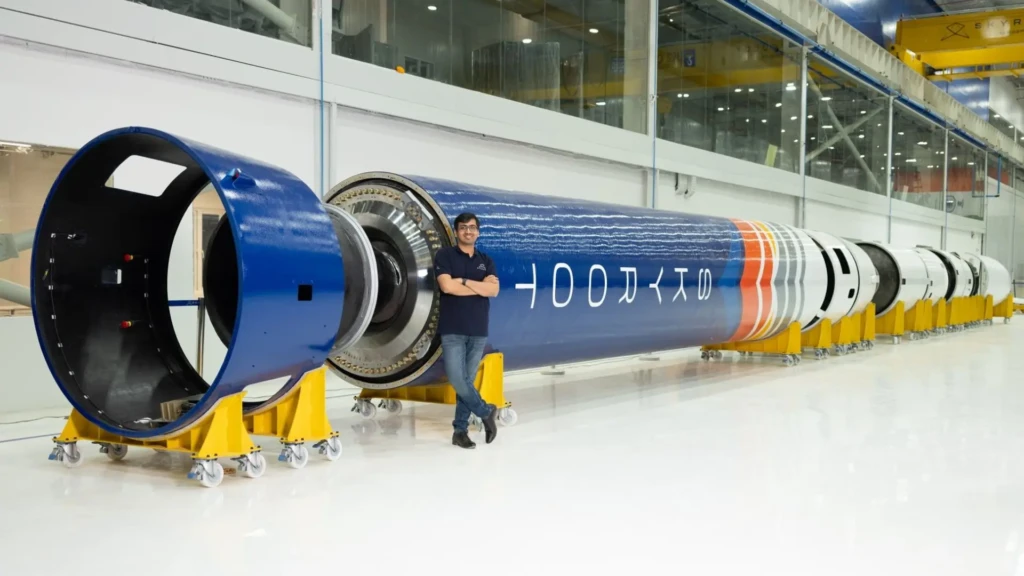
According to Skyroot, Vikram-I has an all carbon-composite structure which makes it significantly lighter than metallic rockets. Lower mass means the rocket will use less propellant during liftoff and yield greater launch efficiency. It will also enable higher payload capacity per launch, lower manufacturing and operating costs and offer higher launch cadence by reducing turnaround time.
🚀 India’s first private orbital launch is closer than ever: Vikram-1’s first stage, Kalam-1200, has been fully validated, with 236 data channels confirming flawless performance.
💥 This powerhouse motor lifts the rocket from the launchpad to 50+ km altitude. Watch it roar for… pic.twitter.com/iJw9PLTw6E
— Skyroot Aerospace (@SkyrootA) August 10, 2025
Vikram-I is a four-stage rocket and the first three stages use solid propellant. The first stage is powered by Kalam-1200 engine which produces 1200 kN of peak thrust whereas the second stage uses Kalam-250. Measuring 11 meters tall, the first stage was fully validated in August after a full-duration test at ISRO‘s Satish Dhawan Space Center. The third stage, powered by Kalam-100, has a thrust capacity of 100 kN. Finally, the 3D printed fourth stage is powered by a cluster of four Raman engines that use liquid propellant. The fourth stage will give Skyroot flexibility, and room for adjustments during satellite deployment and perhaps even allow multiple burns, which is not possible with solid propellant stages.
The fourth stage uses the classic hypergolic propellant combo of monomethylhydrazine and nitrogen tetroxide (oxidiser) which ignite spontaneously without a spark when they’re mixed.
All stages of Vikram-I have been fully tested and its maiden launch is reportedly targeted in early 2026. Skyroot is also preparing to debut Vikram-II next year. Powered by a cryogenic engine, this rocket will provide greater lift and payload capacity of up to 900 kg to LEO.
ALSO READ: ISRO Gears Up To Launch SpaceX Rival’s Broadband Satellite On Dec 15
ALSO READ: ISRO Completes Parachute Air Drop Test Of Gaganyaan Crew Module | Video