Blue Terra Journal

  • Home
  • Spaceflight
    SpaceflightShow More
    NASA's SR-1 Freedom spacecraft.
    What Is NASA’s SR-1 Freedom Mission? The First Nuclear Reactor In Space Explained
    March 27, 2026
    Artist's impression of a NASA Moon base.
    NASA Moon Base: How The US Will Spend $20 Billion On This Ambitious Project
    March 25, 2026
    Russia's Soyuz rocket ascending to space.
    Russia’s Progress Spacecraft Suffers Mystery Glitch On Its Way To ISS; What Happened?
    March 23, 2026
    Robert Goddard
    Celebrating Robert Goddard – The Man Who Changed Rocketry 100 Years Ago
    March 17, 2026
    International Space Station gets extension to beat China
    Watch Out China! US Proposes Extending International Space Station Lifespan To 2032
    March 10, 2026
  • Astronomy
    AstronomyShow More
    Meteor spotted over Houston.
    Video Captures 1-Ton Meteor Exploding Over Houston Skies, NASA Releases Statement
    March 22, 2026
    NASA black hole simulation
    Fall Into A Black Hole With This Incredibly Scary Simulation Made By NASA
    March 18, 2026
    Comet C/2026 A1 MAPS
    Comet C/2026 A1 MAPS: What Are ‘Sun-Grazer’ Comets And Why Are They Special?
    March 12, 2026
    Moon is safe from asteroid 2024 YR4.
    The Moon Is Safe! James Webb Space Telescope Rules Out Asteroid 2024 YR4’s Collision
    March 6, 2026
    NASA Moon orbiter
    NASA Prepares To Save Its Orbiter During Total Solar Eclipse On The Moon
    March 3, 2026
  • India
    IndiaShow More
    Shubhanshu Shukla aboard the ISS.
    ISRO Astronaut Shubhanshu Shukla Awarded Ashoka Chakra For Heroic Ax-4 Mission
    February 9, 2026
    ISRO's PSLV lifts off to space.
    ISRO’s PSLV Rocket Suffers Third Stage Failure After Successful Liftoff; Payloads Lost
    January 23, 2026
    Dhruva Space team at ISRO facility.
    India’s Dhruva Space To Launch 10 Missions, Including 1st Northeastern Satellite, On ISRO’s PSLV
    January 12, 2026
    ISRO's PSLV rocket
    ISRO To Seek Redemption With PSLV-C62 Mission Launch On January 12
    January 12, 2026
    ISRO SSLV
    ISRO’s SSLV Rocket Just Got Better After Latest Third Stage Test Fire
    December 31, 2025
  • Artemis
    ArtemisShow More
    NASA Artemis II crew
    NASA’s Christina Koch Turns ‘Space Plumber’ To Fix $30 Million Toilet On Artemis II Mission
    April 3, 2026
    NASA Orion spacecraft
    NASA’s Artemis II Astronauts Are Moon-Bound After Successful Trans-Lunar Injection Burn
    April 3, 2026
    NASA Artemis II lifts off.
    Artemis II Lifts Off! NASA Launches 4 Astronauts To The Moon After Over 50 Years
    April 2, 2026
    NASA's Artemis II astronauts
    NASA Artemis II Launch Live: Watch Humanity Return To The Moon On April 2
    April 2, 2026
    NASA Apollo 8 image
    NASA Artemis II: Why This Moon Mission Is Our Generation’s Apollo 8
    March 30, 2026
  • More
    • About
    • Privacy Policy
    • Terms
    • Contact

Blue Terra Journal

  • Home
  • Spaceflight
  • Astronomy
  • India
  • Artemis
Search
  • Pages
    • About
    • Contact
    • Privacy Policy
    • Terms

Home - Spaceflight - Russia’s Baikonur Pad Collapses After Soyuz Launch To International Space Station

Spaceflight

Russia’s Baikonur Pad Collapses After Soyuz Launch To International Space Station

It was Russia's only active launch pad.

Harsh Vardhan
Last updated: November 28, 2025 12:50 PM
Harsh Vardhan
Share
5 Min Read
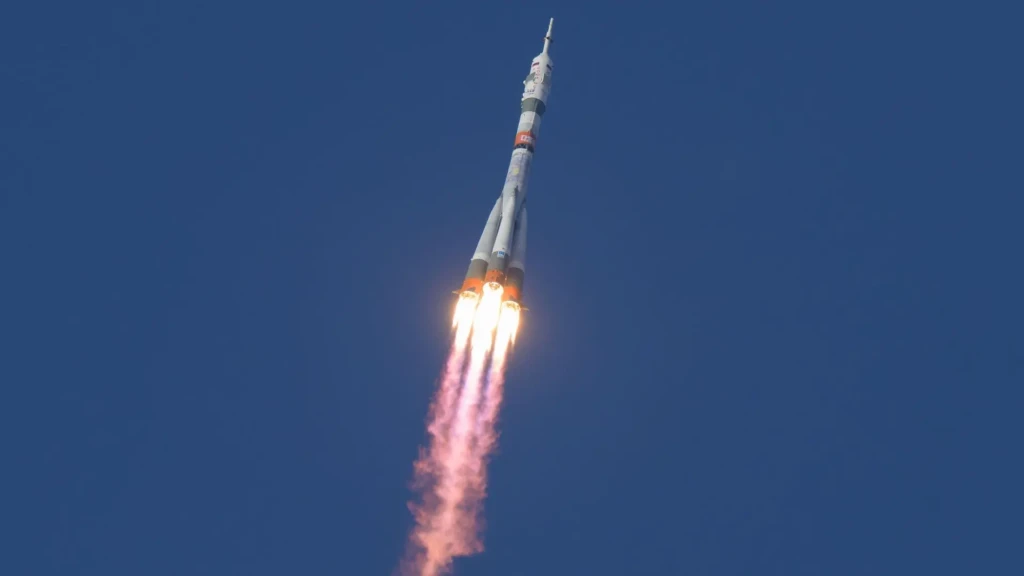
Russia Soyuz
Russia's Soyuz 2.1a rocket launching to the ISS. Image: NASA
SHARE

Russia’s Baikonur Cosmodrome launch pad in Kazakhstan has reportedly suffered significant damage after yesterday’s launch. Reports say that the service tower at Pad 31 collapsed after the Soyuz 2.1a rocket lifted off on November 27 with three astronauts. The astronauts were part of the MS-28 mission which launched to the International Space Station (ISS).

Baikonur was used by the Soviet Union for a secretive space program during the cold-war era and has been leased by Russia after Kazakhstan gained independence in 1991. 

Off they go! @Astro_ChrisW is embarking on his first-ever flight to space. The crew aboard the spacecraft will spend eight months conducting research on the @Space_Station. pic.twitter.com/MLzOnKL7DL

— NASA (@NASA) November 27, 2025

The damage was reportedly caused by the rocket’s exhaust plume, affecting the mobile service tower which provides access to technicians for pre-launch servicing of the launch vehicle’s aft section.

Taking note of the pad’s condition, Russian space agency Roscosmos said per TASS News – “The launch site was inspected, as is done every time after a rocket launch. Damage to a number of launch pad elements was detected. Such damage may appear after launch, so an inspection like this is mandatory in international practice. The condition of the launch complex is currently being assessed.”

⚡️BREAKING: Russia has suddenly lost access to space

An accident at Baikonur has effectively deprived Russia of the ability to launch humans into space for the first time in 60 years.

During the launch of the Soyuz MS-28, the service tower collapsed at launch pad 31.

This is… pic.twitter.com/mGQv2c3xoh

— NEXTA (@nexta_tv) November 27, 2025

Pad 31 is more than 60 years old and it’s currently the only active site available for Russia’s rocket launches. The second site Gagarin’s Start was decommissioned in 2019 and Kazakhstan has plans to build a museum at the site. The incident has crippled Russia’s ability for rocket launches for now and the forthcoming crew and cargo missions will be delayed indefinitely.

“All the necessary spare parts are available for restoration, and the damage will be repaired in the near future,” Roscosmos has said per TASS, however, the restoration is likely to take at least a few months.

According to NEXTA, space expert Vitaly Yegorov said that Russia “has lost its ability to send humans into space” and that the repair work could take up to two years.
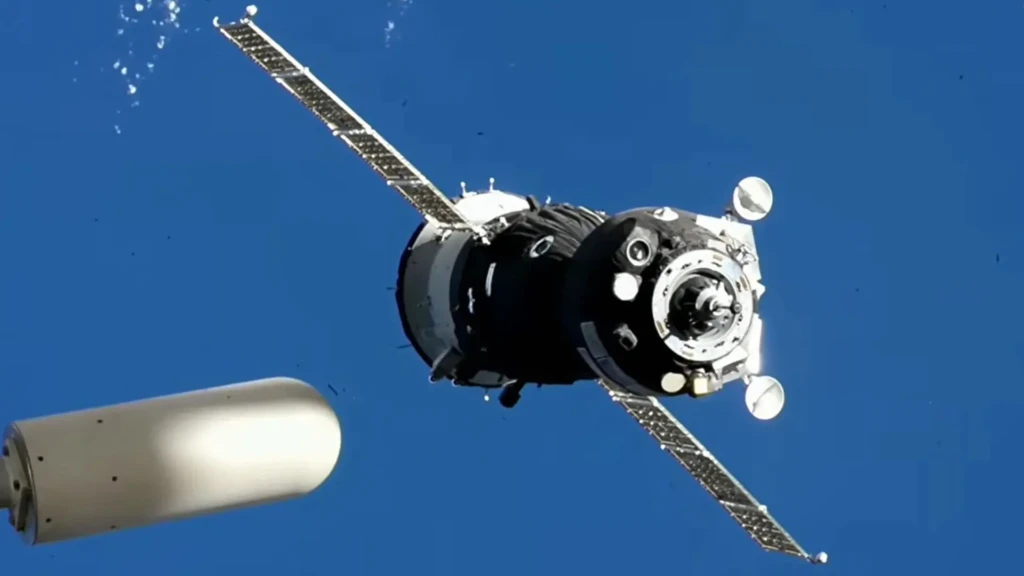
Russia's Soyuz Ms-28 spacecraft.
Russia’s Soyuz MS-28 spacecraft approaching the ISS. Image: NASA

Roscosmos occasionally launches a three-member crew to the ISS along with cargo on its Progress spacecraft. As part of a seat-swap agreement between Russia and the US, astronauts of both countries hitch a ride to the ISS on each other’s spacecraft.

With Russia no longer capable, SpaceX’s Crew Dragon remains the only option for both American and Russian travellers. For cargo missions, that send equipment and essential supplies for space station astronauts, NASA has SpaceX Cargo Dragon and Northrop Grumman’s Cygnus spacecraft as the available alternatives.

ALSO READ: Russia Launches Three Humans, Including NASA Astronaut, To ISS On Thanksgiving

MS-28 crew safe at the ISS

Meanwhile, the riders of the MS-28 spacecraft – Chris Williams of NASA, and Russia’s Sergey Kud-Sverchkov and Sergei Mikaev – are safe aboard the space station. Their journey was smooth as the launch had no effect on them. The trio reached their destination a couple of hours after liftoff at 3:57 pm IST and were welcomed by the seven-member Expedition 73 team.

They will spend eight-months on the orbital lab conducting microgravity experiments and research.

ALSO READ: China’s Shenzhou-22 ‘Rescue’ Spacecraft Docks At Tiangong Space Station
TAGGED:BaikonurInternational Space StationRussiaSoyuz
Share This Article
Facebook Pinterest Whatsapp Whatsapp LinkedIn Copy Link Print

Latest News

NASA Artemis II crew
NASA’s Christina Koch Turns ‘Space Plumber’ To Fix $30 Million Toilet On Artemis II Mission
Artemis
NASA Orion spacecraft
NASA’s Artemis II Astronauts Are Moon-Bound After Successful Trans-Lunar Injection Burn
Artemis
NASA Artemis II lifts off.
Artemis II Lifts Off! NASA Launches 4 Astronauts To The Moon After Over 50 Years
Artemis
NASA's Artemis II astronauts
NASA Artemis II Launch Live: Watch Humanity Return To The Moon On April 2
Artemis

You Might Also Like

ISRO Gaganyaan drop test.
India

ISRO Completes Parachute Air Drop Test Of Gaganyaan Crew Module | Video

November 21, 2025
Robert Goddard
Spaceflight

Celebrating Robert Goddard – The Man Who Changed Rocketry 100 Years Ago

March 17, 2026
Blue Origin will attempt booster landing on November 10.
Spaceflight

Like SpaceX, Blue Origin Eyes Landing New Glenn Booster During ESCAPADE Launch

November 8, 2025
NASA ESCAPADE Mars spacecraft.
Spaceflight

ESCAPADE: Why It May Be NASA’s Most Important Mars Mission In Years

November 19, 2025
© 2026, Blue Terra Journal
  • About
  • Privacy Policy
  • Terms
  • Contact
Welcome Back!

Sign in to your account

Username or Email Address
Password

Lost your password?