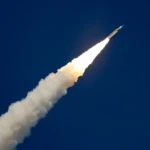
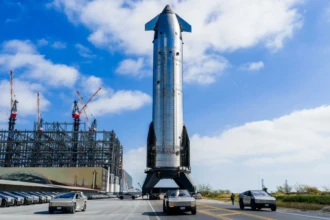
Blue Origin on Monday scrubbed New Glenn’s second mission due to bad weather. In an update, the commentary team announced the official scrub citing unfavourable weather over the launch pad at Cape Canaveral Space Force Station in Florida. The rocket was supposed to launch NASA’s twin-satellite ESCAPADE mission to Mars along with a satellite as secondary payload for technology demonstration to support NASA‘s Communications Services Project.
The liftoff was scheduled during a 2.5-hour launch window which opened at 1:15 am IST, but clouds and slight rain forced multiple holds during the countdown. When the weather did clear momentarily, Blue Origin said it identified an issue with the ground support equipment. However, it confirmed later that the scrub was due to bad weather.
Today’s NG-2 launch is scrubbed due to weather, specifically the cumulus cloud rule. We’re reviewing opportunities for our next launch attempt based on forecasted weather.
— Blue Origin (@blueorigin) November 9, 2025
“Today’s NG-2 launch is scrubbed due to weather, specifically the cumulus cloud rule. We’re reviewing opportunities for our next launch attempt based on forecasted weather,” Blue Origin posted on X. Meanwhile, a new launch date is awaited.
The ESCAPADE mission will be New Glenn’s second mission after its successful debut flight in January. Interestingly, ESCAPADE is clocking in a lot of firsts. It is the world’s first twin spacecraft mission launched to explore Mars, the first Mars mission for New Glenn and the first interplanetary mission for Rocket Lab which built the two satellites named Blue and Gold. The satellites will occupy different elliptical orbits to study the real-time interaction between solar wind and the hybrid Martian magnetosphere for 11 months.
— Jeff Bezos (@JeffBezos) November 8, 2025
But ESCAPADE won’t launch directly to Mars. The satellites will spend a year at the second Lagrange point or L2 in space before getting transferred into a Mars-bound trajectory once the red planet gets closer to Earth in late 2026. It will then spend about 11 months journeying to Mars before inserting itself in the Martian orbit around September 2027.
ALSO READ: ESCAPADE: Why It May Be NASA’s Most Important Mars Mission In Years
Using the collected data, NASA intends to find out how Mars lost its magnetosphere and got stripped of its atmosphere. This lack of atmosphere is said to be the reason why this now desolate world lost its liquid water billions of years ago.
This mission, which costs less than $80 million, was funded by NASA’s Small Innovative Missions for Planetary Exploration (SIMPLEx) program. ESCAPADE also has other partners like Space Sciences Laboratory at the University of California, Berkeley which is leading the science aspect of it, NASA’s Goddard Space Flight Center, Embry-Riddle Aeronautical University and Advanced Space LLC.
Interestingly, ESCAPADE’s launch is highly anticipated because it’s the first major NASA mission to Mars since the Perseverance rover’s launch in 2020.
ALSO READ: Memorial On Mars? Celestis Will Send Cremated Remains, DNA Samples In 2030