Blue Terra Journal

  • Home
  • Spaceflight
    SpaceflightShow More
    NASA's SR-1 Freedom spacecraft.
    What Is NASA’s SR-1 Freedom Mission? The First Nuclear Reactor In Space Explained
    March 27, 2026
    Artist's impression of a NASA Moon base.
    NASA Moon Base: How The US Will Spend $20 Billion On This Ambitious Project
    March 25, 2026
    Russia's Soyuz rocket ascending to space.
    Russia’s Progress Spacecraft Suffers Mystery Glitch On Its Way To ISS; What Happened?
    March 23, 2026
    Robert Goddard
    Celebrating Robert Goddard – The Man Who Changed Rocketry 100 Years Ago
    March 17, 2026
    International Space Station gets extension to beat China
    Watch Out China! US Proposes Extending International Space Station Lifespan To 2032
    March 10, 2026
  • Astronomy
    AstronomyShow More
    Meteor spotted over Houston.
    Video Captures 1-Ton Meteor Exploding Over Houston Skies, NASA Releases Statement
    March 22, 2026
    NASA black hole simulation
    Fall Into A Black Hole With This Incredibly Scary Simulation Made By NASA
    March 18, 2026
    Comet C/2026 A1 MAPS
    Comet C/2026 A1 MAPS: What Are ‘Sun-Grazer’ Comets And Why Are They Special?
    March 12, 2026
    Moon is safe from asteroid 2024 YR4.
    The Moon Is Safe! James Webb Space Telescope Rules Out Asteroid 2024 YR4’s Collision
    March 6, 2026
    NASA Moon orbiter
    NASA Prepares To Save Its Orbiter During Total Solar Eclipse On The Moon
    March 3, 2026
  • India
    IndiaShow More
    Shubhanshu Shukla aboard the ISS.
    ISRO Astronaut Shubhanshu Shukla Awarded Ashoka Chakra For Heroic Ax-4 Mission
    February 9, 2026
    ISRO's PSLV lifts off to space.
    ISRO’s PSLV Rocket Suffers Third Stage Failure After Successful Liftoff; Payloads Lost
    January 23, 2026
    Dhruva Space team at ISRO facility.
    India’s Dhruva Space To Launch 10 Missions, Including 1st Northeastern Satellite, On ISRO’s PSLV
    January 12, 2026
    ISRO's PSLV rocket
    ISRO To Seek Redemption With PSLV-C62 Mission Launch On January 12
    January 12, 2026
    ISRO SSLV
    ISRO’s SSLV Rocket Just Got Better After Latest Third Stage Test Fire
    December 31, 2025
  • Artemis
    ArtemisShow More
    NASA Artemis II crew
    NASA’s Christina Koch Turns ‘Space Plumber’ To Fix $30 Million Toilet On Artemis II Mission
    April 3, 2026
    NASA Orion spacecraft
    NASA’s Artemis II Astronauts Are Moon-Bound After Successful Trans-Lunar Injection Burn
    April 3, 2026
    NASA Artemis II lifts off.
    Artemis II Lifts Off! NASA Launches 4 Astronauts To The Moon After Over 50 Years
    April 2, 2026
    NASA's Artemis II astronauts
    NASA Artemis II Launch Live: Watch Humanity Return To The Moon On April 2
    April 2, 2026
    NASA Apollo 8 image
    NASA Artemis II: Why This Moon Mission Is Our Generation’s Apollo 8
    March 30, 2026
  • More
    • About
    • Privacy Policy
    • Terms
    • Contact

Blue Terra Journal

  • Home
  • Spaceflight
  • Astronomy
  • India
  • Artemis
Search
  • Pages
    • About
    • Contact
    • Privacy Policy
    • Terms

Home - Astronomy - NASA’s Webb Telescope Discovers 13 Billion Years Old Supernova; Breaks Own Record

Astronomy

NASA’s Webb Telescope Discovers 13 Billion Years Old Supernova; Breaks Own Record

"This particular event is very rare and very exciting."

Harsh Vardhan
Last updated: December 18, 2025 12:51 PM
Harsh Vardhan
Share
5 Min Read
NASA James Webb Space Telescope
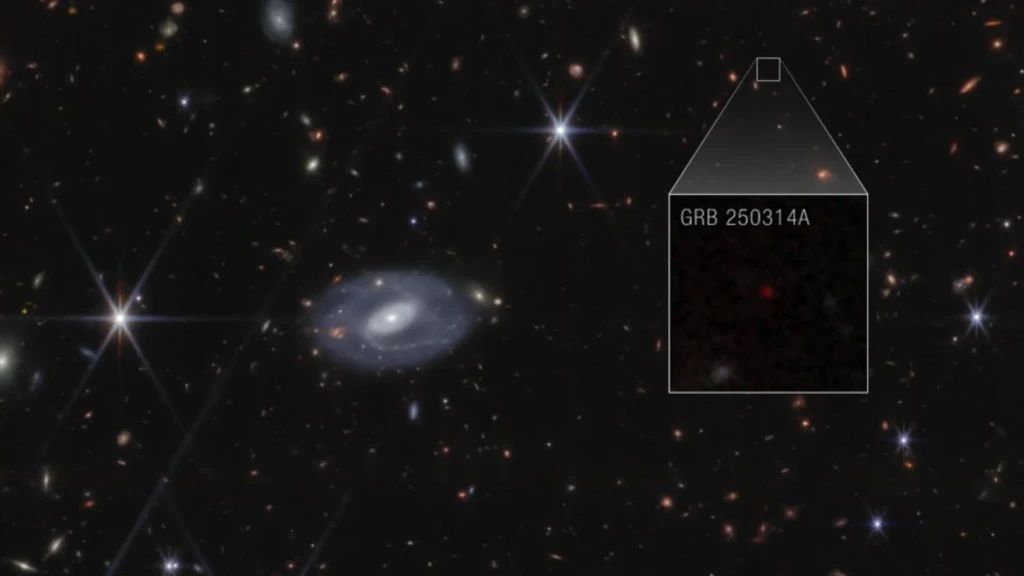
The supernova GRB 250314A captured by James Webb Space Telescope. Image: NASA
SHARE

Contents
  • Webb telescope’s rare discovery
  • Discovery suprises scientists

NASA’s James Webb Space Telescope has broken its own record of discovering the oldest supernova ever. The world’s most powerful observatory has confirmed that a bright flash of light detected in March indeed came from a massive exploding star. 

When a star at least five times more massive than the Sun reach the end of its life, it runs out of fuel and collapses under its own weight within seconds. This collapse creates enormous shock waves, causing the outer part of the star to explode, creating a supernova.

🆕 Webb has spotted the earliest supernova yet! 💥

After a bright flash of light (a gamma-ray burst) was detected by the SVOM mission in March, Webb was brought onto the case to investigate. It quickly confirmed that it came from the explosive death of a massive star ⭐☠️ This… pic.twitter.com/uu1Z3UXKhT

— ESA Webb Telescope (@ESA_Webb) December 9, 2025

In the study published in the journal Astronomy & Astrophysics, scientists said that the supernova confirmed by Webb occurred nearly 13 billion years ago, when the universe was just 730 million years old. The last earliest known supernova occurred 1.8 billion years after the big bang. They also noted that this supernova was accompanied by a gamma-ray burst (GRB) – the rare, energetic jet of gamma radiation – that signalled the explosion. 

Webb telescope’s rare discovery

“There are only a handful of gamma-ray bursts in the last 50 years that have been detected in the first billion years of the Universe,” Andrew Levan, lead author and professor at Netherlands’ Radboud University, said in a statement. “This particular event is very rare and very exciting.”
NASA James Webb Space Telescope
The supernova GRB 250314A captured by James Webb Space Telescope. Image: NASA

Gamma ray-bursts are hard to detect because they last only a few seconds. The recent one designated GRB 250314A was a burst that lasted 10 seconds, scientists said. Longer bursts are frequently linked to explosion of massive stars.

According to the European Space Agency (ESA), which built the Webb telescope alongside NASA, the supernova discovery resulted from a confluence of multiple observatories. The GRB was first noticed on March 14 by Space-based multi-band astronomical Variable Objects Monitor (SVOM) mission. Using NASA’s Neil Gehrels Swift Observatory, astronomers then pinpointed its location in the sky. Few hours later, the Nordin Optical Telescope in Spain revealed an infrared-light GRB afterglow, which associated it with a distant object, allowing the European Southern Observatory’s Very Large Telescope to estimate that the star (that went supernova) existed 730 million years after the universe was born.

ALSO READ: ESA’s Euclid Telescope Spies Nebula Birthing Stars 1,300 Light-Years Away

“Only Webb could directly show that this light is from a supernova – a collapsing massive star,” said Levan who later led the research team using Webb. “This observation also demonstrates that we can use Webb to find individual stars when the Universe was only 5% of its current age.“

Discovery suprises scientists

The supernova discovery was surprising because it was very similar to a modern, nearby supernovae they compared it to. Since very little is known about the first billion years of the universe, scientists can only speculate what it must have been like. “We went in with open minds,” said co-author Nial Tanvir. “And lo and behold, Webb showed that this supernova looks exactly like modern supernovae.” What’s even more interesting, is that Webb was able to locate the supernova’s host galaxy as well. This distant galaxy is also similar to other galaxies that existed at the same time, the telescope revealed.

Levan and team have received approval to observe more GRBs emitted by early universe objects using the Webb telescope. Their observation is likely to reveal a lot about the star which may have exploded when the universe lacked heavy elements.

ALSO READ: Alaknanda: Why This Ancient Spiral Galaxy’s Discovery By Indian Scientists Matters
TAGGED:ESAJames Webb Space TelescopeNASAsupernovaWebb Telescope
Share This Article
Facebook Pinterest Whatsapp Whatsapp LinkedIn Copy Link Print

Latest News

NASA Artemis II crew
NASA’s Christina Koch Turns ‘Space Plumber’ To Fix $30 Million Toilet On Artemis II Mission
Artemis
NASA Orion spacecraft
NASA’s Artemis II Astronauts Are Moon-Bound After Successful Trans-Lunar Injection Burn
Artemis
NASA Artemis II lifts off.
Artemis II Lifts Off! NASA Launches 4 Astronauts To The Moon After Over 50 Years
Artemis
NASA's Artemis II astronauts
NASA Artemis II Launch Live: Watch Humanity Return To The Moon On April 2
Artemis

You Might Also Like

Artemis vs apollo suit
Artemis

Artemis Vs Apollo: Why New Prada Spacesuits Are Better For NASA Astronauts

November 27, 2025
NASA Mars
Astronomy

NASA Unveils 100000th Image Captured By Its Mars Reconnaissance Orbiter

December 18, 2025
Comet C/2026 A1 MAPS
Astronomy

Comet C/2026 A1 MAPS: What Are ‘Sun-Grazer’ Comets And Why Are They Special?

March 12, 2026
Blue Origin SpaceX
Spaceflight

How Does Blue Origin’s Monstrous New Glenn Rocket Compare To Starship?

November 23, 2025
© 2026, Blue Terra Journal
  • About
  • Privacy Policy
  • Terms
  • Contact
Welcome Back!

Sign in to your account

Username or Email Address
Password

Lost your password?