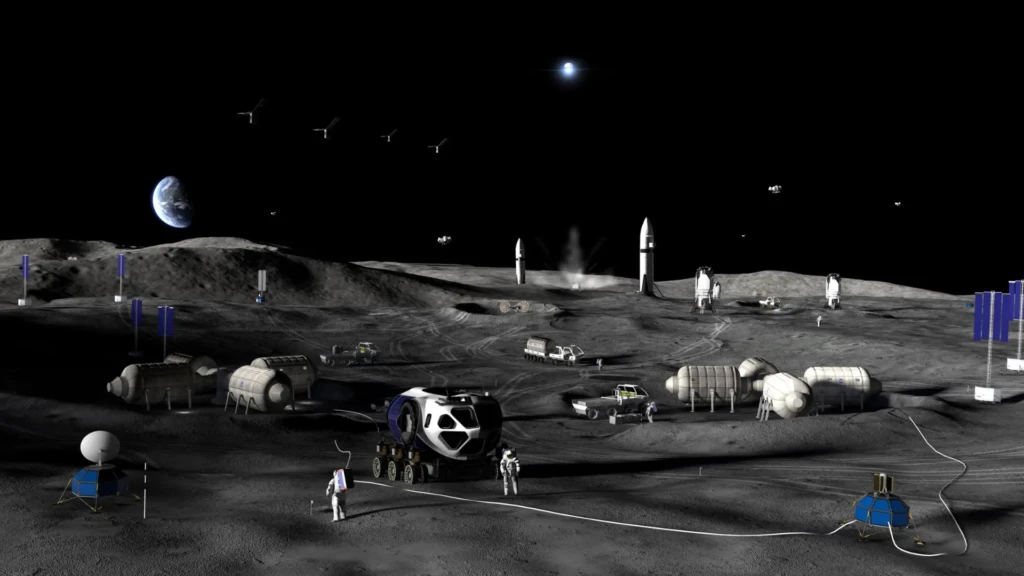
NASA on Tuesday made several huge announcements to fast track its goal to colonise the Moon. Administrator Jared Isaacman revealed at the ‘Ignition’ event that the Lunar Gateway project has been cancelled to focus on building a habitable base starting 2027.
“The moon base will not appear overnight,” NASA Administrator Jared Isaacman said at the event. “We will invest approximately $20 billion over the next seven years and build it through dozens of missions.”
To build a sustained human presence on the Moon, we are building @NASAMoonBase, prioritizing surface operations and scalable infrastructure.
– Frequent robotic landings and mobility testing including MoonFall drones
– Starting in 2027 nearly monthly cadence of equipment and… pic.twitter.com/3T00Y450kO— NASA Administrator Jared Isaacman (@NASAAdmin) March 24, 2026
The Gateway was supposed to be a space station in the lunar orbit to support surface operations. It would have been a platform for science experiments, spacecraft docking and habitat for astronauts in order to build a sustained lunar presence. But the priorities have shifted as the agency wants to channel its funds toward higher productivity and less wastage.
NASA’s $20 billion Moon base plan
NASA intends to build the base in three phases by leveraging the Commercial Lunar Payload Services (CLPS) and the Lunar Terrain Vehicle (LTV) initiatives. Phase one, the agency says, is ‘build, test, learn’ that requires frequent launches of lunar mission with rovers and technology demonstrations to support power generation, communications, navigation and surface operations. This phase requires 21 landings overall and delivery of 4 metric tons of payload including rovers and ‘Moon Fall’ drones.

Phase two is establishing a semi‑habitable infrastructure through repeated astronaut landings with help from domestic and international partners. It entails 27 landings to deliver 60 metric tons of payload. Phase three is enabling long-term human presence by delivering heavier infrastructure such as multi-purpose habitats and rovers astronauts can ride. This entails 28 landing missions to deliver 150 metric tons of payload.
The construction of the base will begin in 2027 – the year NASA launches the Artemis III mission. Artemis III has been changed into a test launch with astronauts to validate docking technologies in Earth orbit for future Moon landings.
The Moon landings will begin in 2028 with Artemis IV and beyond. Isaacman has previously said that NASA will aim for two Moon landings in 2028 with Artemis IV and Artemis V.
To return Americans to the Moon, NASA is shifting to an iterative, execution-focused approach – just as we did during Apollo.
We are standardizing rocket architecture, embedding NASA expertise across industry, and increasing launch cadence to support sustained lunar operations.…
— NASA Administrator Jared Isaacman (@NASAAdmin) March 24, 2026
“We are standardizing rocket architecture, embedding NASA expertise across industry, and increasing launch cadence to support sustained lunar operations,” Isaacman posted on X. “We are sending a demand signal for crewed missions beyond Artemis V, with at least two providers capable of bringing astronauts to the surface every 6 months. The goal is not just to reach the Moon, but to stay. America will never give up the Moon again.”
ALSO READ: Four Moon Missions By 2028? How NASA Envisions Artemis Program After Sweeping Changes
ALSO READ: Watch Out China! US Proposes Extending International Space Station Lifespan To 2032