NASA has released the 1,00,000th image of Mars captured by the Mars Reconnaissance Orbiter (MRO). Shared on Tuesday, the picture features the Syrtis Major region about 80 kilometres southeast of Jezero Crater, the exploration site of Perseverance rover. NASA says the image was captured on October 7 as MRO is nearing 20 years of its operations. It was taken using the High Resolution Imaging Science Experiment (HiRISE) camera from an altitude of between 250-300 kilometres, and shows mesas (flat-topped hills) and dunes of Syrtis Major in great detail.

“HiRISE hasn’t just discovered how different the Martian surface is from Earth, it’s also shown us how that surface changes over time,” Leslie Tamppari, MRO’s project scientist at NASA’s Jet Propulsion Laboratory (JPL), said in a statement. “We’ve seen dune fields marching along with the wind and avalanches careening down steep slopes.”
According to NASA, scientists are analysing the latest image to better understand the source of windblown sand that gets trapped in the region’s landscape and eventually form dunes.
And you thought it was hard to scroll through all the photos on your phone…
NASA’s Mars Reconnaissance Orbiter has snapped its 100,000th image of the surface with its HiRISE camera. More on this milestone image: https://t.co/71CuPgO1Ep pic.twitter.com/4IBr7sNGQ3
— NASA Mars (@NASAMars) December 16, 2025
The agency has also shared a highlight of best images captured by HiRISE that has snapped features ranging from impact craters, sand dunes, and ice deposits to potential landing sites on the Martian surface.
About NASA’s Mars Reconnaissance Orbiter
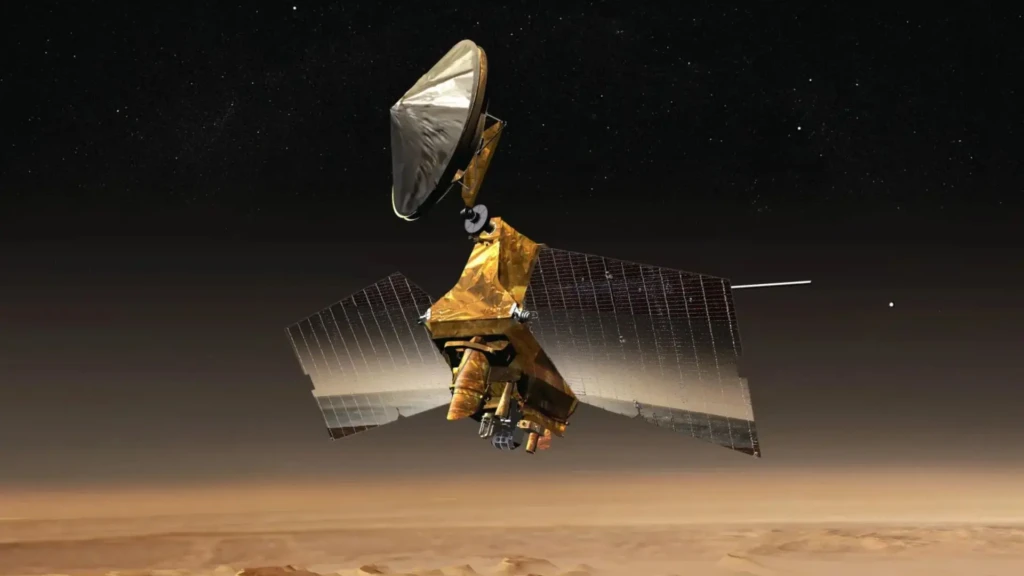
The orbiter was launched in August 2005 and it entered the Martian orbit in 2006. It is NASA’s second oldest spacecraft orbiting the red planet after Mars Odyssey which is active since 2001. MRO was built to investigate the history of water on Mars. Using its suite of instruments, it photographs the Martian surface, analyses minerals, hunts subsurface water, traces the distribution of atmospheric dust and monitors daily global weather.
The MRO serves another purpose as a data relay platform. It relays data between Perseverance and Curiosity rovers on the Martian surface and Earth using its high gain antenna. Most recently, the mission team at JPL turned the HiRISE camera toward interstellar comet 3I/ATLAS as part of a wider surveillance project.
ALSO READ: Has MAVEN Mars Orbiter Met Its End? NASA Says It Was Rotating Unexpectedly
ALSO READ: Comet 3I/ATLAS Will Get Closest To Earth On Dec 19 – Here’s What You Must Know