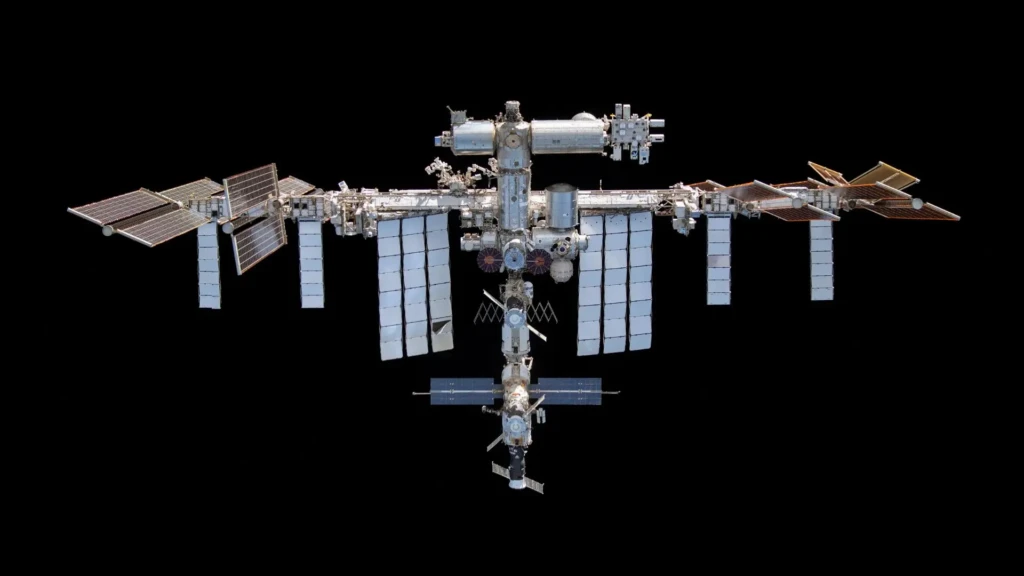
A NASA Authorisation bill has proposed extending the lifespan of the International Space Station (ISS) two years beyond its planned retirement in 2030. The bill approved by the US Senate Committee on Commerce, Science and Transportation outlined several objectives for NASA to achieve, including stopping China from outrunning the Americans in the space domain.
The NASA Authorisation bill says that an extension for the ISS to 2032 is necessary “to avoid a gap in continuous human presence and capabilities in LEO, thus avoiding ceding leadership to China before commercial stations are ready.” The ISS is managed by the US, Russia, Europe, Canada and Japan. Russia has announced that it will exit the partnership in 2028, leaving just four players keeping the lab afloat.

NASA had announced plans to deorbit the ISS by early 2031 and even awarded SpaceX more than $800 million to develop a spacecraft that would pull the orbital lab from low-Earth orbit. The idea is to crash the space station into Point Nemo of the Pacific Ocean and make way for private space stations that would ensure human presence in orbit.
US genuinely concerned about rival China
The bill explicitly names China as a rival, calling for American dominance in the modern era space race. “The United States is in an intensifying strategic space race with the People’s Republic of China, spanning Earth’s orbit, the Moon, and the broader expanse of deep space,” it states.
“Beijing is rapidly advancing its lunar ambitions, expanding its on-orbit capabilities, constructing supporting infrastructure beyond Earth, and promoting alternative governance frameworks such as the International Lunar Research Station – all with a clear objective: dominate the Moon, control strategic terrain in space, and write the rules of the 21st century,” the bill further says.
NASA administrator Jared Isaacman has also vowed to beat China to the Moon, something which he reiterated during the Senate hearing in December after his nomination as the agency chief.
The race back to the Moon is measured in months.
⁰China has made its ambitions clear. They’re going to get there BEFORE 2030.America must lead on the ultimate high ground of space—returning astronauts to the Moon and winning the second space race, and we’re going to take… pic.twitter.com/QEQpmazRLm
— NASA Administrator Jared Isaacman (@NASAAdmin) March 6, 2026
Calling China a “great rival,” Isaacman said that falling behind in space would mean the shift of “balance of power on Earth.”
Isaacman, the billionaire founder of Shift4 payments company, is currently leading NASA through the Artemis Program, which has suffered a slew of delays allowing China to catch up. Beijing wants to land humans on the Moon by 2030.
Artemis II is currently scheduled for launch in April this year followed by two Moon landing missions in 2028, given NASA sticks to schedule.
ALSO READ: Four Moon Missions By 2028? How NASA Envisions Artemis Program After Sweeping Changes
ALSO READ: NASA Shifts Moon Landing To Artemis IV, Alters Artemis III To Test Mission