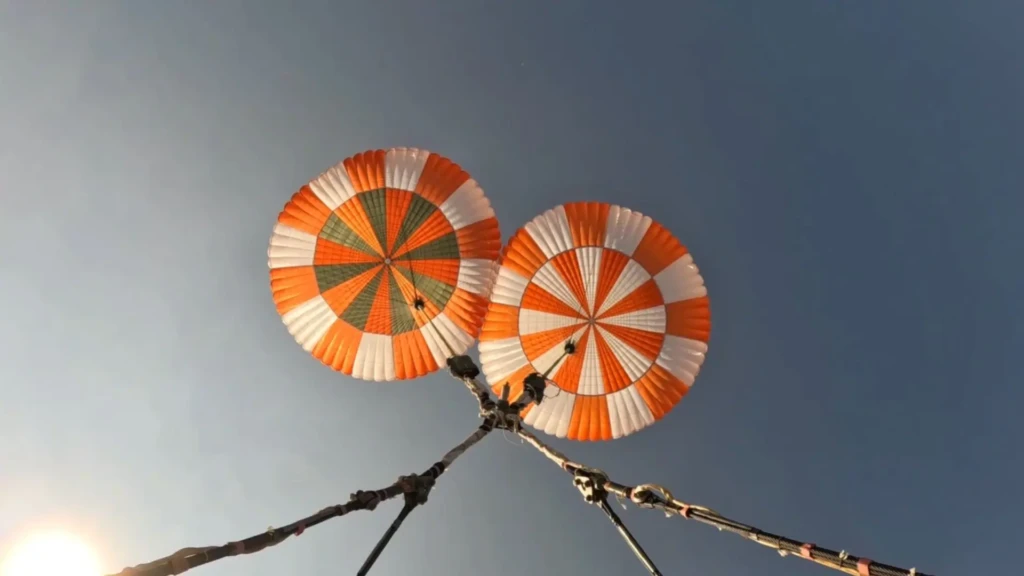
India moved a step closer to its first human spaceflight mission with the successful completion of an airdrop test. ISRO announced on Tuesday that it successfully conducted the Gaganyaan crew module’s parachutes, validating the spacecraft’s robust system. ISRO, in collaboration with the Vikram Sarabhai Space Centre, DRDO, the Indian Army and Air Force tested the Gaganyaan module at the Babina Field Firing Range in Jhansi on November 3.
The demonstration involved reducing the velocity of the crew module for a safe splashdown after dropping it from an altitude of 2.5 km using the Indian Air Force’s IL-76 aircraft. A total of 10 parachutes, each deployed at specific altitudes, were tested.
ISRO successfully conducted a key Integrated Main Parachute Airdrop Test (IMAT) for the Gaganyaan mission at Babina Field Firing Range, Jhansi, on Nov 3, 2025. The test validated the main parachutes under extreme conditions. #ISRO #Gaganyaan
For more information visit… pic.twitter.com/nqCgRmMkDn
— ISRO (@isro) November 11, 2025
ISRO explained in a statement – “The descent sequence begins with two apex cover separation parachutes that remove the protective cover of the parachute compartment, followed by two drogue parachutes that stabilize and decelerate the module. Upon release of the drogues, three pilot parachutes are deployed to extract three main parachutes, which further slow down the Crew Module to ensure a safe touchdown.”
According to ISRO, the system is designed with redundancy and just two of the three main parachutes are sufficient to achieve a safe landing.
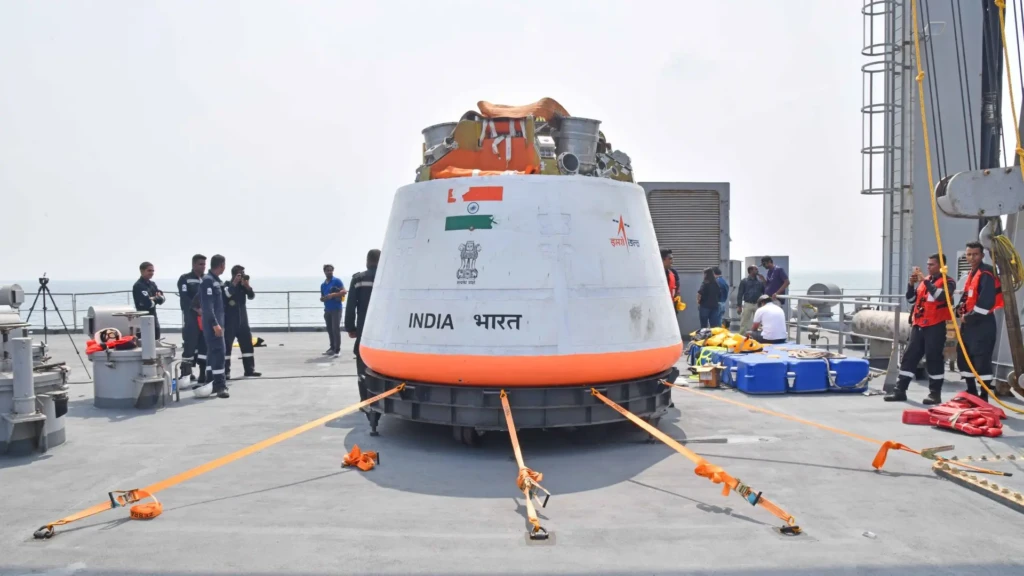
The parachutes will be used in case of an abort, when the crew escape system pulls the spacecraft away from the rocket, and during re-entry when the capsule is travelling at a staggering speed of nearly 28,000 km per hour.
The recent tests check another box in a long list of validations needed before launching humans to space. The Gaganyaan program will see ISRO launch Indian astronauts to the low-Earth orbit for a few days and bring them back safely in the module, which they are working hard to make human-rated.
Last week, ISRO chairman Dr. V Narayanan reportedly announced that the first of three uncrewed tests has been postponed to 2026 from late 2025. However, he said the agency has completed more than 8,000 relating to the program and hardware integration are also underway in full-swing.
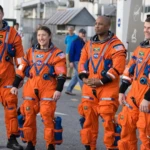
The $1.4 billion Gaganyaan program is being built with support from Russia’s Roscosmos which signed an agreement on joint activities for manned missions in 2018. Under this agreement, four Indian Air Force officers – Shubhanshu Shukla, Prasanth Balakrishnan Nair, Ajit Krishnan and Angad Pratap – underwent 11-months of intensive training at the Yuri Gagarin Cosmonaut Training Centre in Moscow. Roscosmos will also reportedly help ISRO in building life support system for the Gaganyaan module.
ALSO READ: How Gaganyaan Delays Are Setting India Back In Modern Space Race
ALSO READ: Comet 3I/ATLAS May Have Broken Into 16 Or More Pieces, Says Scientist