The Sun is past its absolute peak of the solar cycle 25 but we’re still witnessing significant solar flares and geomagnetic events. The National Oceanic and Atmospheric Administration’s (NOAA) Space Weather Prediction Center on Wednesday predicted a minor (G1) geomagnetic storm through November 27 due to a recent eruption on the Sun earlier this week.
The charged particles associated with that eruption were expected to reach Earth today, potentially triggering auroras in the polar regions as well as across Europe, Canada and parts of the US.
Large eruption from the farside is in-progress and could have possibly been triggered by our old pal AR4274 👀 pic.twitter.com/YadRhd112F
— ☀️ Sara Housseal ☀️ (@SNHWx) November 25, 2025
On November 11, scientists recorded the strongest solar eruption of 2025, with auroras reported as far south as Mexico. But how do auroras form and why are they typically visible only in and around the polar regions?
The formation of auroras
Auroras arise from the interaction between the Sun, Earth’s magnetic field and the gases in its atmosphere. They are known as northern lights or aurora borealis in the northern hemisphere and southern lights or aurora australis in the southern hemisphere.
The aurora-formation process, NASA explains, begins with Coronal Mass Ejection or CME – a massive burst of plasma from the Sun’s outermost atmosphere called corona. When these particles, pushed by the solar wind, reach Earth they disturb its magnetosphere – the magnetic shield that protects our planet and helps retain its atmosphere. Without a magnetosphere, intense solar winds and radiation would gradually strip away the atmosphere’s gases, rendering our planet uninhabitable.
The arrival of a CME disturbs Earth’s magnetosphere, accelerating electrons already trapped within it. These electrons then spiral down along magnetic field lines into the polar regions. According to NASA, CMEs take between a few hours to a couple of days to reach Earth, depending on how fast they’re moving.
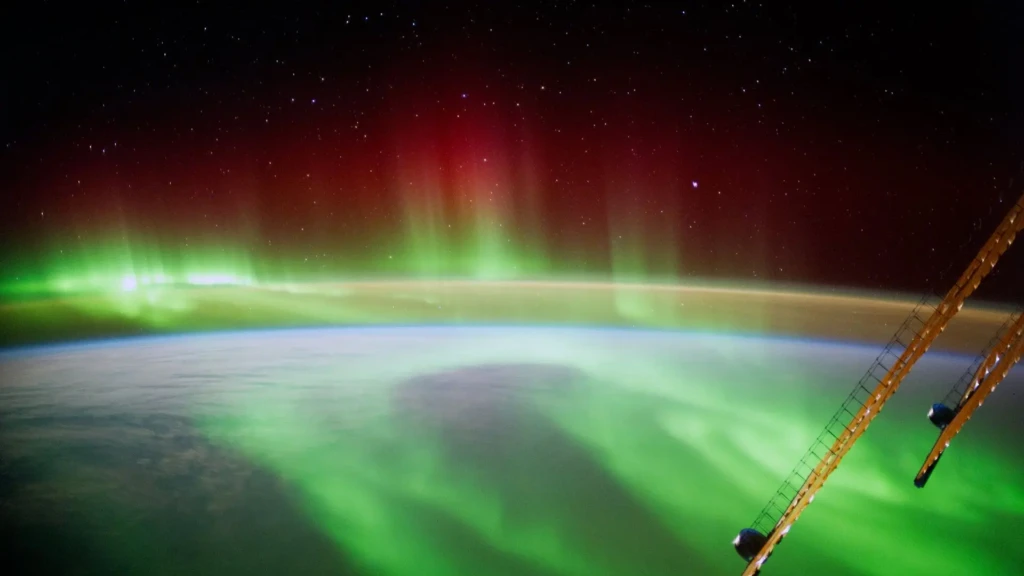
I’ve still never seen aurora from below, but up here, it’s a frequent show. Last week’s was especially good. See if you can spot Houston, Florida, and the northern lights all in one frame, before we head out across the Gulf and some great lightning storms over South America at… pic.twitter.com/THqX83wNXL
— Zena Cardman (@zenanaut) November 17, 2025
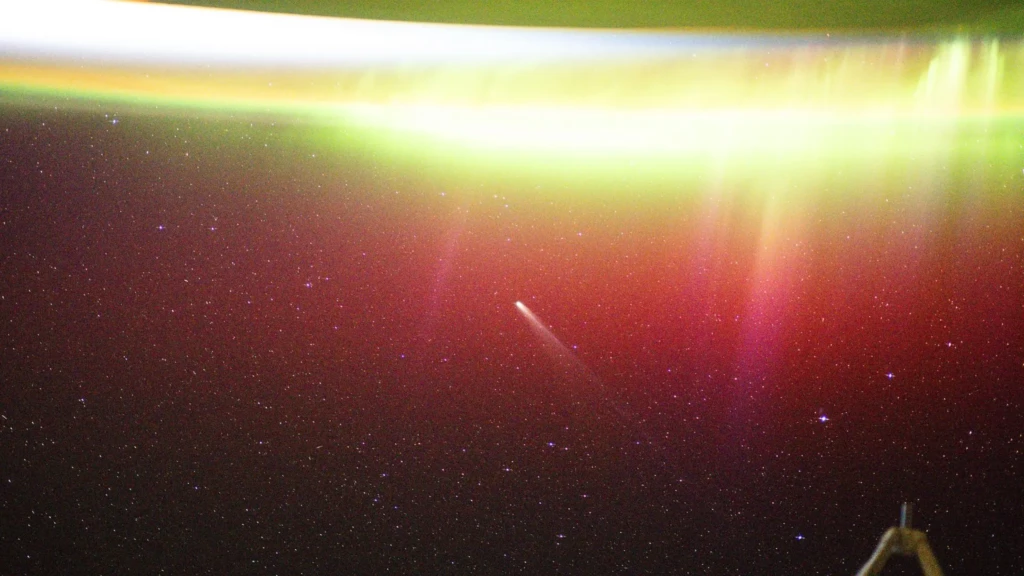
It is these electrons and their collision with atoms and molecules in the atmosphere that results in auroras. The collision transfers energy into nitrogen atoms nearly 100 km above surface, and the release of that energy causes the atoms to glow pink. Nitrogen and oxygen at mid-altitude (100-200 km) glow blue and green, respectively, whereas oxygen atoms above 200 km altitude glow red.
This chain of events constitutes a geomagnetic storm and its intensity depends on the strength of the solar eruption.
ALSO READ: Massive Coronal Mass Ejection Spotted On Another Star For The First Time
Dangers of a CME
While CMEs trigger stunning auroras in the polar regions, they also bring a grave threat to low-Earth orbit. A geomagnetic storm can damage invaluable assets like navigation and weather satellites, and interfere with radio frequency causing communication blackouts.
Reports say blackouts were reported across Europe and Africa during the solar eruption earlier this month.
Severe events can also affect power grids and pipelines and disrupt equipment aboard the International Space Station (ISS), which is home to half-a-dozen astronauts most of the time.
ALSO READ: Strongest Solar Eruption Of 2025 Lights Up Skies With Auroras, Triggers Blackouts