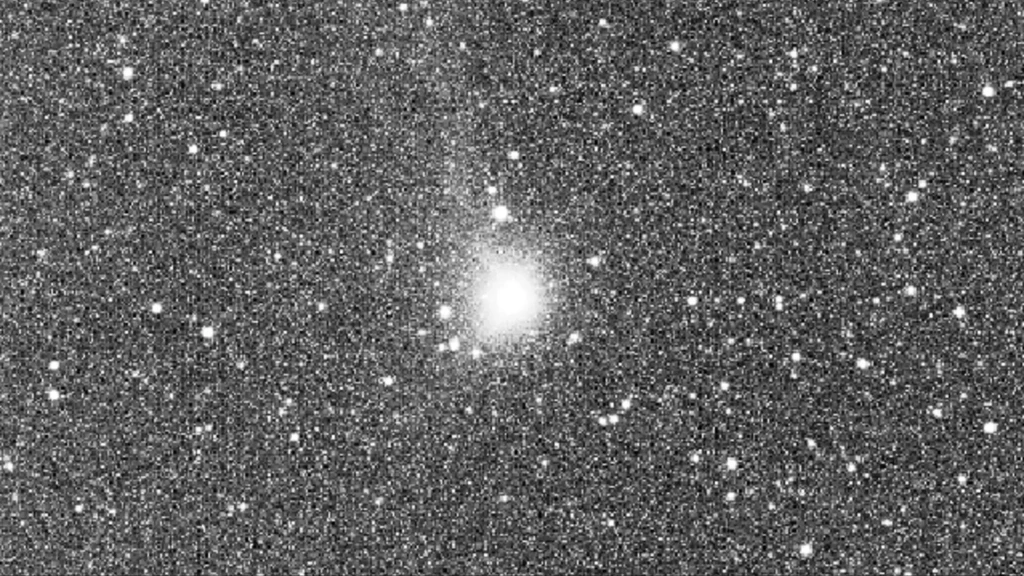
The European Space Agency (ESA) has revealed an early glimpse of Comet 3I/ATLAS‘s images captured by the JUICE mission spacecraft. Instead of waiting until February 2026, the agency decided to release a quarter of a single image that was captured on November 2. JUICE, which is on its way to study Jupiter’s icy moons, is one of the many active missions ESA and NASA are using to spy on the interstellar comet.
While the complete data release is scheduled on February 18 and 20, 2026, the image shared on Thursday shows what’s in store.
☄️ Our #ESAJuice team couldn’t wait until February, when they will receive data on #3IATLAS from the mission’s science instruments.
So they downloaded just a quarter of an image from its navigation camera to get a surprise sneak preview.
More info and annotations 👉… pic.twitter.com/e8JGpOkCfd
— ESA Science (@esascience) December 4, 2025
JUICE’s onboard Navigation Camera (NavCam) captured a clear view of 3I/ATLAS’s coma (cloud of gas around nucleus) two days before the spacecraft’s closest approach from a distance of about 66 million kilometers. Since 3I/ATLAS had already reached perihelion (closest point to the Sun) on October 31, it was photographed in a more active state.
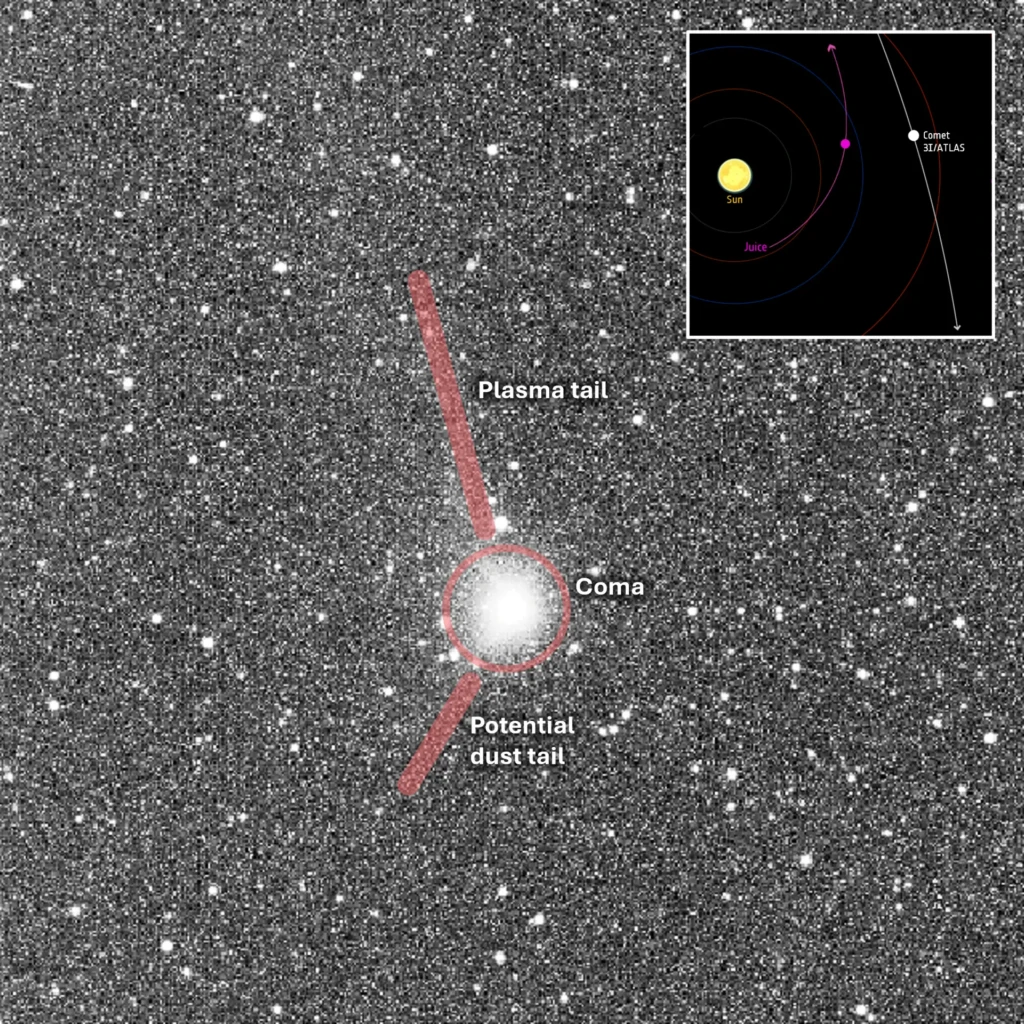
“Not only do we clearly see the glowing halo of gas surrounding the comet known as its coma, we also see a hint of two tails. The comet’s ‘plasma tail’ – made up of electrically charged gas, stretches out towards the top of the frame. We may also be able to see a fainter ‘dust tail’ – made up of tiny solid particles,” ESA said in a statement.
The mission team expects to see clearer signs of activity once data is downloaded from the spacecraft’s all five instruments. “This includes not only images from JANUS – Juice’s high-resolution optical camera – but also spectrometry data from MAJIS and UVS, composition data from SWI, and particle data from PEP,” ESA said.
There’s a delay in data transmission because JUICE is using its main high-gain antenna as a heat shield to protect it from the Sun, leaving its smaller medium-gain antenna to send data back to Earth at a much lower rate, the agency explained.
3I/ATLAS will reportedly make its closest approach to Earth on December 19 from a distance of around 270 million kilometers. It was discovered by the NASA-funded Asteroid Terrestrial-impact Last Alert System (ATLAS) on July 1 and was soon confirmed to be the third object from interstellar space to visit our solar system. NASA has so far used 12 active missions to observe the comet from space and released the much-awaited pictures last month.
ALSO READ: Why Are Comet 3I/ATLAS Images Released By NASA So Blurry?
ALSO READ: NASA’s PUNCH Mission Spies Newly Discovered Comet SWAN In Thrilling Footage