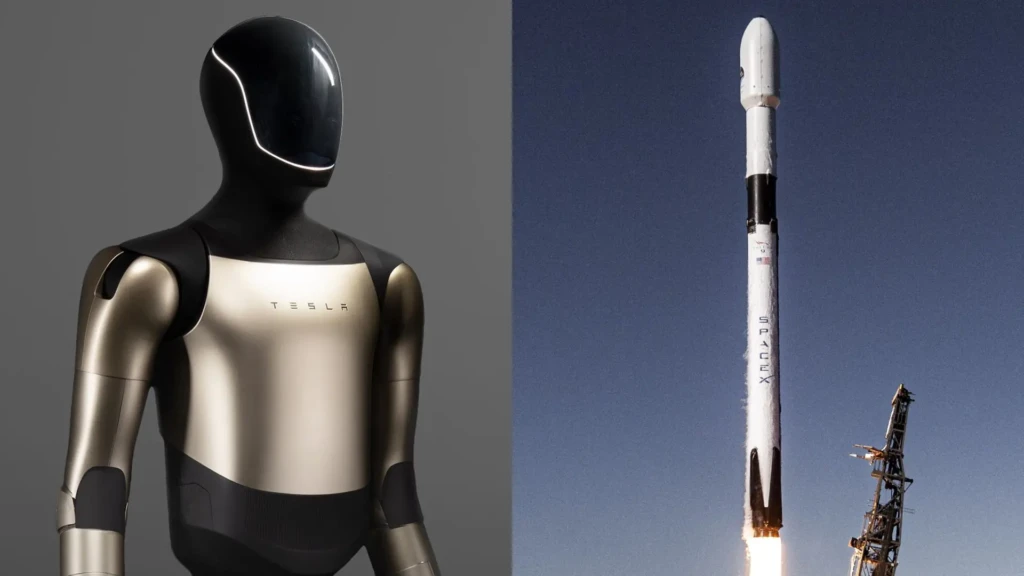
Elon Musk is currently leading six major companies and three of them, he says, are converging to achieve a bigger goal. During an interview with Zerodha’s billionaire co-founder, investor and YouTuber Nikhil Kamath, Elon Musk talked about the parallel functioning of his aerospace firm SpaceX, electric car manufacturer Tesla, and artificial intelligence company xAI, and a common objective that brings them together – solar-powered AI satellites.
When asked which of his businesses he’s most excited about, Musk replied – “Well, I think that there’s increasingly a convergence between SpaceX, Tesla, and xAI, in that if the future is solar-powered AI satellites — which it pretty much needs to be in order to harness a non-trivial amount of the energy of the Sun — you have to move to solar-powered AI satellites in deep space, which is somewhat a confluence of Tesla expertise, SpaceX expertise, and xAI on the AI front.“
Elon Musk in a new interview on which of his businesses he is most excited about:
“Well, I think that there’s increasingly a convergence, actually, between SpaceX, Tesla, and xAI, in that if the future is solar-powered AI satellites—which it pretty much needs to be in order to… pic.twitter.com/oIVN9OEOty
— Nic Cruz Patane (@niccruzpatane) November 30, 2025
“So, it does feel like, over time, there‘s somewhat of a convergence there. But all the companies are doing great things. Very proud of the teams that do great work,” he added.
Why solar-powered AI satellites matter
Musk says that the best place to run large-scale AI computation is in space where satellites receive uninterrupted energy supply. They also won’t require cooling systems because they radiate heat efficiently into the vacuum and can operate without the limits of Earth-based power grids.
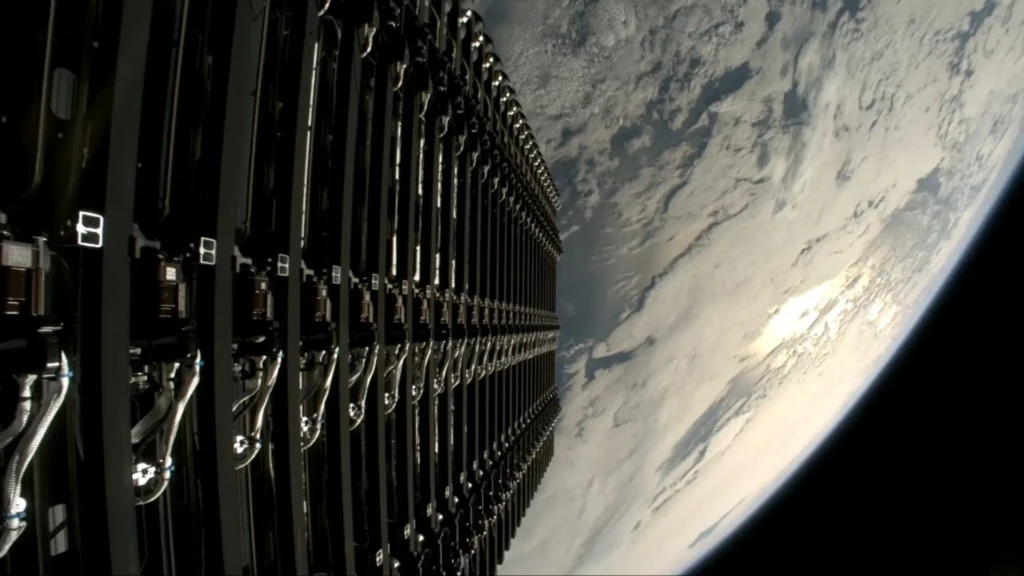
Musk says that AI satellites will require enormous amounts of electricity, which is hard to find on Earth. Installing these satellites in a Sun-synchronous orbit could be the solution. “Satellites with localized AI compute, where just the results are beamed back from low-latency, sun-synchronous orbit, will be the lowest cost way to generate AI bitstreams in <3 years,” he posted on X.
Musk estimates that 1 megaton per year of satellites with 100kW per satellite will yield 100GW of AI “with no operating or maintenance cost, connecting via high-bandwidth lasers to the Starlink constellation.”
Musk is also promoting the idea of setting up factories on the Moon and launching them into orbit using an electromagnetic railgun, which will eliminate the need for rockets. “That scales to >100TW/year of Al and enables non-trivial progress towards becoming a Kardashev II civilization,” Musk wrote. The Kardashev scale is used to measure the technological advancement of a civilization. A Kardashev II civilization is one which is capable of harnessing the power of its star. It’s also called a Type II civilization. Ours is considered a Type 0 civilization because humanity hasn’t even completely harnessed the full energy of Earth.
ALSO READ: Elon Musk Says Tesla’s Optimus Will Be A Von Neumann Probe. What Does It Mean?
ALSO READ: Mars On Earth: Why NASA Is Training Humans To Live Like Martians