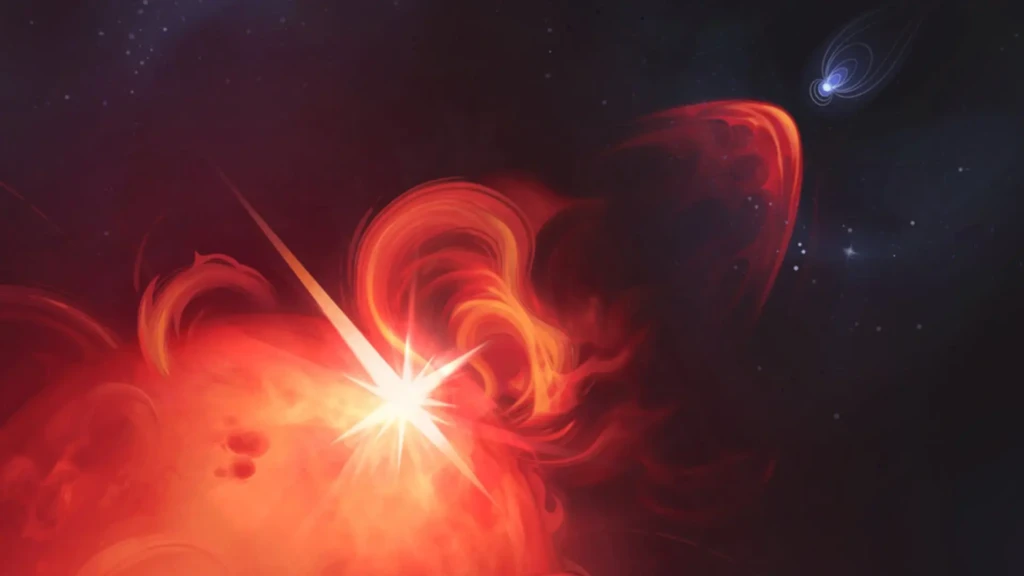
Astronomers have confirmed witnessing an explosion on a star other than the Sun for the first time. According to the European Space Agency (ESA), a powerful burst was caught by its XMM-Newton Space Observatory and the Low Frequency Array (LOFAR) telescope on a star located around 130 light-years away.
📣 For the first time ever, scientists have confirmed seeing a giant explosion on a star other than our own!
Our @ESA_XMM observatory and the LOFAR telescope contributed to making this long sought-after discovery 👉 https://t.co/NQkRTFJPWZ
— ESA Science (@esascience) November 12, 2025
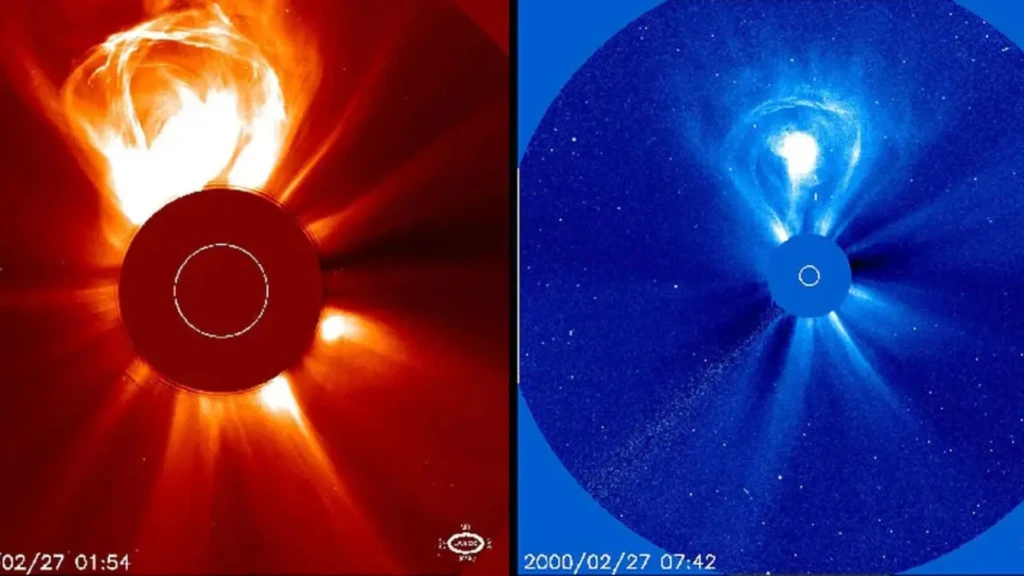
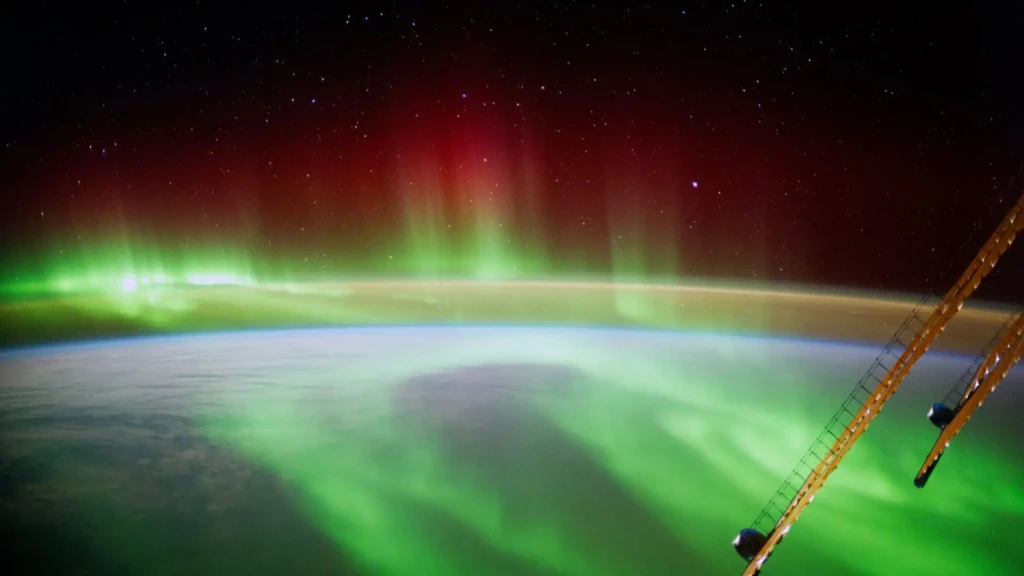
The event is said to be a coronal mass ejection or CME, the eruption from the Sun’s corona (outermost atmospheric region) which releases an enormous cloud of supercharged gas. NASA says that a large CME can contain a billion tons of matter that can accelerate to millions of kilometres per hour. CMEs are the reason why we see auroras on Earth and they’re drivers of space weather.
“Astronomers have wanted to spot a CME on another star for decades,” stated Joe Callingham of the Netherlands Institute for Radio Astronomy (ASTRON) and lead author of the study published in Nature. “Previous findings have inferred that they exist, or hinted at their presence, but haven’t actually confirmed that material has definitively escaped out into space. We’ve now managed to do this for the first time,” he added.
Callingham and team were able to notice the event through a burst of radio waves associated with the shock wave that is produced during a CME. The scientists deducted that the radio signal they received must have resulted from a CME.
ALSO READ: Strongest Solar Eruption Of 2025 Lights Up Skies With Auroras, Triggers Blackouts
Why this discovery is concerning
While the discovery is historic and exciting, it raises some concerns about habitability of a planet around such stars. This CME-flinging star is a red dwarf which are generally fainter, cooler and smaller than the Sun. However, if a planet is close enough, over-exposure to intense CME events can strip the planet of its atmosphere, leaving behind an uninhabitable world.
According to ESA, scientists found that this red dwarf is roughly half as massive as the Sun, rotates 20 times faster and its magnetic field is 300 times more powerful. While most known planets in the Milky Way orbit such stars, constant bombardment by charged particles may cause them to lose atmosphere despite being in the habitable zone.
The study says that the CME from this star moved at 2,400 km per second and was fast and dense enough to completely strip away atmospheres of any planets around it.
“It seems that intense space weather may be even more extreme around smaller stars – the primary hosts of potentially habitable exoplanets,” said Henrik Eklund, an ESA research fellow based at the European Space Research and Technology Centre (ESTEC), Netherlands. “This has important implications for how these planets keep hold of their atmospheres and possibly remain habitable over time.”
ALSO READ: Comet 3I/ATLAS May Have Broken Into 16 Or More Pieces, Says Scientist