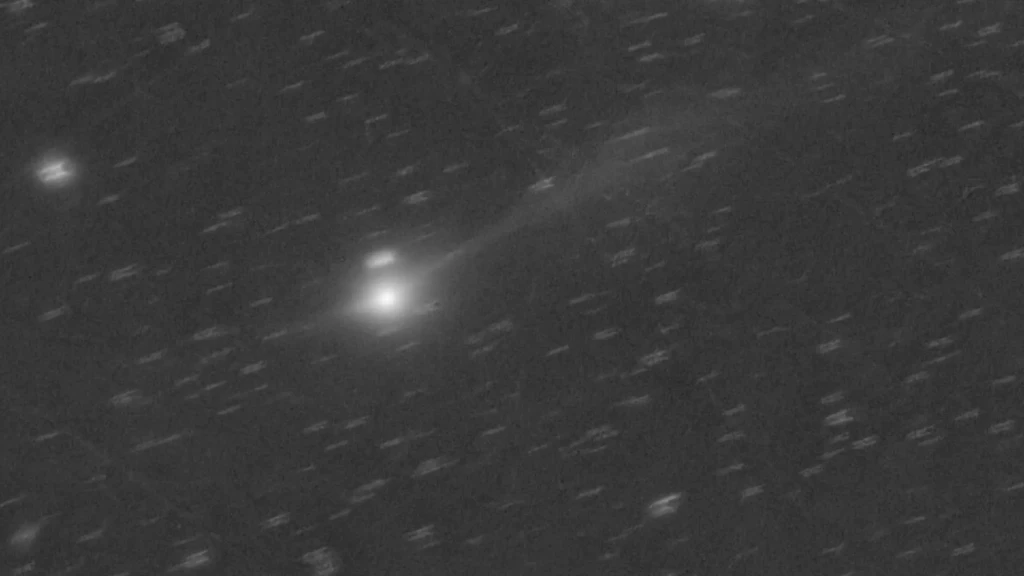
The interstellar comet 3I/ATLAS will make its closest approach to Earth on December 19 and you can watch it live from the comfort of your home. This visitor will fly past Earth from a safe distance of 270 million kilometres as it continues its journey out of the inner solar system. 3I/ATLAS is the third confirmed interstellar object to visit our solar system and scientists are keen to learn about what environment it formed in.
How to watch comet 3I/ATLAS live?
The Virtual Telescope Project headed by astronomer Gianluca Masi will stream the comet’s closest pass from Earth live tomorrow. The webcast is scheduled to begin at 9:30 am IST (11 pm EST the night before) on Virtual Telescope’s YouTube channel.
A once-in-a-lifetime opportunity
Comet 3I/ATLAS literally offers scientists a once-in-a-lifetime opportunity to learn about its mysterious characteristics and origins. It is estimated that the comet might be older than the Sun and carries elements like water, carbon dioxide, carbon monoxide, carbonyl sulphide, iron and nickel in its nucleus.

According to European Space Agency (ESA), it could be between a few metres to a few kilometres wide. During perihelion (closest approach to the Sun) in late October, 3I/ATLAS was travelling at roughly 2,50,000 km per hour, which is the highest ever recorded for an interstellar object.

Discovered on July 1, by the NASA-funded ATLAS (Asteroid Terrestrial-impact Last Alert System) survey telescope in Chile, comet 3I/ATLAS was presented as a potential alien spacecraft by Harvard physicist Avi Loeb. Despite Loeb highlighting more than a dozen ‘anomalies’, NASA insists that it’s nothing but a comet.
The agency recently pointed several of its spacecraft cameras toward 3I/ATLAS to photograph its journey through our solar system. ESA, along with NASA, also snapped the comet using their Mars orbiters during the closest pass on October 3.
With the closest approach to Earth coming up, astronomers are excited about using ground-based telescopes to take a closer look at 3I/ATLAS. They believe this comet may answer what kind of star systems exist and how chemistry differs there from ours.
ALSO READ: NASA Finally Releases Comet 3I/ATLAS Images Captured From Mars & Beyond
ALSO READ: Interstellar Comet 3I/ATLAS Captured In Ghostly X-ray Image By ESA Telescope