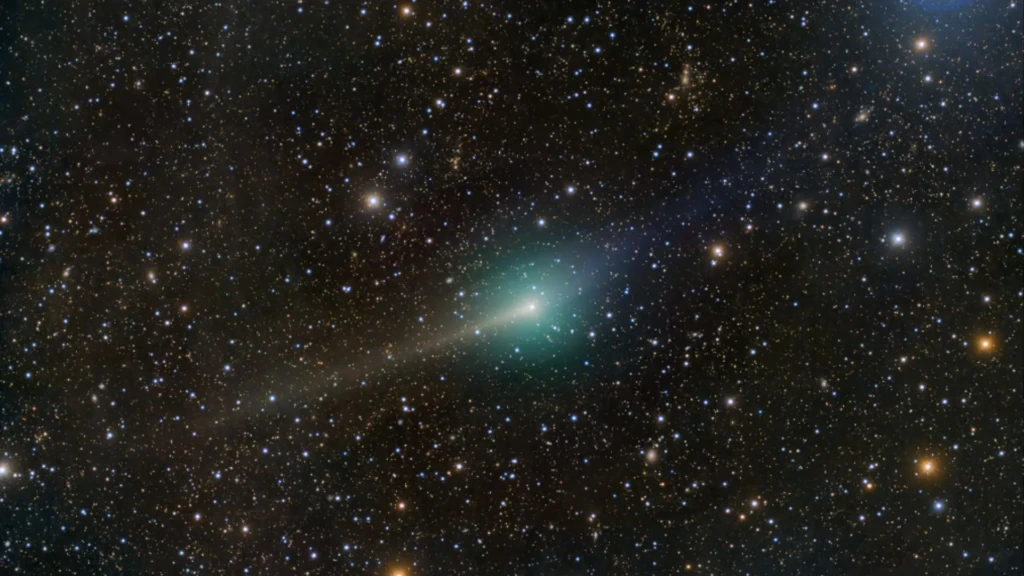
The interstellar comet 3I/ATLAS is speeding on its hyperbolic trajectory out of the inner solar system after its closest approach to Earth on December 19. The visitor flew from a safe distance of 270 million kilometres and offered astronomers a chance to closely study its many strange features uncovered since its discovery on July 1.
Now that the closest approach is behind us, 3I/ATLAS is still exhibiting strange behaviour, although space agencies like NASA are still convinced it’s just a comet and not a potential alien spacecraft – as posited by Harvard physicist Avi Loeb.

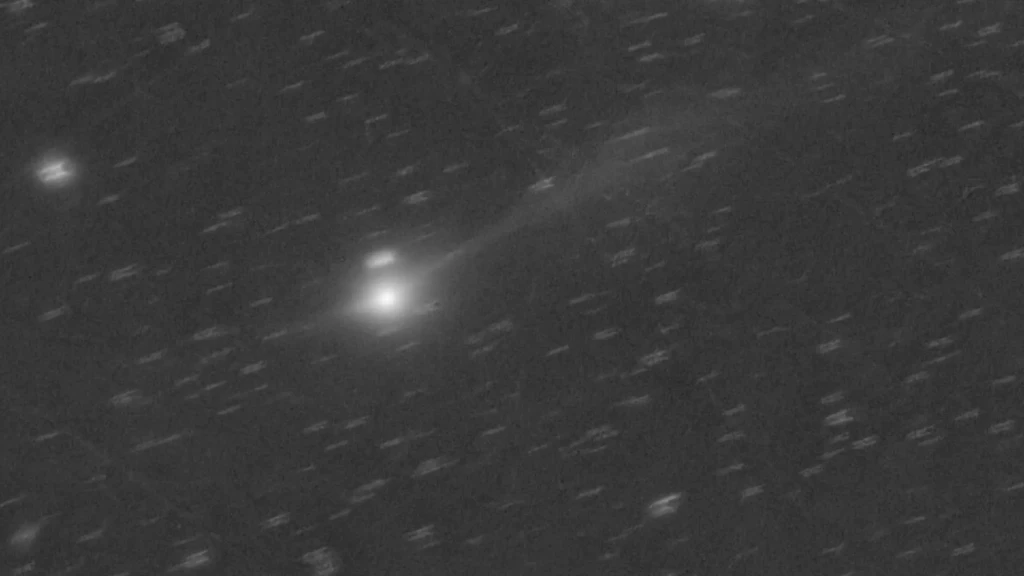
Loeb has continued observing the comet and publishing blogs about its outward journey and the ‘anti-tail’ jet which he says is unusual.
Current status of comet 3I/ATLAS
In his latest blog published on December 26, Loeb said that this Sun-facing anti-tail is made of dust grains about 10 microns in size – larger than typical comet dust. He calculated that the jet measures 4,00,000 kilometres in length and that 3I/ATLAS is losing dust and gas at a rate of 3.3 kg per second and 500 kg per second, respectively. He also poses a question whether 3I/ATLAS formed in, or passed through, a molecular cloud where it picked up unusually large dust grains in interstellar space.

Comets shed material as they travel through space. As they get close to the Sun, this shedding increases significantly because the Sunlight heats up their nucleus which consequentially releases frozen gas that drag dust particles away, creating millions of kilometres long tail. 3I/ATLAS made its closest approach to the Sun (perihelion) on October 29.
As of today, NASA or other agencies and observatories have not shared updates on the comet after the December 19 approach. Interestingly, Breakthrough Listen – the research program dedicated to finding evidence of alien civilisation – used this opportunity to conduct a study to find ‘technosignatures‘ on 3I/ATLAS.
Is 3I/ATLAS an alien spacecraft?
Scientists hunt for technosignatures – technological traces of intelligent life – to confirm whether a suspicious object has an unnatural origin. Breakthrough Listen also conducted a similar search but found no evidence of 3I/ATLAs being an alien spacecraft.

“Unlike 1I/’Oumuamua, 3I/ATLAS exhibits mostly typical cometary characteristics, including a coma and an unelongated nucleus. There is currently no evidence to suggest that ISOs are anything other than natural astrophysical objects,” the researchers wrote in the new unpublished paper.
Oumuamua was the first interstellar comet to be discovered in 2017, and 2I/Borisov was the second in 2019.
“However, given the small number of such objects known (only three to date), and the plausibility of interstellar probes as a technosignature, thorough study is warranted,” they further wrote.
What we already know about 3I/ATLAS
Comet 3I/ATLAS, officially designated C-2025 N1, was discovered by the NASA-funded ATLAS (Asteroid Terrestrial-impact Last Alert System) survey telescope in Chile and it’s the third known interstellar comet.
In the months following its discovery, scientists found many odd characteristics of this icy object which is estimated to be between 400 metres to 5 kilometres wide. Its coma (cloud of dust and gas around nucleus) is dominated by carbon dioxide and has other volalities like cyanide gas, carbon monoxide and water vapour. It also had higher nickel composition and low iron – which is different from the average comet and hints at a completely different condition it was formed in.
Besides, it is estimated to be older than our solar system – probably over seven billion years old.
Scientists also noticed a non-gravitational acceleration of 3I/ALTAS which made for a strong argument that this object might be using a propulsion system. This argument, however, is not supported by NASA and its partners.
ALSO READ: Comet 3I/ATLAS Entered The Oort Cloud 8000 Years Ago. What Was Earth Like Then?
ALSO READ: ESA Drops Surprise Preview Of Comet 3I/ATLAS Images From JUICE Spacecraft