Blue Terra Journal

  • Home
  • Spaceflight
    SpaceflightShow More
    NASA's SR-1 Freedom spacecraft.
    What Is NASA’s SR-1 Freedom Mission? The First Nuclear Reactor In Space Explained
    March 27, 2026
    Artist's impression of a NASA Moon base.
    NASA Moon Base: How The US Will Spend $20 Billion On This Ambitious Project
    March 25, 2026
    Russia's Soyuz rocket ascending to space.
    Russia’s Progress Spacecraft Suffers Mystery Glitch On Its Way To ISS; What Happened?
    March 23, 2026
    Robert Goddard
    Celebrating Robert Goddard – The Man Who Changed Rocketry 100 Years Ago
    March 17, 2026
    International Space Station gets extension to beat China
    Watch Out China! US Proposes Extending International Space Station Lifespan To 2032
    March 10, 2026
  • Astronomy
    AstronomyShow More
    Meteor spotted over Houston.
    Video Captures 1-Ton Meteor Exploding Over Houston Skies, NASA Releases Statement
    March 22, 2026
    NASA black hole simulation
    Fall Into A Black Hole With This Incredibly Scary Simulation Made By NASA
    March 18, 2026
    Comet C/2026 A1 MAPS
    Comet C/2026 A1 MAPS: What Are ‘Sun-Grazer’ Comets And Why Are They Special?
    March 12, 2026
    Moon is safe from asteroid 2024 YR4.
    The Moon Is Safe! James Webb Space Telescope Rules Out Asteroid 2024 YR4’s Collision
    March 6, 2026
    NASA Moon orbiter
    NASA Prepares To Save Its Orbiter During Total Solar Eclipse On The Moon
    March 3, 2026
  • India
    IndiaShow More
    Shubhanshu Shukla aboard the ISS.
    ISRO Astronaut Shubhanshu Shukla Awarded Ashoka Chakra For Heroic Ax-4 Mission
    February 9, 2026
    ISRO's PSLV lifts off to space.
    ISRO’s PSLV Rocket Suffers Third Stage Failure After Successful Liftoff; Payloads Lost
    January 23, 2026
    Dhruva Space team at ISRO facility.
    India’s Dhruva Space To Launch 10 Missions, Including 1st Northeastern Satellite, On ISRO’s PSLV
    January 12, 2026
    ISRO's PSLV rocket
    ISRO To Seek Redemption With PSLV-C62 Mission Launch On January 12
    January 12, 2026
    ISRO SSLV
    ISRO’s SSLV Rocket Just Got Better After Latest Third Stage Test Fire
    December 31, 2025
  • Artemis
    ArtemisShow More
    NASA Artemis II crew
    NASA’s Christina Koch Turns ‘Space Plumber’ To Fix $30 Million Toilet On Artemis II Mission
    April 3, 2026
    NASA Orion spacecraft
    NASA’s Artemis II Astronauts Are Moon-Bound After Successful Trans-Lunar Injection Burn
    April 3, 2026
    NASA Artemis II lifts off.
    Artemis II Lifts Off! NASA Launches 4 Astronauts To The Moon After Over 50 Years
    April 2, 2026
    NASA's Artemis II astronauts
    NASA Artemis II Launch Live: Watch Humanity Return To The Moon On April 2
    April 2, 2026
    NASA Apollo 8 image
    NASA Artemis II: Why This Moon Mission Is Our Generation’s Apollo 8
    March 30, 2026
  • More
    • About
    • Privacy Policy
    • Terms
    • Contact

Blue Terra Journal

  • Home
  • Spaceflight
  • Astronomy
  • India
  • Artemis
Search
  • Pages
    • About
    • Contact
    • Privacy Policy
    • Terms

Home - Astronomy - Is 3I/ATLAS Really A Comet? Its Strange Anti-Tail May Hold The Answer

Astronomy

Is 3I/ATLAS Really A Comet? Its Strange Anti-Tail May Hold The Answer

The mystery continues.

Harsh Vardhan
Last updated: January 6, 2026 9:05 PM
Harsh Vardhan
Share
6 Min Read
NASA Comet 3I/ATLAS
Comet 3I/ATLAS captured by Gemini observatory. Image: GeminiObs/NOIRLab/NSF/AURA
SHARE

Contents
  • Comet 3I/ATLAS and its anti-tail
  • Is Comet 3I/ATLAS just a comet?

Update January, 6, 2026 – New findings on comet 3I/ATLAS suggest this interstellar visitor is a natural object and not an alien spacecraft. Scientist Avi Loeb is still suspicious about its origin. Article originally published on Jan 3, 2026. 

The interstellar comet 3I/ATLAS‘s strange anti-tail may hold clues to its true nature, says Harvard physicist Avi Loeb who suspects it of being an alien spacecraft. In his recent blog, Loeb suggested that ground-based telescopes must collect data on the release of gases along the comet’s anti-tail jet which extends hundreds of thousands of kilometres long.

3I/ATLAS NASA Avi Loeb
Comet 3I/ATLAS captured by Hubble telescope. Image: NASA

3I/ATLAS has a massive Sun-facing jet which is unusual because materials ejected from comets are normally pushed away from the Sun.

Comet 3I/ATLAS and its anti-tail

The anti-tail jet consists of dust and gas which are being released as the comet moves on its hyperbolic trajectory. When a comet travels through space, sunlight heats its surface and triggers sublimation (conversion of frozen ice directly into gas) which causes it to shed mass and creates a tail.
3I/ATLAS NASA Avi Loeb
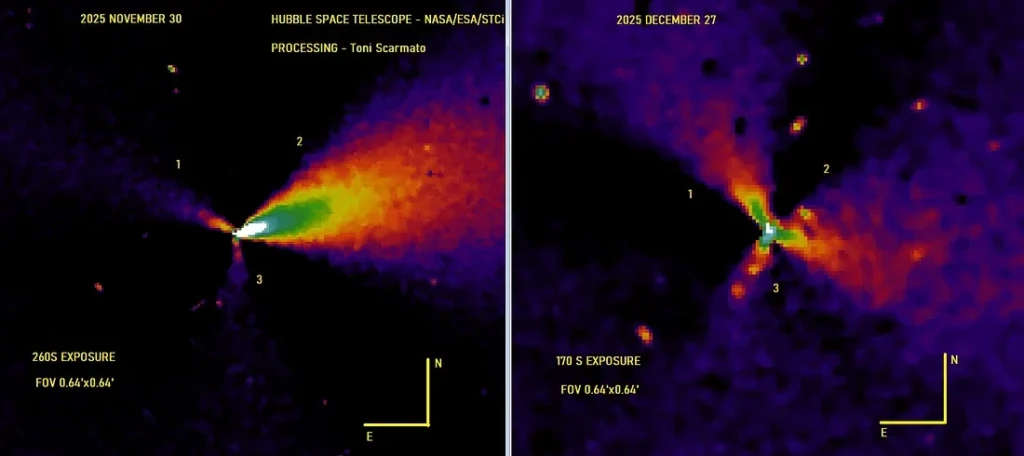
Comet 3I/ATLAS’s anti-tail jet seen in Hubble telescope images. Image: NASA/ESA/CSA/STScI

Observations from several major telescopes, including NASA’s Hubble telescope, have revealed that one of 3I/ATLAS’s narrow sunward anti-tail jet is 10 times longer than it is wide. These jets of varying lengths are one of the comet’s many anomalies Loeb has highlighted.

The scientist has explained that dust grains about 10 microns in size are being ejected from the comet and the gases being released are pushing the dust particles despite solar radiation pressure. Loeb, however, argues that if 3I/ATLAS is a natural comet the gases should not be streaming as far as the dust does along the anti-tail – it should stop within 5,000 km of the comet’s nucleus.

3I/ATLAS NASA Avi Loeb
Comet 3I/ATLAS captured post perihelion. Image: GeminiObs/NOIRLab/NSF/AURA/B. Bolin

Loeb even brought up propulsion systems saying chemical thrusters, like on rockets, could send gases up to 25,000 km beyond the nucleus whereas ion thrusters could reach 1,00,000 km from the nucleus.

“If it is a natural comet, then the anti-tail jet should not include streaming gas beyond a distance of 5,000 kilometers from the nucleus. At distances much larger than 5,000 kilometers from 3I/ATLAS as a comet, the anti-tail should be composed primarily of a stream of 10-micron dust particles with no streaming gas,” Loeb wrote.
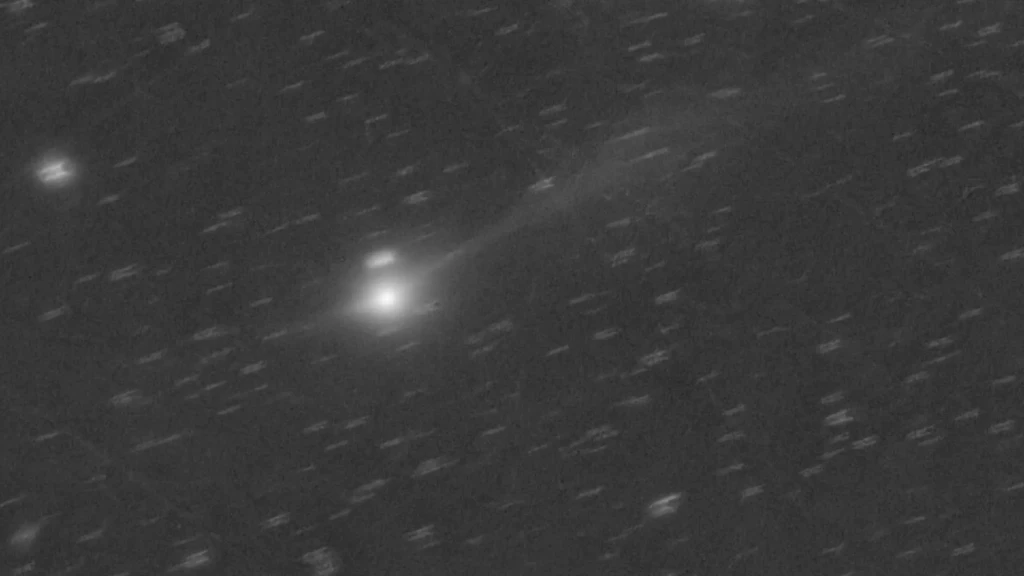
Comet 3I/ATLAS post perihelion. Image: Virtual Telescope
Comet 3I/ATLAS captured on November 11. Image: Virtual Telescope

According to him, the anti-tail jet presently must be gas-free and the reach of volatiles like frozen carbon dioxide or carbon monoxide 5,000 km beyond the nucleus could reveal a lot about the comet’s nature.

3I/ATLAS was discovered on July 1, 2025 by the NASA-funded Asteroid Terrestrial-impact Last Alert System (ATLAS) and it’s the third confirmed interstellar object after comets Oumuamua and Borisov. It reached perihelion (closest point to the Sun) on October 29 and made its closest approach to Earth on December 19, 2025. NASA has rejected all claims of 3I/ATLAS being an alien spacecraft, saying that its strange characteristics are just a result of the comet originating in a different environment than our solar system.

Is Comet 3I/ATLAS just a comet?

The scientific concensus leans heavily toward natural comet despite its many anomalies Loeb has flagged. One solid argument against the alien theory is the lack of technosignatures – signs of technology from advanced civilisation – from 3I/ATLAS which the Breakthrough Listen Initiative was looking for.

“We all would have been thrilled to find technosignatures coming from 3I/ATLAS, but they’re just not there. Finding no signals was the result we expected, due to the significant evidence for 3I/ATLAS being a comet with only natural features,” Benjamin Jacobson-Bell from the University of California, Berkeley, who led the research told Space.com. Loeb, however, is still not convinced as he argued in his latest blog that 3I/ATLAS may not have emitted any signal at the time of the 5-hour research – a short window. He has also questioned the Central Intelligence Agency (CIA) on its “neither confirm nor deny” answer to a query under the Freedom of Information Act. 

ALSO READ: Comet 3I/ATLAS: Should We Take Avi Loeb’s Alien Theory Seriously?

ALSO READ: So What Happened To Comet 3I/ATLAS After Its Closest Approach To Earth?

TAGGED:3I/ATLASAvi LoebComet 3I/ATLASNASASpace
Share This Article
Facebook Pinterest Whatsapp Whatsapp LinkedIn Copy Link Print

Latest News

NASA Artemis II crew
NASA’s Christina Koch Turns ‘Space Plumber’ To Fix $30 Million Toilet On Artemis II Mission
Artemis
NASA Orion spacecraft
NASA’s Artemis II Astronauts Are Moon-Bound After Successful Trans-Lunar Injection Burn
Artemis
NASA Artemis II lifts off.
Artemis II Lifts Off! NASA Launches 4 Astronauts To The Moon After Over 50 Years
Artemis
NASA's Artemis II astronauts
NASA Artemis II Launch Live: Watch Humanity Return To The Moon On April 2
Artemis

You Might Also Like

ISRO SSLV
India

ISRO’s SSLV Rocket Just Got Better After Latest Third Stage Test Fire

December 31, 2025
Pandora NASA
Astronomy

Meet Pandora, The NASA Observatory Made With James Webb Telescope’s Spare Parts

December 27, 2025
comet 3I/ATLAS Oort Cloud
Astronomy

ESA Drops Surprise Preview Of Comet 3I/ATLAS Images From JUICE Spacecraft

December 8, 2025
NASA's SR-1 Freedom spacecraft.
Spaceflight

What Is NASA’s SR-1 Freedom Mission? The First Nuclear Reactor In Space Explained

March 27, 2026
© 2026, Blue Terra Journal
  • About
  • Privacy Policy
  • Terms
  • Contact
Welcome Back!

Sign in to your account

Username or Email Address
Password

Lost your password?