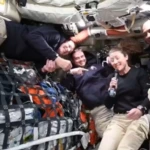
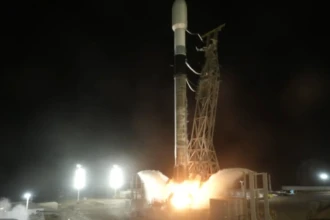
China’s three-member crew of the Shenzhou-20 mission safely returned to Earth on November 14 after facing a grave crisis. The crew was scheduled to return on November 5 after about six months at the Tiangong space station but the mission was aborted after a piece of space debris was suspected to have struck their capsule. Ditching it for safety reasons, the trio used the newly docked Shenzhou-21 spacecraft to get home.
The China Manned Space Engineering (CMSE) confirmed that mission Commander Chen Dong, pilot Chen Zhongrui and engineer Wang Jie were in good health.
The Shenzhou 21 spacecraft, launched on Oct 31, departed Tiangong space station today for a record-breaking short 13-day mission, rescuing Shenzhou 20 crews. Full HD:https://t.co/4obU53R81J pic.twitter.com/NeAOc3Um9K
— CNSA Watcher (@CNSAWatcher) November 14, 2025
In a statement, CMSE reportedly said that the Shenzhou-20 capsule may have been hit by debris piece which resulted in a crack on the spacecraft window. “Based on preliminary analysis of photographs, design review, simulation analysis, and wind tunnel testing, a comprehensive assessment determined that the Shenzhou-20 manned spacecraft’s return capsule window glass had developed a minor crack, most likely caused by an external impact from space debris, thus failing to meet the release conditions for a safe manned return. The Shenzhou-20 manned spacecraft will remain in orbit to conduct relevant experiments.”
Space debris menace back in spotlight
The incident, which could have resulted in tragedy, highlights a serious yet overlooked issue – growing space debris. Objects ranging from fragments just a few inches across to intact defunct satellites are whipping around low-Earth orbit at the speed of nearly 29,000 km per hour, posing grave risk to functioning infrastructure in low-Earth orbit (LEO).
According to European Space Agency‘s (ESA) 2025 report, there are 1.2 million objects larger than 1 cm in size and more than 50,000 objects larger than 10 cm in Earth’s orbit. In 2024, space surveillance networks tracked over 3,000 new objects as a result of fragmentation events. The fragmentation may be due to collision, explosion or other reasons. This causes a chain reaction, adding new objects faster than floating debris can naturally re-enter the atmosphere – a process known as Kessler Syndrome.

The incident with China’s Shenzhou-20 must serve as a warning since the International Space Station (ISS) has avoided colliding with such objects several times and will continue to dodge until it retires in 2030. NASA and its partners use the spacecraft docked at the ISS to manoeuvre it away from a debris cloud. In June last year, ISS astronauts including Sunita Williams were forced to take shelter in the docked capsules after NASA warned of a satellite breakup in the station’s orbit.

Apart from the space stations like ISS and Tiangong, space junk is also a threat to active satellites in orbit. The LEO is getting increasingly congested as SpaceX launches dozens of Starlink satellites every week and is planning to launch 42,000 in total to complete the constellation. There are already nearly 9,000 Starlink satellites in low-Earth orbit.
While this may seem like a space problem, people on the ground aren’t safe either. We’re safe only if debris lands into oceans or burn-up during atmospheric reentry but a crash in inhabited regions could be catastrophic. There have been multiple instances of space debris crashing on Earth and even in residential buildings. In March 2024, a piece of debris released from the ISS crashed into a house in Florida, prompting the owner to sue NASA.

In the same month, the trunk section of SpaceX’s crew Dragon spacecraft, which brought Sunita Williams home, made an uncontrolled re-entry over Morocco. In May, another massive piece of metallic object, suspected to be part of SpaceX’s Dragon spacecraft fell in North Carolina, US. A SpaceX capsule remnant crashed in Australia in 2022, followed by the crash of a rocket part, possibly from a Chinese launch vehicle this October.
ALSO READ: Neil deGrasse Tyson Shares The Only Reasons Humans May Reach Mars
There have been numerous other incidents, including premature re-entries of Starlink and other satellites, warranting proactive measures to curb the menace of space debris. Thankfully, there is some hope owing to the mitigation efforts undertaken in the recent past.
ESA says that both rocket bodies and payloads are re-entering in greater numbers year-on-year, especially in the commercial sector. “About 90% of rocket bodies in low-Earth orbits are now leaving valuable orbits in compliance with the re-entry within 25 years standards from before 2023, with more than half re-entering in a controlled manner,” the agency stated.
Besides, there are initiatives to purposefully pluck debris pieces out of orbit. Japan’s Astroscale is actively working to develop debris removal technologies and has conducted three tests in space so far. In collaboration with ClearSpace, ESA is also working to launch the ClearSpace-1 mission in 2029 that will rendezvous, capture and safely bring down a satellite for re-entry.
ALSO READ: NASA’s ESCAPADE Mission Is Off To Mars. What Happens Next?