Blue Terra Journal

  • Home
  • Spaceflight
    SpaceflightShow More
    SpaceX Dragon spacecraft for NASA's Crew-12 mission.
    SpaceX Rolls Out Dragon Spacecraft For NASA’s Crew-12 Mission While Falcon 9 Remains Grounded
    February 4, 2026
    NASA partners with Axiom Space
    NASA And Axiom Space Announce 5th Private Crew Mission To International Space Station In 2027
    February 1, 2026
    Blue Origin Mark 1 lander.
    Blue Origin Halts New Shepard Missions For At Least 2 Years To Land Humans On The Moon
    February 1, 2026
    SpaceX Starship on flight 11.
    SpaceX CEO Elon Musk Reveals When Starship Will Launch On Next Test Flight
    January 29, 2026
    NOAA's SOLAR-1 observatory.
    NOAA’s Sun Spying SOLAR-1 Observatory Reaches Its Destination 1.5 Million Km From Earth
    January 31, 2026
  • Astronomy
    AstronomyShow More
    Voyager 1 illustration
    NASA’s Voyager 1 Will Be One Light-Day Away From Earth In 2026 – What This Means
    January 26, 2026
    Auroras triggered by CMEs.
    Auroras Flood The Night Skies After Largest Solar Radiation Storm In Over 20 Years | Photos
    January 20, 2026
    Hubble discovers Cloud-9.
    Hubble Telescope Uncovers New Object ‘Cloud-9’ – A ‘Failed Galaxy’ With No Stars
    January 13, 2026
    SpaceX launches NASA telescope.
    SpaceX Launches NASA’s Exoplanet Exploring Telescope Pandora On Twilight Mission
    January 19, 2026
    Comet 3I/ATLAS by Hubble telescope
    Comet 3I/ATLAS Is Not An Alien Spacecraft – This Research Likely Confirms It
    January 10, 2026
  • India
    IndiaShow More
    Shubhanshu Shukla aboard the ISS.
    ISRO Astronaut Shubhanshu Shukla Awarded Ashoka Chakra For Heroic Ax-4 Mission
    January 25, 2026
    ISRO's PSLV lifts off to space.
    ISRO’s PSLV Rocket Suffers Third Stage Failure After Successful Liftoff; Payloads Lost
    January 23, 2026
    Dhruva Space team at ISRO facility.
    India’s Dhruva Space To Launch 10 Missions, Including 1st Northeastern Satellite, On ISRO’s PSLV
    January 12, 2026
    ISRO's PSLV rocket
    ISRO To Seek Redemption With PSLV-C62 Mission Launch On January 12
    January 12, 2026
    ISRO SSLV
    ISRO’s SSLV Rocket Just Got Better After Latest Third Stage Test Fire
    December 31, 2025
  • Artemis
    ArtemisShow More
    NASA's SLS rocket.
    NASA’s Artemis II Rocket Plagued By Leaks Again; Administrator Jared Isaacman Reacts
    February 5, 2026
    NASA's Artemis II SLS Rocket
    NASA Delays Artemis II Moon Mission Launch To March – Here’s Why
    February 3, 2026
    NASA's SLS rocket.
    Astronauts In Quarantine, Rocket Powered On – How NASA Is Preparing For Artemis II
    February 3, 2026
    NASA's Artemis II crew
    Inside Artemis II: How NASA Will Study Astronaut Health And Deep Space Radiation
    January 30, 2026
    NASA's SLS rocket at launch pad.
    NASA’s Artemis II To Carry Relic Of Humanity’s First Flight And More To The Moon
    January 27, 2026
  • More
    • About
    • Privacy Policy
    • Terms
    • Contact

Blue Terra Journal

  • Home
  • Spaceflight
  • Astronomy
  • India
  • Artemis
Search
  • Pages
    • About
    • Contact
    • Privacy Policy
    • Terms

Home - Spaceflight - NASA’s Deep Space Probes Send Stunning Images Of Earth, Moon And Uranus

Spaceflight

NASA’s Deep Space Probes Send Stunning Images Of Earth, Moon And Uranus

OSIRIS-APEX peered 3.2 billion km away.

Harsh Vardhan
Last updated: November 29, 2025 7:22 PM
Harsh Vardhan
Share
4 Min Read
NASA OSIRIX-APEX
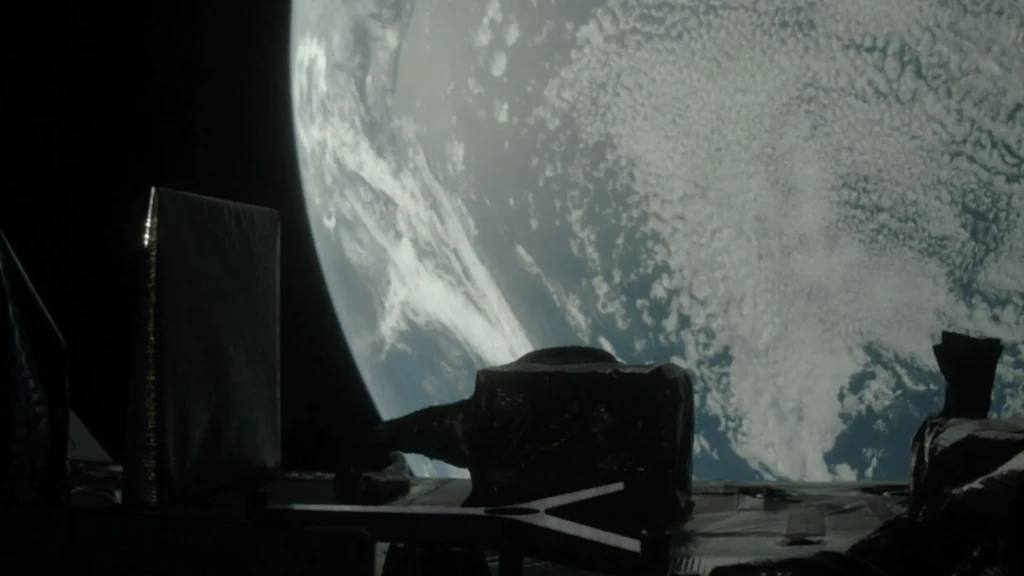
Earth photographed by NASA's OSIRIS-APEX spacecraft. Image: NASA
SHARE

Contents
  • OSIRIS-APEX’s Earth flyby
  • Europa Clipper spots Uranus

NASA has shared back-to-back images captured by two of its spacecraft in deep space. On November 25, the agency released imagery by the OSIRIS-APEX spacecraft from its recent Earth flyby followed by a picture from the Europa Clipper spacecraft that captured planet Uranus from a distance of 3.2 billion kilometres.

While OSIRIS-APEX is on its way to study the asteroid Apophis, Europa Clipper is off to explore Jupiter’s moon Europa which has a sub-surface ocean.

OSIRIS-APEX’s Earth flyby

The first views are from the OSIRIS-APEX (Origins, Spectral Interpretation, Resource Identification, and Security – Apophis Explorer) spacecraft which flew within 3,438 km from Earth on September 23.

Hope you didn’t blink!

On Sept. 23, @NASA‘s OSIRIS-APEX spacecraft made a quick flyby, passing 2,136 miles above Earth. Along the way, OSIRIS-APEX turned to look home. https://t.co/wexOWQZ8h0 pic.twitter.com/vs3s1LrIxt

— NASA Solar System (@NASASolarSystem) November 25, 2025

During the flyby, the probe captured Earth’s images and other data to calibrate its science instruments. NASA says the images were collected using the MapCam imager about nine hours after OSIRIS-APEX’s closest approach to Earth, when it was 2,28,000 km away. At a distance of 5,95,500 km, the spacecraft captured a second picture on September 24 using the StowCam, featuring the Moon and the Earth.

NASA OSIRIS-APEX
Moon and the Earth captured by NASA’s OSIRIS-APEX spacecraft. Image: NASA

OSIRIS-APEX has been repurposed from OSIRIS-REx, which launched in September 2016 and delivered samples of the asteroid Bennu in 2023. After dropping the sample capsule, the spacecraft was rerouted toward Apophis which will have its closest encounter with Earth in April 2029. NASA wants to study the asteroid’s physical changes that will result from the rare encounter.

Europa Clipper spots Uranus

Europa Clipper photographed Uranus while the mission team was experimenting with one of its two cameras used for maintaining orientation.

We love a good cameo 📹

En route to study Jupiter’s icy moon Europa, NASA’s Europa Clipper spacecraft captured this image of a starfield that includes the planet Uranus from a distance of about 2 billion miles (3.2 billion kilometers) away!

Read more about it here:… pic.twitter.com/RR0cUDo2tJ

— NASA Marshall (@NASA_Marshall) November 25, 2025

In a seemingly dark and blurry picture, which represents just 0.1% sky area around Clipper, Uranus is marked as a bright dot next to several background stars.
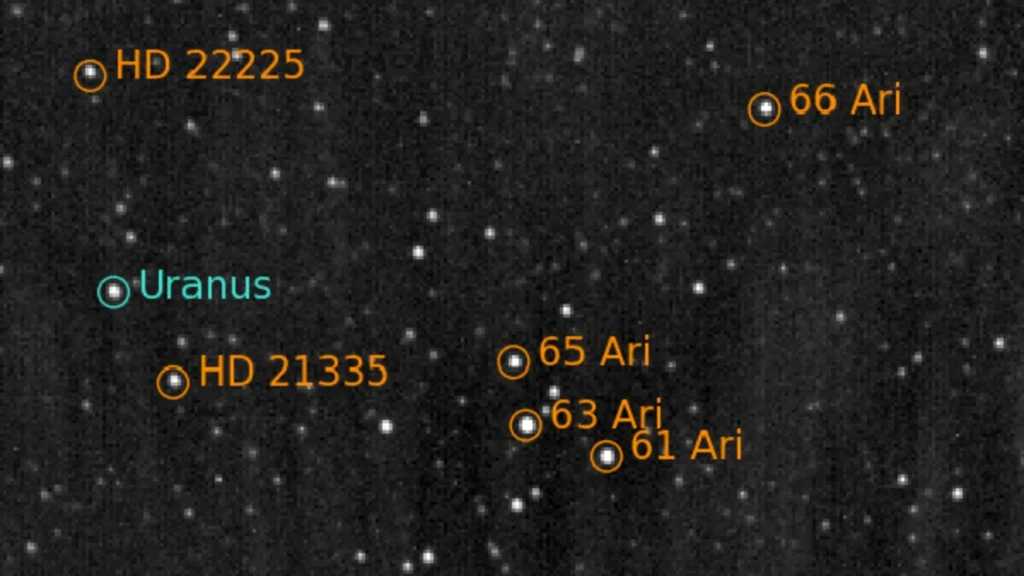
NASA Europa Clipper
Uranus and background stars captured by Europa Clipper. Image: NASA

NASA says Clipper was 3.2 billion km from Uranus when it took the picture.

The spacecraft is scheduled to reach Europa in 2030. It will conduct about 50 flybys of the icy Moon and use its suite of advanced instruments to determine the thickness of Europa’s icy shell and its surface interactions with the ocean below, to investigate its composition, and to characterise its geology. The objective of this mission is to find potentially habitable regions in locations other than the Earth.

ALSO READ: NASA’s ESCAPADE Mars Spacecraft Receives ‘First Light’ In Space; Images Released

ALSO READ: Saturn’s Rings Have Disappeared Again Due To This Cosmic Illusion

TAGGED:EuropaEuropa ClipperNASAOSIRIS-APEX
Share This Article
Facebook Pinterest Whatsapp Whatsapp LinkedIn Copy Link Print

Latest News

NASA's SLS rocket.
NASA’s Artemis II Rocket Plagued By Leaks Again; Administrator Jared Isaacman Reacts
Artemis
SpaceX Dragon spacecraft for NASA's Crew-12 mission.
SpaceX Rolls Out Dragon Spacecraft For NASA’s Crew-12 Mission While Falcon 9 Remains Grounded
Spaceflight
NASA's Artemis II SLS Rocket
NASA Delays Artemis II Moon Mission Launch To March – Here’s Why
Artemis
NASA's SLS rocket.
Astronauts In Quarantine, Rocket Powered On – How NASA Is Preparing For Artemis II
Artemis

You Might Also Like

NASA ESCAPADE
Spaceflight

NASA’s ESCAPADE Mars Spacecraft Receives ‘First Light’ In Space; Images Released

November 27, 2025
Comet 3I/ATLAS NASA Avi Loeb
Astronomy

Comet 3I/ATLAS Entered The Oort Cloud 8000 Years Ago. What Was Earth Like Then?

December 15, 2025
Comet 3I/ATLAS by Gemini observatory. Image: GeminiObs/NOIRLab/NSF/AURA
Astronomy

Is 3I/ATLAS Really A Comet? Its Strange Anti-Tail May Hold The Answer

January 6, 2026
Blue Origin's New Glenn rocket.
Spaceflight

Blue Origin Postpones NASA’s ESCAPADE Mission Launch Due To Solar Storm

November 13, 2025
© 2026, Blue Terra Journal
  • About
  • Privacy Policy
  • Terms
  • Contact
Welcome Back!

Sign in to your account

Username or Email Address
Password

Lost your password?