Blue Terra Journal

  • Home
  • Spaceflight
    SpaceflightShow More
    SpaceX Dragon spacecraft for NASA's Crew-12 mission.
    SpaceX Rolls Out Dragon Spacecraft For NASA’s Crew-12 Mission While Falcon 9 Remains Grounded
    February 4, 2026
    NASA partners with Axiom Space
    NASA And Axiom Space Announce 5th Private Crew Mission To International Space Station In 2027
    February 1, 2026
    Blue Origin Mark 1 lander.
    Blue Origin Halts New Shepard Missions For At Least 2 Years To Land Humans On The Moon
    February 1, 2026
    SpaceX Starship on flight 11.
    SpaceX CEO Elon Musk Reveals When Starship Will Launch On Next Test Flight
    January 29, 2026
    NOAA's SOLAR-1 observatory.
    NOAA’s Sun Spying SOLAR-1 Observatory Reaches Its Destination 1.5 Million Km From Earth
    January 31, 2026
  • Astronomy
    AstronomyShow More
    Voyager 1 illustration
    NASA’s Voyager 1 Will Be One Light-Day Away From Earth In 2026 – What This Means
    January 26, 2026
    Auroras triggered by CMEs.
    Auroras Flood The Night Skies After Largest Solar Radiation Storm In Over 20 Years | Photos
    January 20, 2026
    Hubble discovers Cloud-9.
    Hubble Telescope Uncovers New Object ‘Cloud-9’ – A ‘Failed Galaxy’ With No Stars
    January 13, 2026
    SpaceX launches NASA telescope.
    SpaceX Launches NASA’s Exoplanet Exploring Telescope Pandora On Twilight Mission
    January 19, 2026
    Comet 3I/ATLAS by Hubble telescope
    Comet 3I/ATLAS Is Not An Alien Spacecraft – This Research Likely Confirms It
    January 10, 2026
  • India
    IndiaShow More
    Shubhanshu Shukla aboard the ISS.
    ISRO Astronaut Shubhanshu Shukla Awarded Ashoka Chakra For Heroic Ax-4 Mission
    January 25, 2026
    ISRO's PSLV lifts off to space.
    ISRO’s PSLV Rocket Suffers Third Stage Failure After Successful Liftoff; Payloads Lost
    January 23, 2026
    Dhruva Space team at ISRO facility.
    India’s Dhruva Space To Launch 10 Missions, Including 1st Northeastern Satellite, On ISRO’s PSLV
    January 12, 2026
    ISRO's PSLV rocket
    ISRO To Seek Redemption With PSLV-C62 Mission Launch On January 12
    January 12, 2026
    ISRO SSLV
    ISRO’s SSLV Rocket Just Got Better After Latest Third Stage Test Fire
    December 31, 2025
  • Artemis
    ArtemisShow More
    NASA's SLS rocket.
    NASA’s Artemis II Rocket Plagued By Leaks Again; Administrator Jared Isaacman Reacts
    February 5, 2026
    NASA's Artemis II SLS Rocket
    NASA Delays Artemis II Moon Mission Launch To March – Here’s Why
    February 3, 2026
    NASA's SLS rocket.
    Astronauts In Quarantine, Rocket Powered On – How NASA Is Preparing For Artemis II
    February 3, 2026
    NASA's Artemis II crew
    Inside Artemis II: How NASA Will Study Astronaut Health And Deep Space Radiation
    January 30, 2026
    NASA's SLS rocket at launch pad.
    NASA’s Artemis II To Carry Relic Of Humanity’s First Flight And More To The Moon
    January 27, 2026
  • More
    • About
    • Privacy Policy
    • Terms
    • Contact

Blue Terra Journal

  • Home
  • Spaceflight
  • Astronomy
  • India
  • Artemis
Search
  • Pages
    • About
    • Contact
    • Privacy Policy
    • Terms

Home - India - ISRO Releases Image Of Godavari Delta Captured By $1.5 Billion NISAR Satellite

India

ISRO Releases Image Of Godavari Delta Captured By $1.5 Billion NISAR Satellite

NISAR enters science phase.

Harsh Vardhan
Last updated: December 2, 2025 11:33 PM
Harsh Vardhan
Share
4 Min Read
ISRO NISAR satellite
NISAR satellite's view of the Godavari delta. Image: ISRO
SHARE

The NASA-ISRO Synthetic Aperture Radar or NISAR satellite has officially entered the science phase. In a statement released Friday, ISRO shared a picture of a key Indian ecosystem captured by the satellite’s S-Band antenna, after the successful deployment of its massive 12-metre radar antenna reflector.

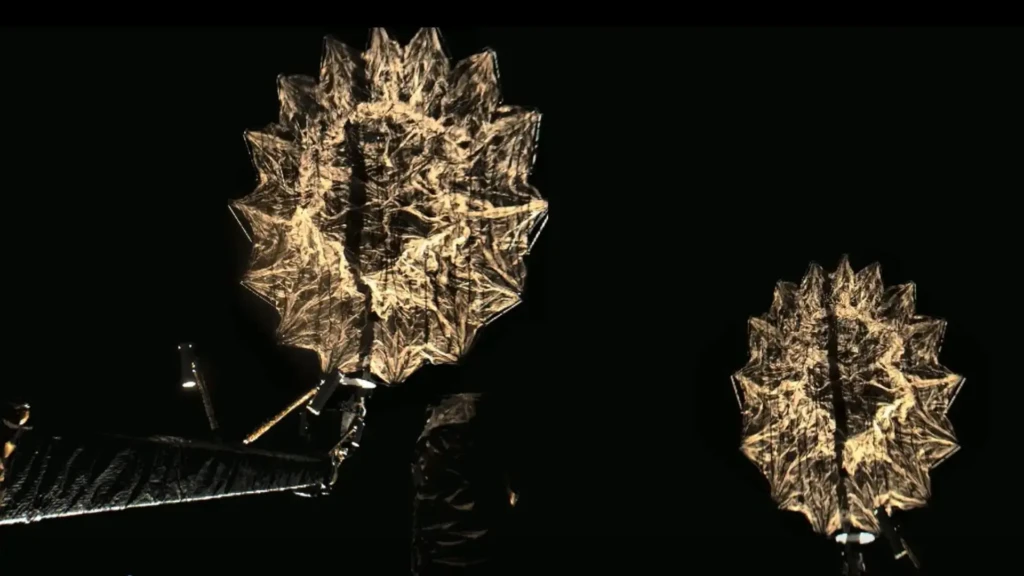
The antenna, which is attached to a 9-metre boom, was launched in a stowed condition because such a large structure can’t fit inside a rocket fairing. Over five days, engineers slowly unfolded the boom in stages like extending the joints of a robotic arm, and on August 15, the boom was fully opened and tests showed it is working properly.
ISRO NISAR satellite
NISAR satellite’s antenna reflector being deployed. Image: ISRO

Since August 19, NISAR’s S-band radar built by ISRO has been imaging the Indian landmass. ISRO had deployed reference targets such as corner reflectors around Ahmedabad, Gujarat to fine-tune the instrument. The Amazon rainforests were also used for calibration purpose. Announcing the commencement of NISAR’s science phase, the agency also released a picture of the Godavari delta in Andhra Pradesh rich with various vegetation classes like mangroves, agriculture, arecanut plantations and acquaculture fields. 

ISRO NISAR satellite
NISAR satellite’s view of the Godavari delta. Image: ISRO

“Initial analysis by scientists and engineers revealed the potential of S-Band SAR data for various targeted science and application areas like agriculture, forestry, geo-sciences, hydrology, Polar/Himalayan ice/snow and oceanic studies,” ISRO said adding that that delta image, “highlights NISAR’s S-Band SAR ability to map river deltas and agricultural landscapes with precision.”

All about NISAR

The $1.5 billion NISAR is the world’s most expensive Earth observation satellite jointly built by NASA and ISRO. It launched on July 30 atop ISRO’s GSLV F16 rocket, and it’s currently orbiting Earth in a Sun-synchronous polar orbit at an altitude of approximately 750 kilometers (466 miles).

The satellite is tasked with tracking motion of ice sheets and glaciers, the deformation of land due to floods, earthquakes, volcanoes, wildfires, oil spills and landslides, along with changes in forest and wetland ecosystems down to a centimeter. Besides, it will also provide invaluable information for disaster response, infrastructure monitoring and food security.

While the L-Band system by NASA will see through clouds and forest canopy, the S-Band system by ISRO will penetrate cloud covers. The S-band is also highly sensitive to light vegetation and moisture in snow and both radars will be utilised during the day as well as night. NASA says that NISAR will make detailed measurements of our planet every 12 days, documenting the slightest of planetary changes over five years.

ALSO READ: ISRO Gears Up To Launch SpaceX Rival’s Broadband Satellite On Dec 15

ALSO READ: ISRO Completes Parachute Air Drop Test Of Gaganyaan Crew Module | Video

TAGGED:ISROISRO NISAR satelliteNASANISAR
Share This Article
Facebook Pinterest Whatsapp Whatsapp LinkedIn Copy Link Print

Latest News

NASA's SLS rocket.
NASA’s Artemis II Rocket Plagued By Leaks Again; Administrator Jared Isaacman Reacts
Artemis
SpaceX Dragon spacecraft for NASA's Crew-12 mission.
SpaceX Rolls Out Dragon Spacecraft For NASA’s Crew-12 Mission While Falcon 9 Remains Grounded
Spaceflight
NASA's Artemis II SLS Rocket
NASA Delays Artemis II Moon Mission Launch To March – Here’s Why
Artemis
NASA's SLS rocket.
Astronauts In Quarantine, Rocket Powered On – How NASA Is Preparing For Artemis II
Artemis

You Might Also Like

NASA Crew-12
Spaceflight

NASA Introduces Astronauts For Crew-12 Mission After Russian Cosmonaut’s Removal

December 22, 2025
Quadrantids meteor shower NASA
Astronomy

Quadrantids Meteor Shower: What To Know About 2026’s First Cosmic Event Peaking Jan 3-4

January 5, 2026
Blue Origin SpaceX
Spaceflight

How Does Blue Origin’s Monstrous New Glenn Rocket Compare To Starship?

November 23, 2025
image 4 1
India

How Gaganyaan Delays Are Setting India Back In Modern Space Race

November 19, 2025
© 2026, Blue Terra Journal
  • About
  • Privacy Policy
  • Terms
  • Contact
Welcome Back!

Sign in to your account

Username or Email Address
Password

Lost your password?