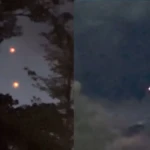
A tiny meteor streaked over the sky in Portugal, resulting in a stunning fireball last week. The European Space Agency (ESA) said Tuesday that the blazing object was spotted about 97 km above Castelo Branco, before disintegrating at an altitude of 43 km above Coimbra in Portugal on November 2. A video of the object was captured by ESA’s AMS82, a meteor detection station in Cáceres, Spain. It has been classified as a bolide, extremely bright meteors that are big enough to carve a crater.
☄️ Fireball observed over Spain and Portugal!
On 2 November 2025 at 20:41 CET, ESA’s fireball camera in Cáceres, Spain, recorded a bright bolide streaking northwest over Portugal. It was travelling at approximately 81 000 km/h.
Credit: ESA/PDO/AMS82 – AllSky7… pic.twitter.com/vc82Z25hHS
— ESA Operations (@esaoperations) November 4, 2025
Fireball makes surprise entry
In a statement, ESA said that the bolide was travelling at a speed of 81,000 km per hour and was not detected prior to its atmospheric entry. It is said to have originated from a comet and its surface heated to several thousand degrees Celsius during entry. “The event was marked by a striking explosion, caused by the sudden rupture of the rock, which produced a sharp increase in brightness. Before extinguishing, the fireball travelled roughly 80 km through the atmosphere,” the agency revealed.
ALSO READ: Japan’s Akatsuki Orbiter Goes Silent Forever Ending Our Venus Presence
Interestingly, another meteor preceded this incident about an hour earlier the same day and lit up the skies for around 8 to 10 seconds. “Despite the close timing, the two events followed distinct trajectories, indicating they were likely unrelated,” ESA said.
The bolide was preceded almost an hour before, at 19:42 CET, by a meteor that lit up the skies for around 8 to 10 seconds. Despite the close timing, the two events followed distinct trajectories, indicating they were likely unrelated.
Credit: ESA/PDO/AMS82 – AllSky7 pic.twitter.com/6r7YIczxmz
— ESA Operations (@esaoperations) November 4, 2025
This cosmic visit by the meteor comes just days after another possible impact event in late October. Reports say that the mystery object which struck a moving Tesla car in Whyalla, South Australia may have been a meteorite. Meteorites are fragments of meteors that survive atmospheric entry and land on Earth. The car’s owner Andrew Melville-Smith told ABC News that the object shattered his windscreen, causing the glass to soften and partially melt, Science Alert reported.
According to Smithsonian Magazine, around 500 meteorites hit the Earth’s surface every year but less than 10 percent are recovered. Besides, estimates suggest that about 5,200 tonnes of material from space rains down on Earth annually.
Experts are investigating whether the impacting object was space debris or a similar object. Notably, mineralogist Kieran Meaney of the South Australian Museum reportedly told the ABC that a meteorite is the most plausible explanation for now.
ALSO READ: Comet 3I/ATLAS: Should We Take Avi Loeb’s Alien Theory Seriously?