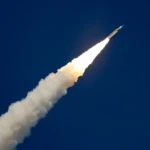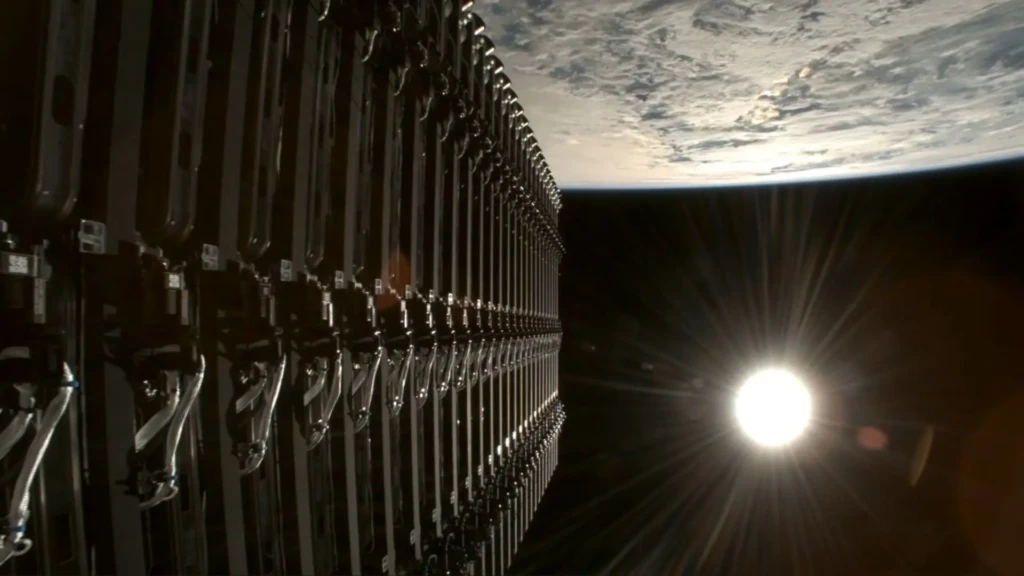
SpaceX’s Starlink satellite recently had a close brush with danger. According to Michael Nicolls, vice president of Starlink engineering at SpaceX, the danger was posed by one of the nine satellites launched by the Kinetica 1 rocket on December 9. It lifted off from China‘s Jiuquan Satellite Launch Center in the Gobi desert and the lack of data about their position resulted in a “dangerously” close approach. Nicolls revealed that the satellite came as close as 200 metres at 560 km altitude.
When satellite operators do not share ephemeris for their satellites, dangerously close approaches can occur in space. A few days ago, 9 satellites were deployed from a launch from the Jiuquan Satellite Launch Center in Northwestern China. As far as we know, no coordination or…
— Michael Nicolls (@michaelnicollsx) December 13, 2025
“When satellite operators do not share ephemeris for their satellites, dangerously close approaches can occur in space. A few days ago, 9 satellites were deployed from a launch from the Jiuquan Satellite Launch Center in Northwestern China,” he posted on X Saturday.
“As far as we know, no coordination or deconfliction with existing satellites operating in space was performed, resulting in a 200 meter close approach between one of the deployed satellites and STARLINK-6079 (56120) at 560 km altitude. Most of the risk of operating in space comes from the lack of coordination between satellite operators – this needs to change,” Nicolls added.
CAS Space, which operates the Kinetica rocket, responded to the SpaceX official’s post saying it launches all rockets within suitable windows to avoid collisions with satellites and debris.
If confirmed, this incident occurred nearly 48 hours after payload separation, by which time the launch mission had long concluded. CAS Space will coordinate with satellite operators to proceed. This calls for re-establishing collaborations between the two New Space ecosystems. https://t.co/bsuFLeguxo
— CAS Space (@cas_space) December 13, 2025
“If confirmed, this incident occurred nearly 48 hours after payload separation, by which time the launch mission had long concluded. CAS Space will coordinate with satellite operators to proceed. This calls for re-establishing collaborations between the two New Space ecosystems,” CAS posted on X.
ALSO READ: NASA Chief Nominee Jared Isaacman Reiterates Pledge To Beat China In Moon Race
According to China Daily, the rocket carried three foreign satellites from the UAE, Egypt and Nepal. Although, Nicolls did not reveal which satellite posed a threat to Starlink.
Starlink currently has the largest internet-providing network with nearly 9,300 satellites, per Space.com. SpaceX reportedly wants to expand this constellation with 42,000 satellites. Each Starlink satellite has a lifespan of five years but it’s unclear how many of them safely re-enter Earth and free up the low-Earth orbit.
In a report released earlier this year, European Space Agency (ESA) revealed that most satellites are not leaving congested orbits at the end of lives and this is adding to the growing problem of space debris. The report said that there are 1.2 million objects larger than 1 cm in size and more than 50,000 objects larger than 10 cm in the low-Earth orbit. Last year, space surveillance networks tracked over 3,000 new objects as a result of fragmentation events.
ALSO READ: China’s Tiangong Space Station Will Host Pakistani Astronaut In 2026