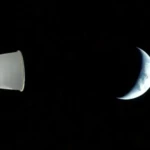
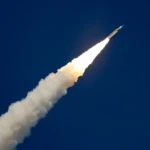
The Space Weather Follow On – Lagrange 1 or SWFO-L1, built by the US National Oceanic and Atmospheric Administration (NOAA), has arrived at Lagrange Point 1 to keep a watchful eye on the Sun. Launched on September 24, 2025 aboard a SpaceX Falcon 9 rocket, the observatory executed its final engine burn to enter its orbital position at L1 on January 23. Now that it’s at its desired location, SWFO-L1 has been renamed to Space weather Observations at L1 to Advance Readiness-1 (SOLAR-1), the NOAA said in an update.
NOAA’s SWFO-L1 observatory executed its final engine burn, successfully entering its final orbital position at Lagrange point 1 and is now renamed SOLAR-1. Full story at https://t.co/5iSlVTpntd pic.twitter.com/TYB7T9ZOyX
— NOAA Space Weather Prediction Center (@NWSSWPC) January 27, 2026
The Lagrange Point is located 1.5 million kilometres (one million miles) from Earth and it provides a unique vantage point for an uninterrupted view of the Sun. ISRO’s Aditya-L1 solar observatory is also parked at the same spot.
“SOLAR-1, America’s first satellite designed exclusively for continuous, operational space weather observations, represents a major advancement in our defense against solar storms,” stated Greg Marlow, NOAA’s director.
The purpose of NOAA’s SOLAR-1 observatory
SOLAR-1 is designed to serve as an early warning system by continuously monitoring the sun and space weather before it impacts our planet. Using a suite of four instruments, the observatory will make real-time measurements of the solar activity, allowing scientists to take precautionary measures in order to protect critical infrastructure on Earth and in space.
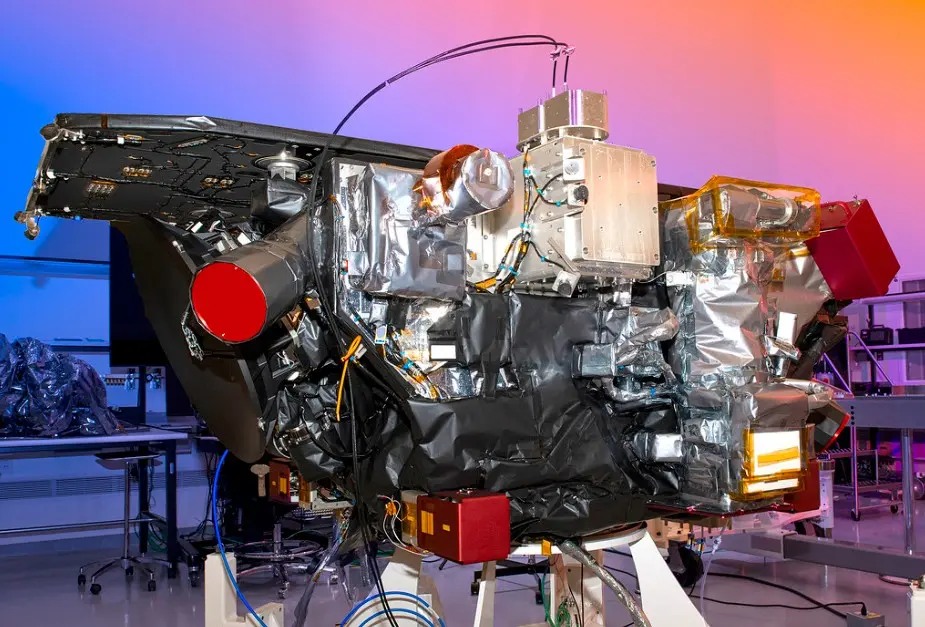
The observatory is equipped with a coronagraph to image coronal mass ejection (CME) – expulsion of charged particles from the Sun – along with a Solar Wind Plasma Sensor (SWiPS), SupraThermal Ion Sensor (STIS), and a magnetometer (MAG). According to NOAA, SOLAR-1 will send data to Earth without interruption allowing infrastructure operators adequate time to act. The coronagraph will be able to send CME imagery within 30 minutes of acquisition as opposed to the NASA Solar and Heliospheric Observatory (SOHO) which takes up to eight hours.
SOLAR-1 is the first of a series of advanced observatories that are being built for space weathering monitoring. It has a designed mission life of five years but the fuel efficient operation at L1, which is also gravitationally stable, might extend its lifespan by several more years.
“The SOLAR-1 spacecraft is going to be an impressive new tool in our arsenal for space weather monitoring and prediction — not only for our nation, but the entire world — because space weather is a global concern,” said Shawn Dahl, Service Coordinator at NOAA’s Space Weather Prediction Center (SWPC).
ALSO READ: How Do Auroras Form? Science Behind This Colourful Cosmic Phenomenon
ALSO READ: Auroras Flood The Night Skies After Largest Solar Radiation Storm In Over 20 Years | Photos