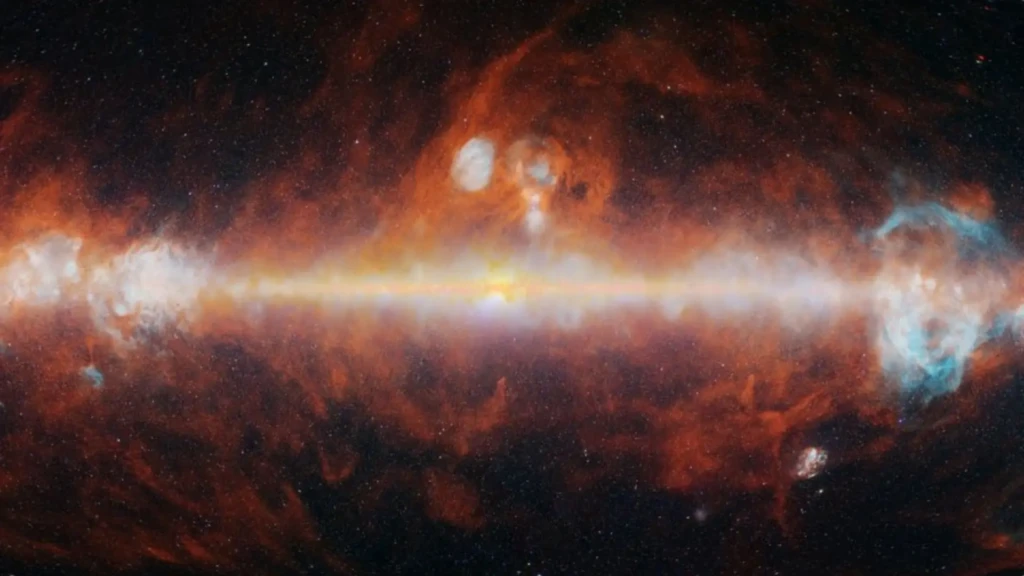
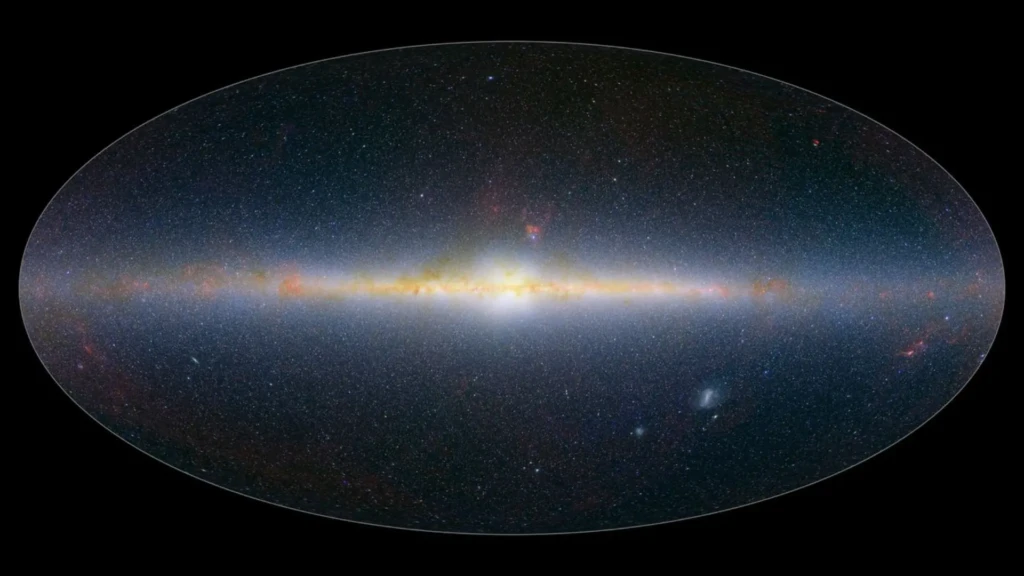
The SPHEREx telescope built by NASA has completed its first all-sky map of the universe. Made over the last eight months, the map was composed in 102 different colours of infrared light which is invisible to the human eye.
“We essentially have 102 new maps of the entire sky, each one in a different wavelength and containing unique information about the objects it sees,” Shawn Domagal-Goldman, director of NASA’s Astrophysics Division, said in a statement.
NASA has released a video produced using the map which features different colours emitted by stars (blue, green and white) and hot hydrogen gas (blue) and cosmic dust (red).
What’s the use of NASA SPHEREx’s cosmic map?
The SPHEREx telescope orbits Earth over the poles 14.5 times every day and collects 3600 images along one strip of the sky. As Earth moves around the Sun, the telescope’s field of view shifts and allows its to create a 360-degree mosaic covering the entire sky. And since this map is 3D, it will enable scientists to measure subtle variations in the way galaxies are clustered and distributed.
The infrared observatory circles the Earth, taking 3600 images per day along one strip of the sky. As the planet moves around the Sun, SPHEREx’s field of view shifts so that, in six months, the observatory creates a 360-degree mosaic that covers the entire sky, like this! pic.twitter.com/yzdnW3UEOF
— NASA JPL (@NASAJPL) December 18, 2025
Spectroscopy is a key aspect of SPHEREx’s observation. This process involves studying light by splitting it into different colours. Each of the 102 colours represent a particular wavelength of infrared light and they provide unique information about the galaxies, stars, planet-forming regions, and other cosmic features.
These colours could also help measure the distance to hundreds of millions of galaxies and ultimately offer insights into an event called ‘inflation’ – wherein the universe expanded by a trillion-trillionfold in fraction of a second after the big bang.
In a way, SPHEREx or Spectro-Photometer for the History of the Universe, Epoch of Reionization, and Ices Explorer is better than the James Webb Space Telescope (JWST). While the Webb telescope can do spectroscopy in more wavelengths of light, its field of view is thousands of times smaller than SPHEREx. Its combination of colours with a wide field of view puts SPHEREx among one of the most powerful telescopes ever.
Launched in May, SPHEREx has an objective of studying the change in galaxies since the big bang and the distribution of key ingredients for life in the Milky Way.
ALSO READ: NASA Unveils 100000th Image Captured By Its Mars Reconnaissance Orbiter
ALSO READ: Comet 3I/ATLAS Entered The Oort Cloud 8000 Years Ago. What Was Earth Like Then?